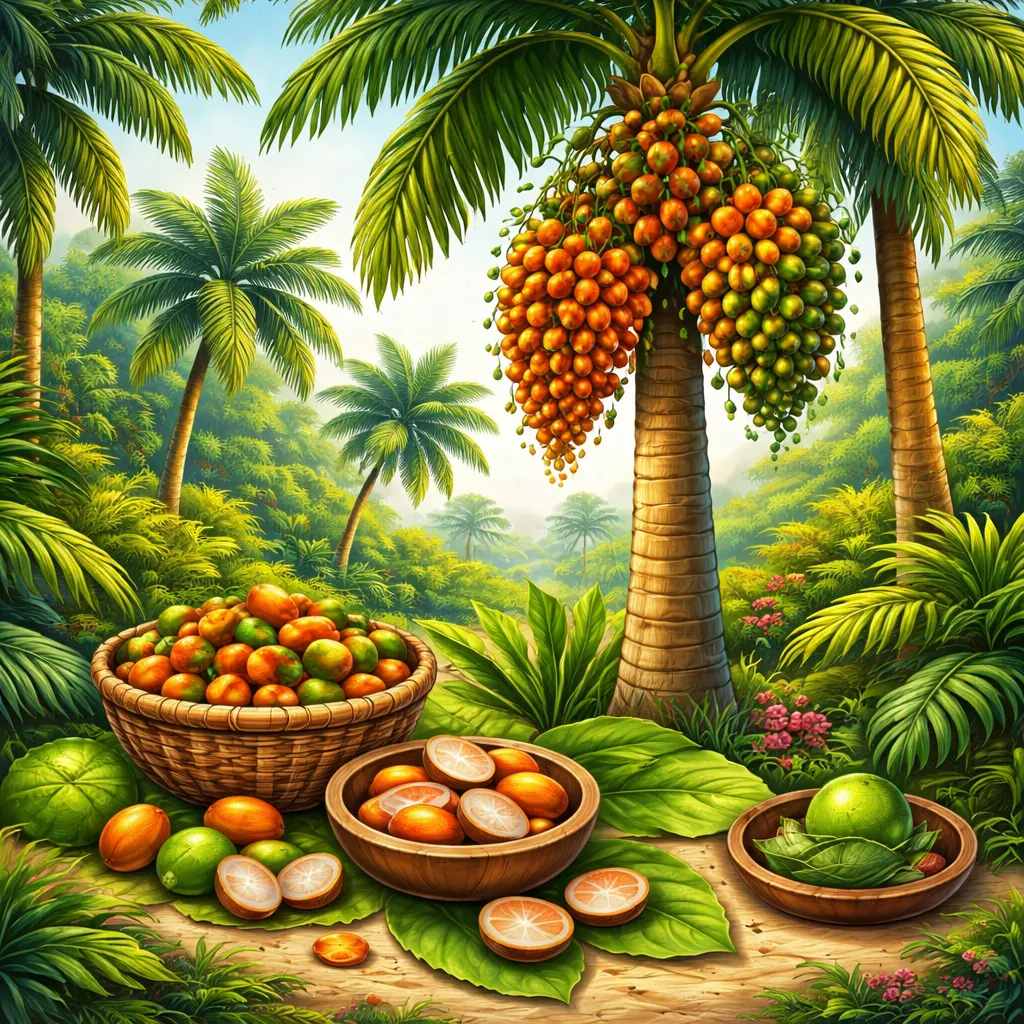

In the warm, humid villages of Southeast Asia and the Pacific islands, there is a tall, slender palm tree that is more than just a plant. It is at the heart of a very old social tradition. You might see people, especially elders, chewing a small packet made from a leaf. Their mouths and lips are stained a reddish-orange color. Inside that leaf packet is a seed from a special palm tree. This seed is not for eating like a normal nut; it is known for its strong, stimulating effect. This plant has a complicated story of culture and health. Let’s begin a careful and curious journey to learn about the Betel Nut Palm plant.
Let’s Learn the Word! – Open the Treasure Box of Language
Formal Name and Pronunciation This culturally important palm is called the Betel Nut Palm. Its scientific name is Areca catechu. You can say it like this: /ˈbiː.təl nʌt pɑːm/ (BEE-tul nut pahm). The “Betel” part sounds like “beetle” the insect. The “Areca” part is pronounced /əˈriː.kə/ (uh-REE-kuh). Say it: Betel Nut Palm. Its name is a mix of two different plants, which is part of its story.
The Etymology Tale The name is a bit mixed up! The “Betel” part comes from the Malayalam word “vettila,” which is actually the name of the leaf (the Betel leaf, Piper betle) that is wrapped around the areca nut. The “nut” is the seed of the Areca palm. So, “Betel nut” is a bit of a misnomer—it’s the areca seed wrapped in the betel leaf! The scientific name Areca comes from a South Asian word for the palm, and catechu is from another Malay word.
Nicknames and Friendly Aliases This palm is known by many names that tell of its use and home. It is most correctly called the Areca Palm or Areca Nut Palm. In many places, the seed is called Supari. Because it is chewed, it is often called the Chewing Nut Palm. In some cultures, it is simply called the Betel Palm, even though that name more accurately belongs to the leaf vine.
Building Your Word Web: Core Parts Let’s learn the words for this palm’s body. The Trunk is tall, slender, and ringed, like a thin green column. The Frond is a large, arching, feather-like leaf. The Crownshaft is the smooth, green, swollen base just below the fronds. The Nut is the seed, which is actually a drupe. It is about the size of a small egg, with a fibrous husk. The Seed inside the husk is the hard, brown areca nut. The Inflorescence is the flower branch, which hangs below the crownshaft. The Husk is the fibrous, orange-yellow outer covering of the fruit.
Action and State Words The Betel Nut Palm is a stately grower. It towers gracefully in tropical gardens. Farmers harvest the clusters of nuts. People chew the prepared nut with betel leaf and lime. The nut contains a stimulant called arecoline. The tree produces fruit for many decades. It is tall, slender, fruit-bearing, and cultivated.
Ecosystem Friends Vocabulary In its native and cultivated settings, the palm is part of a garden ecosystem. Bats and insects may help pollinate its flowers. The fallen fronds and old husks provide shelter for small insects and fungi. It is not a major food source for wild animals, as the nut is intended for human use. It is primarily a plant of human gardens and plantations.
Cultural Imprint in Language The betel nut is deeply woven into the social fabric of many Asian and Pacific cultures. An old saying in India is, “Tamul-pan (betel nut and leaf) is the root of friendship,” meaning sharing it is a sign of hospitality and the start of a conversation. In many traditional stories and poems, offering betel nut is a sign of respect, welcome, or the beginning of an important discussion. It is a symbol of ceremony, but also a subject of health warnings today.
Ready for Discovery We know its name and its complex cultural role. Are you ready to be a thoughtful detective and uncover the botanical facts and the serious human story of this plant? Let’s explore the world of the Betel Nut Palm plant.
Discover the Plant’s Secrets! – A Nature Detective’s Notebook
The Plant Passport The Betel Nut Palm belongs to the Palm family, Arecaceae. Its genus is Areca. It is a beautiful, medium-sized palm with a very straight, slender, green trunk marked by rings. Its crown is a graceful cluster of long, arching, dark green fronds. The flowers grow on a branched inflorescence that hangs below the leaves. The fruit is an orange or red drupe, about the size of a chicken egg, containing a single seed—the areca nut. It is a tropical plant, needing constant warmth and humidity, and it can fruit for 60 years or more.
Survival Smarts This palm is a sun-loving tropical specialist. It thrives in hot, humid climates with lots of rainfall. Its tall, slender form lets it grow in crowded plantations, reaching for the sun. The hard seed inside the fibrous husk is protected during its development. Unlike the coconut, its seed is not designed for ocean travel but is spread mostly by humans who cultivate it. It is a plant that has become completely dependent on people for its spread and survival.
Its Role and Gifts In its ecosystem, as a cultivated tree, it provides structure and some habitat. Its main role, for thousands of years, has been cultural and economic for people. The nut, when chewed, acts as a mild stimulant, increasing alertness. In traditional medicine systems, it was used in very small amounts for certain ailments. However, modern science shows that chewing betel nut is very harmful and can cause serious mouth diseases and cancer. This is a crucial lesson about plants: some can be both traditionally important and very dangerous to our health.
Human History and Cultural Symbol The areca nut has been chewed for at least 5,000 years across a vast area from India and Southeast Asia to the Pacific. It was a valuable trade item. It plays a role in social rituals, weddings, and religious ceremonies as a sacred offering. In some cultures, the way the nut is cut or presented carries specific meanings. Today, while the tradition continues, there are major global health campaigns to reduce its use because of the severe health risks. Its story is one of deep tradition clashing with modern health knowledge.
Fun “Wow!” Facts Get ready for a colorful fact! When you chew betel nut with slaked lime (a white powder), the mixture turns your saliva a bright red or orange color. This is why sidewalks in some cities where it is chewed are stained with red splotches! And here’s a growing fact: a single Betel Nut Palm tree can produce hundreds of nuts every year, and it keeps producing for most of its long life.
From Ancient Ritual to Responsible Learning The story of the Betel Nut Palm plant teaches us about the powerful relationship between plants and people. While we do not grow it to use its nut, we can learn about it responsibly. Would you like to grow an Areca palm as a beautiful ornamental plant, appreciating its form but not its stimulant seed? Let’s see how.
Let’s Grow It Together! – A Little Guardian’s Action Guide
Good for Home Growing? You can grow the Betel Nut Palm (Areca catechu) as a beautiful ornamental tree if you live in a very warm, frost-free tropical climate. It will become a tall tree and needs space. It is not for a small pot forever. Many people grow the smaller and safer Dypsis lutescens, often called the “Areca Palm” or “Butterfly Palm,” indoors. This is a different, non-nut-producing palm that is safe and popular as a houseplant. We will focus on learning about the plant, not cultivating it for its nut.
Little Gardener’s Toolkit If you are in a tropical climate and want to grow the true Betel Nut Palm for study, you would need a fresh seed (nut) with its husk. Get a very deep pot. Use a rich, well-draining potting mix. Have a watering can and a warm, humid greenhouse or outdoor spot ready. Remember, we are growing it for botanical interest, not for consumption.
Step-by-Step Growing Guide
Planting for Knowledge Soak the fresh nut (with its husk) in water for a few days. Plant it on its side, about an inch deep, in a deep pot of moist soil. Keep the pot in a very warm (80-90°F), humid place. It can take several months to sprout. Be patient. This is a project about observing growth, not about the fruit.
Care Calendar Keep the soil consistently moist but not waterlogged. It needs high humidity and bright, indirect light when young. As a seedling, it grows slowly. You can feed it with a weak, balanced liquid fertilizer every month during warm weather. The most important thing is warmth—it cannot stand cold.
Watch and Be Friends Watch for the first spear-like shoot. Notice how the first leaves are simple, not divided like the mature fronds. Document its slow growth. Learn to identify its graceful form. The goal is to appreciate it as a living piece of botany and culture, understanding its significance without engaging in the harmful practice of chewing its nut.
Problem Diagnosis If leaves turn brown at the tips, the air is too dry. Mist the plant. If leaves turn yellow, it might be overwatered or need more fertilizer. As a tropical plant, cold drafts are its biggest enemy. Keep it warm and humid.
Your Rewards and Gifts Your gift is knowledge and respect. You are learning to appreciate a plant’s biology and its powerful cultural story while making smart, healthy choices. Caring for a palm teaches patience and responsibility. Understanding the Betel Nut Palm’s story teaches you about the complex choices people make with plants and the importance of listening to science.
Creative Fun Start a Cultural Botanist’s Journal. Draw the palm and write about its history. On a world map, color the regions where this palm is traditionally used. Create a beautiful artwork of the palm’s form using colored pencils or paints. With an adult, research and write a short report on the difference between traditional use and modern health science. Design a “Healthy Choices” poster that celebrates plants in safe ways.
Growing Wisdom By learning about the Betel Nut Palm, you are not just growing a plant. You are growing cultural awareness, scientific understanding, and the wisdom to make healthy decisions. You are a thoughtful global citizen.
Conclusion and Forever Curiosity What a profound journey of botany and human culture! You started by learning the words “Betel Nut Palm,” you discovered its secrets as a plant of deep tradition and serious health concerns, and you learned how to approach it with respect and caution. You now know the Betel Nut Palm is not just a tropical tree; it is a lesson in history, a case study in botany and health, and a reminder that our relationship with plants must be informed and careful. Remember, curiosity includes asking not just “what” and “how,” but also “why” and “should we?”. Your adventure to learn about the Betel Nut Palm plant shows that true understanding means looking at all sides of a story—the leaves, the nuts, the history, and the science—to make wise choices for yourself and your community.