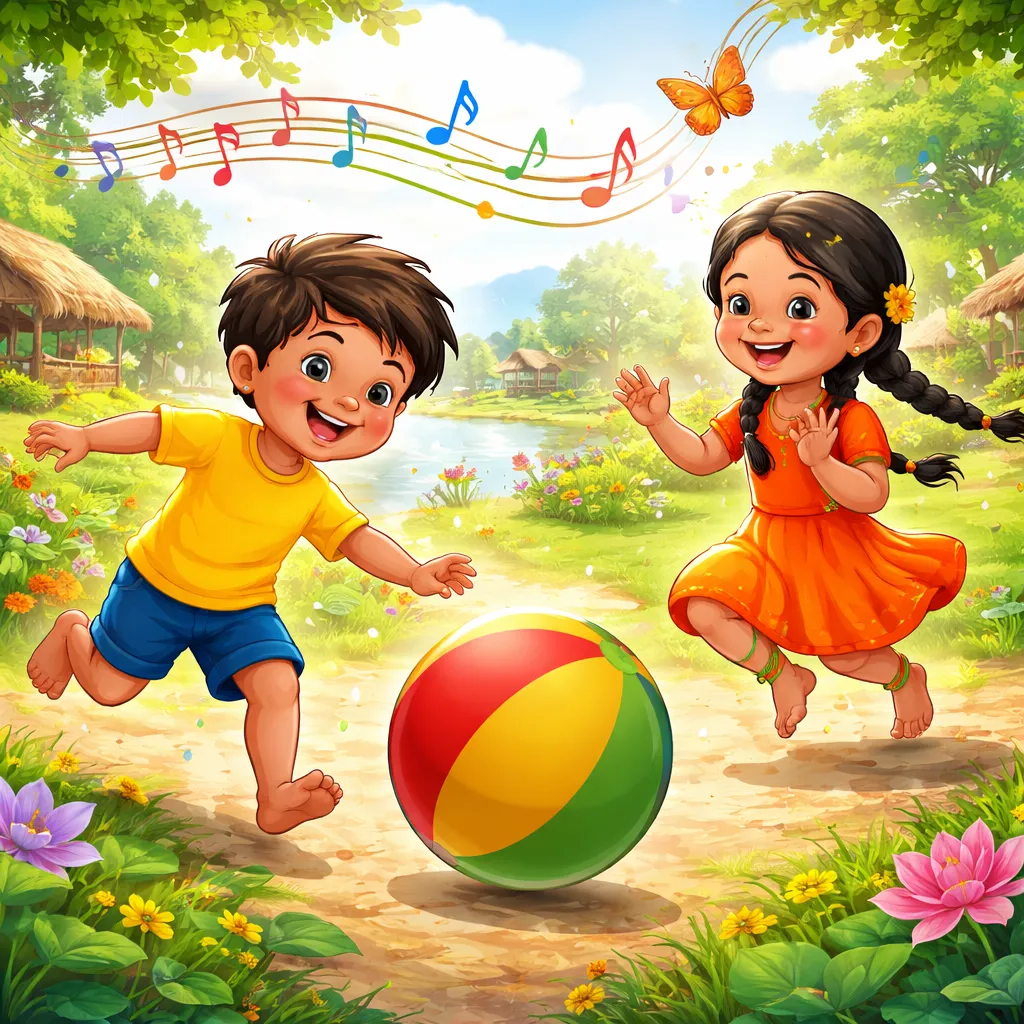

Have you ever dropped a ball and watched it bounce back up? Boing! Have you rolled a ball to a friend and watched them roll it back? A simple ball is one of the best toys in the world. It can bounce, roll, fly, and bring friends together. In Bangladesh and West Bengal, a land of green fields and lively streets, there is a happy song about this playful circle. Let’s play along with the Bengali Song: The Little Ball (বল).
About the Song
Here is a playful verse from this popular children’s song in Bengali and English:
বল, বল, ছোট্ট বল
(Bol, bol, chhoto bol)
Ball, ball, little ball
তুমি লাফাও কেন?
(Tumi laphao keno?)
Why do you bounce?
আমি তোমায় ফেলি, তুমি উঠে আস
(Ami tomay pheli, tumi uthhe aash)
I throw you down, you come up
খেলি সবাই মিলে
(Kheli sabai mile)
We all play together
This song’s original name is “বল” (Bol), which means “Ball” in Bengali. It is a beloved and simple Bengali children’s song. The song talks directly to a little ball, asking it a curious, funny question. The music is bouncy, light, and full of playful energy, with a rhythm that mimics the up-and-down motion of a bouncing ball. The Bengali Song: The Little Ball (বল) is a musical game, celebrating the simple physics of play and the joy of shared fun.
What the Song is About
The song is a cheerful observation of a ball’s magic. First, we call to it: “Ball, ball, little ball.” We notice its main action and ask, “Why do you bounce?” The song then shows the partnership between the player and the ball. The child does an action: “I throw you down.” The ball responds with its own action: “you come up.” This cause and effect is the magic of a ball! But the fun doesn’t stop with one person. The best part is the group: “We all play together.” The song pictures a circle of friends throwing, catching, and laughing, with the little ball bouncing happily from one pair of hands to another, connecting everyone in a game.
Who Made It & Its Story
This song is a traditional Bengali folk song for children, passed down through generations of play. The original creator is unknown, as it comes from the universal experience of children playing with one of the simplest toys. The song reflects a culture that values community and shared activities. The Bengali Song: The Little Ball (বল) is cherished for three bouncy reasons. First, it turns a simple action (bouncing) into a fun question, encouraging curiosity about how everyday things work. Second, it naturally teaches about taking turns and playing cooperatively with others. Third, its melody is incredibly simple, repetitive, and perfectly matched to the action of bouncing, making it easy to remember and act out, turning the song itself into a game.
When to Sing It
You can sing this song while actually bouncing or throwing a ball, saying the words in time with each bounce. It’s perfect to chant with friends while playing catch, taking turns saying a line. You could also sing it during a clapping game, bouncing an imaginary ball in your hands to the rhythm.
The Bengali Song: The Little Ball (বল) gets us playing and thinking. But play is also a powerful way to learn! This song is our playful teacher. It introduces us to action words, shows us how to ask “why” questions, and highlights the cultural value of group play. Let’s catch this ball of knowledge and see what we can learn.
What Children Can Learn
Vocabulary
This song helps us learn words for motion, play, and cooperation.
Bounce: To spring back after hitting a surface. A ball bounces on the ground.
Momentum: The force that keeps a moving object going. A rolling ball has momentum.
Sphere: A perfectly round 3D shape, like a ball. Many balls are spheres.
Elasticity: The ability of an object to return to its original shape after being stretched or squeezed. A ball’s elasticity makes it bounce.
Cooperative: Involving mutual assistance in working toward a common goal. A cooperative game is where everyone plays together.
Kinetic Energy: The energy an object has because of its motion. A moving ball has kinetic energy.
Language Skills
This song is a great example of asking “Why” Questions for Reason. We use “why” to ask for the reason or cause behind something.
What Is It?: Think of “why” as your “curiosity” word. It asks for the reason behind an action or situation. “Why do you bounce?”
Finding the Secret: Look for sentences that start with “Why” and have a question mark. They are asking for an explanation. Ask yourself: “Is this sentence looking for a reason?”
Using It:
◦   Formula: Why + [auxiliary verb] + [subject] + [main verb]?

◦   Examples: “Why are you happy?” “Why does the sun shine?” “Why do birds sing?”

◦   The song’s question is playful and curious: “Why do you bounce?” It invites us to think about cause and effect.
Sounds & Rhythm Fun
Listen to the bouncy rhythm! The Bengali Song: The Little Ball (বল) has a very clear, springy, and upbeat beat. It might sound like the tap-tap-tap of a ball hitting the ground. The repetition of words like “bol, bol” mimics the repetitive action of bouncing. This clear, bouncy rhythm makes it easy to clap or jump along and helps the simple, repetitive lyrics stick in your head instantly. You can use this same bouncy, repetitive rhythm to make up a song about any repetitive action, like jumping rope or hopping.
Culture & Big Ideas
This song connects to the universal and local love for games. In Bengal, a popular traditional game is ডাংগুলি (Danguli), which involves hitting a small stick with a larger one—a game of batting and fielding much like cricket or baseball, centered around a ball. The song reflects the social importance of play. The Bengali Song: The Little Ball (বল) teaches three important ideas. First, Curiosity in Action: Noticing what something does (bouncing) and asking “why” is the first step in scientific thinking. Second, Action and Reaction: For every action (a throw down), there is a reaction (the ball comes up). This is a basic law of physics made fun! Third, Play as Social Glue: Playing together with a simple object is a powerful way to make friends, learn to share, and build a happy community.
Values & Imagination
Imagine you are the little ball. What does it feel like to fly through the air? What does the ground feel like when you bounce? Do you like being caught by gentle hands? This song teaches you to be curious about how ordinary things work. It shows that sharing a toy and playing fairly makes the game more fun for everyone. A simple idea: The next time you play with a ball, try a little experiment. Bounce it on different surfaces—a rug, a tile floor, grass. Ask, “Why does it bounce higher or lower here?” You are being a little scientist at play.
Your Core Takeaways
The Bengali Song: The Little Ball (বল) is a bouncy, joyful lesson in curiosity, physics, and friendship. You learned play words like “bounce,” “momentum,” and “cooperative.” You discovered how to ask “why” questions to find out the reason for things. You moved to the song’s springy, bouncy rhythm. You also connected the ball to universal play and traditional Bengali games. Most importantly, the song teaches that asking “why” is a fun and important habit, that simple actions have reactions, and that the best games are the ones we play together with friends.
Your Practice Missions
- Be a “Why” Detective. With a grown-up, find one simple thing that happens (e.g., a light turns on, a door closes, a toy falls). Ask a “why” question about it. “Why did the toy fall?” (Because gravity pulled it!). Try to find the answer together. This practice turns everyday moments into curiosity adventures.
- Host a “Cooperative Ball” Game. With two or more people, stand in a circle. Use one soft ball. The rule is: you must say the person’s name before you gently roll or toss the ball to them. The goal is to keep the ball moving to everyone without dropping it. You are practicing the song’s last line: “We all play together.”