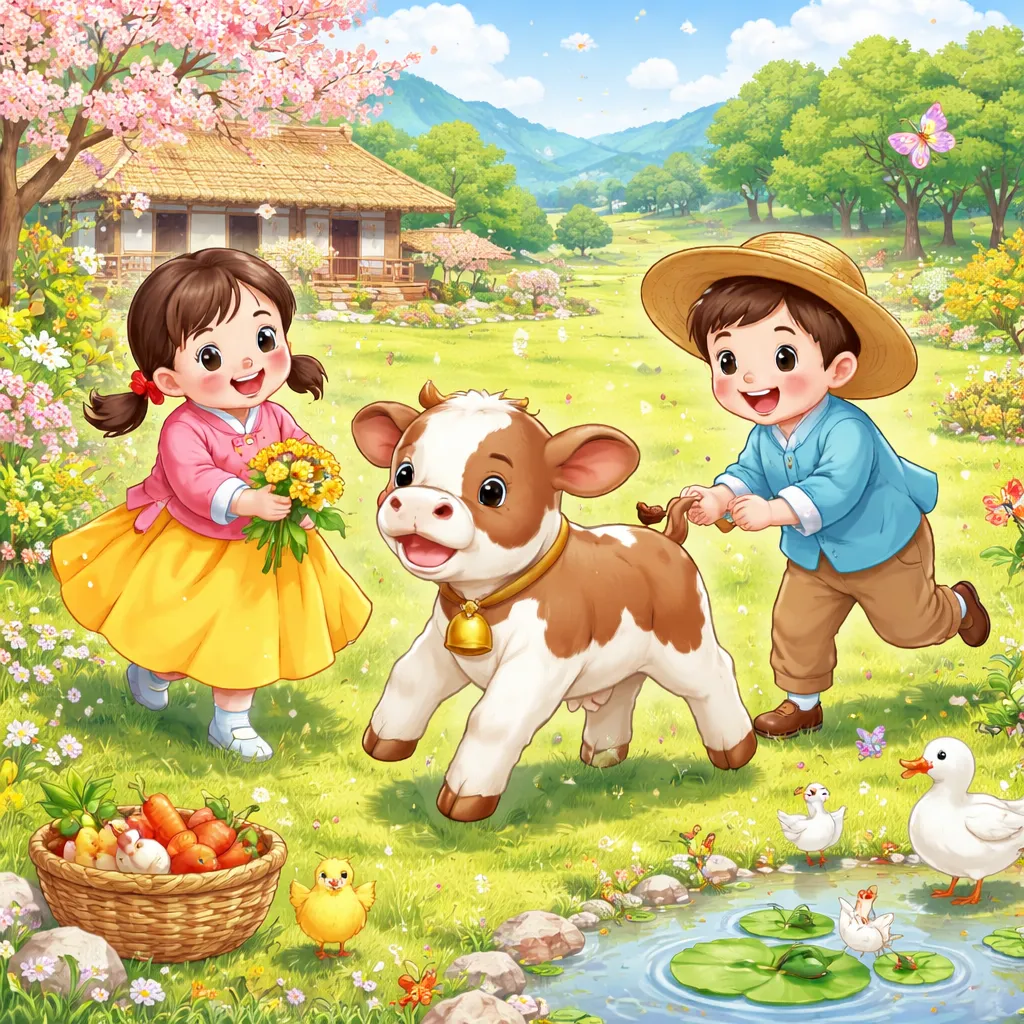

Have you ever seen a baby animal? Maybe a puppy, a kitten, or even a wobbly-legged baby cow? Baby animals are full of energy and curiosity, and they love to play. In Korea, a country with beautiful mountains and countryside, there is a very famous song about a joyful baby cow. Let’s say hello to the Korean Song: The Little Calf (송아지).
About the Song
Here are the classic, playful lyrics of this beloved song in Korean and English:
송아지 송아지 얼룩 송아지
(Song-aji song-aji eol-luk song-aji)
Little calf, little calf, spotted calf
엄마소 따라다니는
(Eom-ma-so dda-ra-da-ni-neun)
Following its mother cow
꼬리를 치며 뛰어노는
(Kko-ri-reul chi-myeo ddwi-eo-no-neun)
Wagging its tail and jumping around
귀여운 우리 송아지
(Gwi-yeo-un u-ri song-aji)
Our cute little calf
This song’s original Korean name is “송아지” (Song-aji), which means “calf.” It is one of the most famous and traditional Korean children’s songs. The song paints a happy picture of a calf on a farm. The music is bouncy, cheerful, and full of playful energy. The Korean Song: The Little Calf (송아지) is a musical snapshot of pure, simple joy and the loving bond between a mother and her baby.
What the Song is About
The song is a happy observation of a calf’s playful day. First, we greet the calf and notice its appearance: “Little calf, little calf, spotted calf.” We see its most important companion: “Following its mother cow.” The calf stays close to its mom, feeling safe and loved. Then, we see its playful actions: “Wagging its tail and jumping around.” We can almost see the calf’s happy tail swishing and its little hops on the grass. The song ends by calling the calf “our cute little calf,” making it feel like a friend that belongs to everyone. The whole song is about the simple, happy life of a cared-for baby animal.
Who Made It & Its Story
This song is a traditional Korean folk song, passed down through many generations. The original creator is unknown because it comes from the shared culture of Korean childhood. The song reflects Korea’s agricultural past, where many families lived in rural areas and farm animals were a common part of life. The Korean Song: The Little Calf (송아지) is adored for three joyful reasons. First, it is incredibly cute and easy for young children to love and remember. Second, its melody is very simple, repetitive, and bouncy, perfect for singing and dancing. Third, it teaches children about animals and the mother-baby bond in a gentle, fun way.
When to Sing It
You can sing this song while walking or hopping around the room, pretending to be a playful calf. It’s perfect to chant during a car ride when you see animals in fields or farms. You could also sing it with a friend, taking turns being the mother cow and the calf who follows and plays.
The Korean Song: The Little Calf (송아지) shows us a scene of playful life. But we can learn more from this happy animal. This song is a fun teacher. It introduces us to animal words, shows us how to describe ongoing actions, and shares a glimpse of traditional Korean life. Let’s explore what else we can discover.
What Children Can Learn
Vocabulary
This song helps us learn words for animals, family, and actions.
Calf: A baby cow or bull. A calf stays close to its mother.
Domestic: Animals that are kept by people, like cows, dogs, and cats. A calf is a domestic animal.
Bond: A close connection joining two people or things. The song shows the strong bond between mother and calf.
Wag: To move from side to side or up and down quickly. A happy dog will wag its tail.
Pasture: A large field where farm animals feed on grass. The calf might play in a green pasture.
Nurture: To care for and protect someone or something while they are growing. The mother cow nurtures her calf.
Language Skills
This song is a clear example of using the Present Continuous Tense for actions happening now. We use this tense to describe actions that are in progress at the moment we are speaking or in a scene we are describing.
What Is It?: Think of the Present Continuous as the “Right Now” tense. It shows actions that are ongoing. The calf isn’t just able to jump; it is jumping right now in the song.
Finding the Secret: Look for the verb “to be” (am, is, are) plus a main verb ending in “-ing.” Ask: “Is this action happening right this minute in the picture?”
Using It:
◦   Formula: [Subject] + is/am/are + [verb-ing].

◦   Examples: “The calf is following its mother.” “I am singing.” “We are learning.”

◦   In the song: The calf is following, is wagging its tail, and is jumping around. These actions are happening in the present scene.
Sounds & Rhythm Fun
Listen to the bouncy, playful rhythm! The Korean Song: The Little Calf (송아지) has a very distinct, upbeat, and cheerful rhythm. It might sound like the light, jumping steps of a calf. The melody is simple, repetitive, and easy to clap along to. This catchy, bouncy rhythm makes the song incredibly fun to sing and easy to remember. You can use this same jumpy, happy rhythm to make up a song about any playful animal, like a puppy or a kitten.
Culture & Big Ideas
This song connects to Korea’s traditional rural life. A major holiday that celebrates family and ancestors is Chuseok (Korean Thanksgiving), when many people travel to their hometowns, often in the countryside. The song’s setting reflects the pastoral scenes associated with this time. The Korean Song: The Little Calf (송아지) teaches three gentle ideas. First, The Security of Family: The calf feels safe and happy because it is close to its mother, showing the importance of family bonds. Second, The Joy of Play: Playing freely is a natural and wonderful part of life for all young creatures. Third, Appreciating Animals: The song encourages us to look at farm animals with affection and curiosity, seeing them as individuals with their own lives and feelings.
Values & Imagination
Imagine you are the little spotted calf. What does the soft grass feel like under your hooves? What does your mother’s gentle “moo” sound like? This song teaches you to appreciate the simple happiness of being cared for and the fun of playing. It shows that all baby animals, just like children, need love and protection. A simple idea: The next time you see a baby animal (in real life, a book, or on screen), watch how it moves and plays. Can you move like it? You are learning about the world through empathy and imagination.
Your Core Takeaways
The Korean Song: The Little Calf (송아지) is a joyful, bouncy lesson in family, playfulness, and kindness to animals. You learned animal words like “calf,” “domestic,” and “pasture.” You discovered how to use the Present Continuous tense to describe actions happening right now. You moved to the song’s catchy, cheerful rhythm. You also connected the song to Korean rural life and the importance of family during holidays like Chuseok. Most importantly, the song teaches that family makes us feel safe, that playing is a natural and happy thing, and that we should look at all creatures with a kind and curious heart.
Your Practice Missions
- Be a “Right Now” Reporter. Look around you. Describe what you or someone else is doing at this very moment, using “is ___ing” or “are ___ing.” Example: “My brother is reading. The clock is ticking. I am sitting.” This practices the Present Continuous tense.
- Create a “Mother and Baby” Story. Draw a picture of an animal parent and its baby (e.g., a cat and kitten, a bird and chick). Show them doing something together, like playing, eating, or sleeping. Tell a short story about your drawing, using the words “following,” “playing,” or “caring for.” This shows the bond the song talks about.