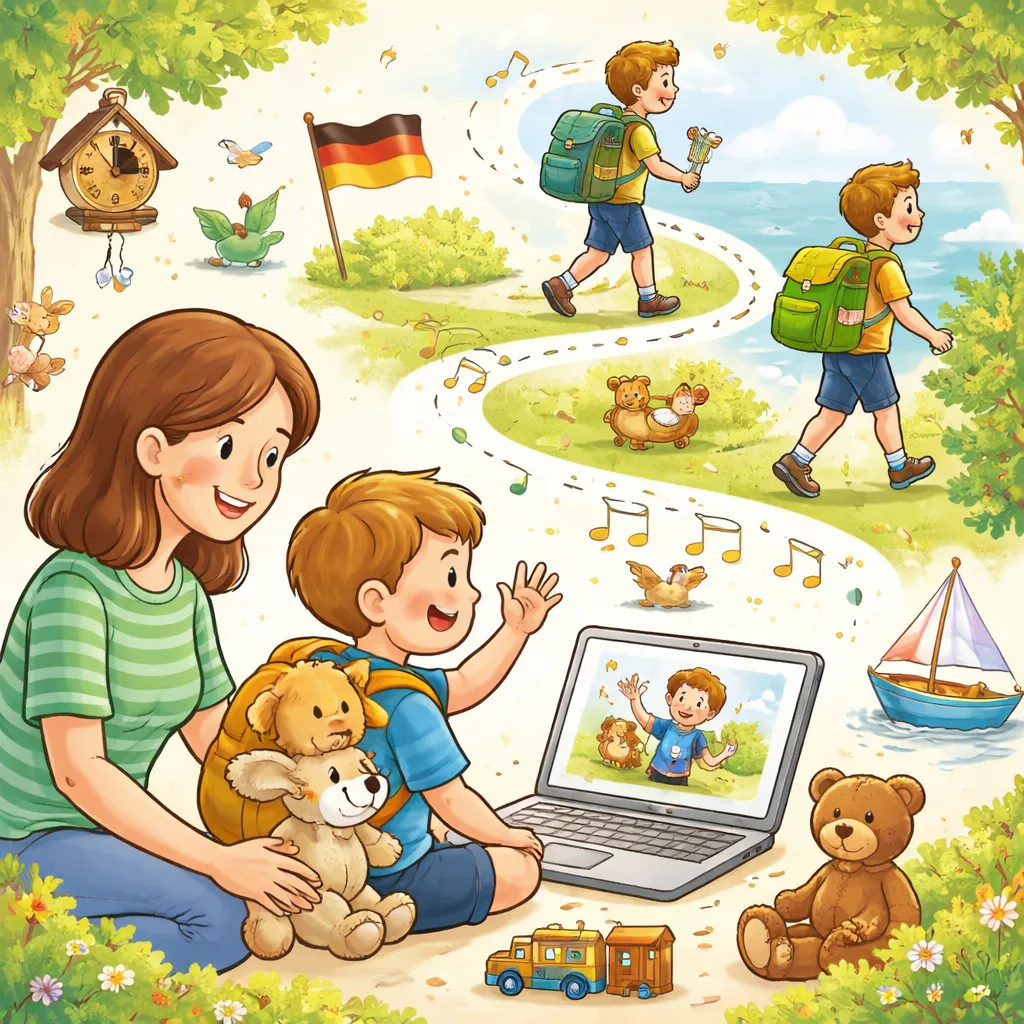

A child grows up and ventures out into the world. Then, one day, they return home. This is a story that every family understands. Today, we explore a beloved German nursery rhyme called “Hänschen klein,” which translates to “Little Hans.” This gentle song follows a young boy who goes out into the world and later returns to find things have changed. We will use this melody as a thoughtful path into English. Together, we will learn new words, explore important sounds, and discover how a simple song can make language learning feel like a journey of growing and coming home. Little Hans goes on a journey. Your child can journey into English with that same sense of adventure.
What is the rhyme? “Hänschen klein” is a traditional German folk song that has been sung for generations. It tells the story of a little boy named Hans who goes out into the world to seek his fortune. After many years, he returns home to find that everything has grown and changed. The song has a gentle, marching rhythm. Children often use hand movements. They walk their fingers like little legs. They pretend to travel far away. They show surprise when things have grown. The song creates a thoughtful, reflective atmosphere. It speaks to the journey of growing up and the importance of home. When we bring this song to English learning, we keep its gentle, growing spirit. We use the familiar melody to introduce English words in a way that feels like taking small steps into a wider world.
The lyrics of nursery rhymes To appreciate this song, we first look at the original German words. Then we see how they translate into English. This shows children that the same story of growing and returning can be told in different languages. You do not need to know German to enjoy the gentle, marching rhythm of the words.
Original Version (German)
Hänschen klein Geht allein In die weite Welt hinein Stock und Hut Steht ihm gut Ist gar wohlgemut
English Version
Little Hans Goes alone Into the wide world Walking stick and hat Suit him well He is very cheerful
A second verse continues the story, describing Hans’s return after many years.
Original Version (German)
Doch der Vater weint Steht ganz allein Ist gar nicht mehr wohlgemut Und die Mutter Weint so sehr Dass das Herz ihr bricht
English Version
But the father cries Stands all alone Is no longer cheerful And the mother Cries so much That her heart breaks
A final verse shows Hans’s return and the joy of reunion.
Original Version (German)
Hänschen klein Kommt nach Haus Ist kein Kind mehr, ist ein Mann Und das Haus Ist so klein Ach, wie groß war ich!
English Version
Little Hans Comes back home Is no longer a child, is a man And the house Is so small Oh, how big I have grown!
As you read these words, notice the thoughtful repetition. The story is simple but deep. A little boy goes into the world alone. His parents miss him. He returns as a man. Everything seems smaller because he has grown. This narrative invites children to think about growth, family, and change.
Vocabulary learning This song offers a rich set of words that connect to growth, family, and emotions. We can explore these words through conversation, pictures, and gentle discussions about growing up.
Start with the main character: Hans. In German, it is Hänschen, which means “little Hans.” In English, we say “Little Hans.” Hans is a common German name. Explain that this song is about a boy who grows up.
Here are the key words to focus on from the song:
Alone: By oneself. Hans goes alone. Talk about times when you are alone and times when you are together.
Wide world: The big world outside home. Point to the horizon. Talk about places far away.
Walking stick: A stick used for walking. Show a picture or use a pretend stick.
Hat: Clothing worn on the head. Point to hats. Hans’s hat suits him well.
Cheerful: Happy and positive. Make a cheerful face. Hans is cheerful.
Cries: Sheds tears. The parents cry because they miss Hans. Talk about feelings.
Heart breaks: Feels very sad. This is a strong expression. Explain that it means feeling very sad when someone is gone.
Comes back home: Returns to where he lives. Talk about returning home.
Grown: Become bigger. Hans has grown into a man. Show how you have grown.
Use these words in natural moments. When your child goes to a friend’s house, say “you go alone, like Little Hans.” When you reunite, say “you come back home.” These connections make the vocabulary meaningful.
Phonics points Phonics helps children understand the sounds that build English words. This song gives us several clear sounds to explore in a thoughtful way.
First, focus on the ‘h’ sound at the beginning of “Hans” and “home.” This is a soft, breathy sound. Say “h h h” like a gentle sigh. Practice with “hello,” “happy,” and “home.” This sound is soft and gentle.
Next, notice the long ‘i’ sound in “wide” and “cries.” Say “eye” like in “my.” Then say “wide.” Practice with “ride,” “time,” and “cries.” This sound is open and clear.
The word “world” contains the ‘or’ sound. Say “or” like in “more.” Then say “world.” Practice with “word,” “work,” and “world.” This sound requires rounded lips.
Finally, look at the ‘g’ sound in “grown” and “great.” This is a voiced sound made with the back of the tongue. Say “g g g” like a gentle growl. Practice with “go,” “good,” and “grown.” The song also has “cheerful,” which contains the ‘ch’ sound. Say “ch” like in “cheese.”
Grammar patterns Even a simple song contains grammar that we can introduce gently. We do not need to use technical terms. Instead, we show how words work together through examples and play.
The song uses the present tense to describe the action. “Goes,” “stands,” and “cries” describe what is happening. You can practice by describing what you do. “You go.” “You stand.” “You cry.” This builds understanding of present tense.
Notice the change from “child” to “man.” This shows growth and change over time. You can practice by talking about how things change. “You are a child. You will be a grown-up.” This introduces the concept of time and change.
The phrase “is no longer” shows that something has changed. “Is no longer a child” means he was a child, but now he is not. You can practice with other “no longer” phrases. “The sun is no longer up.” “You are no longer hungry.” This adds a useful expression.
Also, look at the exclamation “how big I have grown!” This shows surprise and realization. You can practice with other exclamations. “How tall you are!” “How fast you run!” This builds expressive language.
Learning activities Activities bring the song into the body and the imagination. They transform listening into active participation. These ideas are simple and require little preparation.
Little Hans Journey Play the song and pretend to be Little Hans. Walk around the room with a pretend walking stick and hat. When the song says “goes alone,” walk by yourself. When it says “comes back home,” return to a designated spot. When it says “how big I have grown,” stretch up tall. This activity builds listening skills and understanding of the story.
Growing Up Talk Look at photos of your child as a baby and now. Talk about how they have grown. Say “you were a baby. Now you are a big kid. You have grown, like Little Hans.” This connects the song to personal experience.
Family Feelings Talk about feelings. Hans’s parents missed him. Ask your child how they feel when someone is away. Then talk about how happy they are when the person returns. This builds emotional vocabulary.
Printable materials Printable resources offer a quiet way to reinforce the song’s vocabulary. They are perfect for moments when children want to create or focus calmly.
Flashcards Create a set of flashcards. One card shows a boy walking with a stick and hat. One shows a globe for “wide world.” One shows a happy face for “cheerful.” One shows a sad face for “cries.” One shows a house for “comes back home.” One shows a child growing taller for “grown.” Use these cards for a matching game. Sing a line from the song and ask your child to find the matching card. This builds word recognition.
Coloring Page Draw a simple scene from the song. Show Little Hans with his walking stick and hat, walking away from his house. On another page, show him returning as a grown man. Children can color both scenes. As they color, talk about the story. “Where is Hans going?” “What happens when he comes back?” This keeps the language flowing naturally.
Growth Chart Create a simple growth chart. Mark your child’s height. Write the date. Say “you are growing, like Little Hans.” This connects the song to a real measurement.
Educational games Games encourage repetition without boredom. They invite children to use the language in new and creative ways.
Hans Says Play a game similar to “Simon Says.” Give commands using the song’s vocabulary. “Hans says go into the wide world.” “Hans says come back home.” “Hans says grow very tall.” If you give a command without saying “Hans says,” the child does not move. This game builds listening skills.
Before and After Look at pictures of things that have grown. A seed and a flower. A baby and a child. A small house and a big house. Talk about what changed. “Before, it was small. Now it is big.” This builds understanding of change over time.
Feelings Match Create cards with different feelings. Happy. Sad. Cheerful. Use them to talk about how Hans and his parents felt at different parts of the story. This builds emotional vocabulary.
As you share “Hänschen klein” with your child, remember that you are exploring the journey of growing up. Little Hans goes into the world alone. He grows. He returns home to find that everything has changed, including himself. Learning a new language is also a journey. It takes small steps into new territory. It involves growing and changing. And it always involves the comfort of returning to what is familiar. Let Little Hans be your guide. Sing the song when you talk about growing up. Let the gentle journey of Hans remind you both that learning English is a great adventure, and no matter how far you go, home and the ones you love are always there to welcome you back.