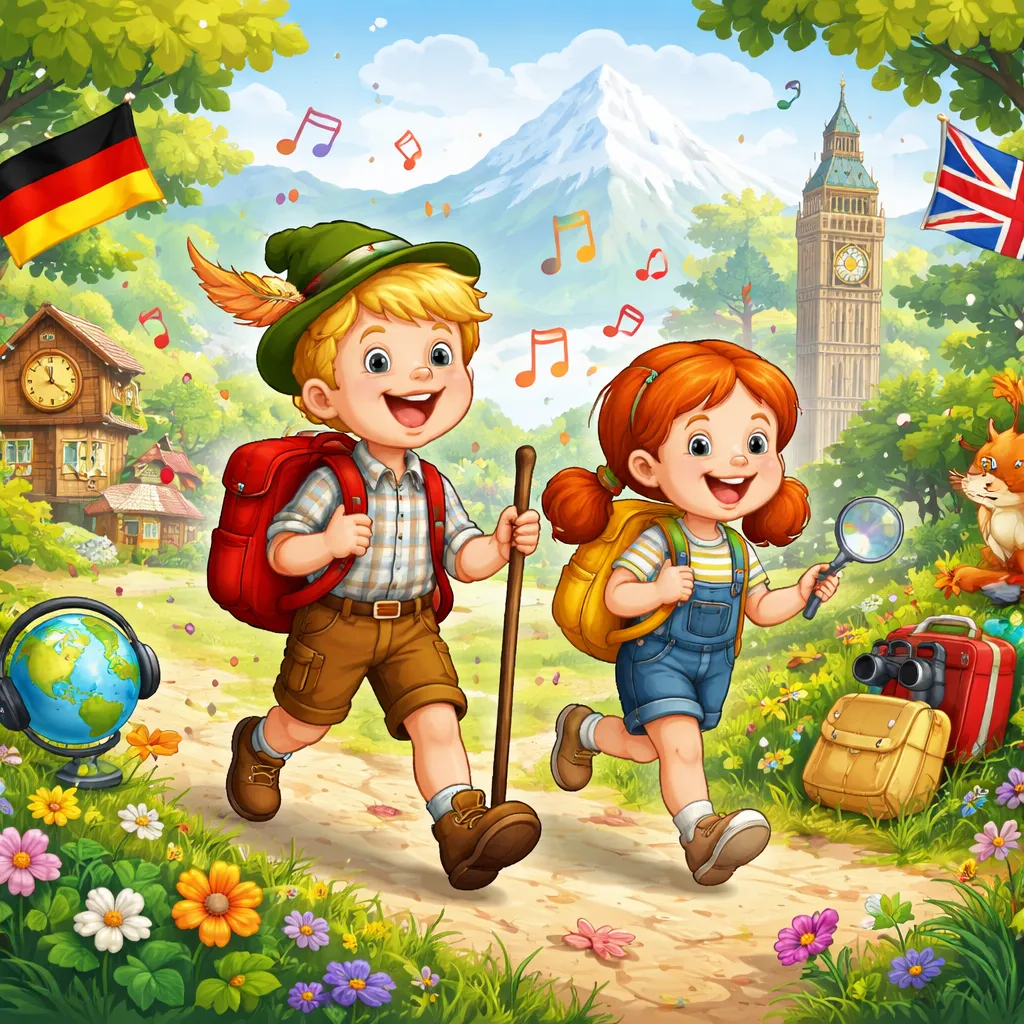

A walk through the forest brings fresh air and new discoveries. A children’s song can bring that same sense of adventure to language learning. Today, we explore a beloved German folk song often called “The Happy Wanderer.” The original title is “Das Wandern ist des Müllers Lust,” which means “Wandering is the Miller’s Joy.” This uplifting song celebrates the joy of walking through nature. We will use this melody as an adventurous path into English. Together, we will learn new words, explore important sounds, and discover how a simple song can make language learning feel like a happy walk through the great outdoors. The wanderer walks with joy. Your child can learn English with that same adventurous spirit.
What is the rhyme? “The Happy Wanderer” is a traditional German folk song that celebrates the joy of walking in nature. It has been sung by hikers, children, and families for generations. The song has a lively, marching rhythm. Children often use hand movements. They march in place. They pretend to look at mountains and valleys. They sing loudly with joy. The song creates a feeling of freedom and adventure. It celebrates the beauty of the natural world. When we bring this song to English learning, we keep its adventurous spirit. We use the familiar melody to introduce English words in a way that feels like setting out on a grand journey.
The lyrics of nursery rhymes To appreciate this song, we first look at the original German words. Then we see how they translate into English. This shows children that the same joyful adventure can be expressed in different languages. You do not need to know German to enjoy the lively, marching rhythm of the words.
Original Version (German)
Das Wandern ist des Müllers Lust Das Wandern Das Wandern ist des Müllers Lust Das Wandern
English Version
Wandering is the miller’s joy Wandering Wandering is the miller’s joy Wandering
A later verse, often sung in the English version, adds the famous chorus:
English Version (Popular Version)
I love to go a-wandering Along the mountain track And as I go, I love to sing My knapsack on my back
Val-deri, val-dera Val-deri, val-dera-ha-ha-ha-ha-ha Val-deri, val-dera My knapsack on my back
Additional verses celebrate the joy of seeing mountains, valleys, and returning home:
I love to wander by the stream That dances on its way The happy song of birds I hear As if to join my lay
Val-deri, val-dera...
I love to climb the mountain high Where leaps the mountain goat And from the summit I can see The valley far remote
Val-deri, val-dera...
I love to wander home at eve When toil is o’er and past I sing again my happy song To greet the night at last
Val-deri, val-dera...
As you read these words, notice the joyful repetition. The rhythm moves like footsteps on a trail. The story is simple and uplifting. The singer loves to wander along mountain tracks, by streams, and up mountains. They sing with joy. They carry a knapsack. They return home at evening. This narrative invites children to see language learning as an adventure.
Vocabulary learning This song offers a wonderful set of words that connect to nature, travel, and joyful activity. We can explore these words through conversation, pictures, and outdoor adventures.
Start with the main idea: wandering. In German, it is Wandern. In English, we say “wandering” or “walking.” Wandering means walking without a specific destination, enjoying the journey.
Here are the key words to focus on from the song:
Wander: To walk slowly, enjoying the scenery. Explain that a wanderer enjoys the journey, not just the destination.
Miller: A person who grinds grain into flour. In the song, the miller loves to wander.
Joy: Great happiness. The miller feels joy when wandering.
Mountain track: A path on a mountain. Show pictures of mountain trails.
Knapsack: A bag carried on the back. Point to a backpack. Explain that this is like a knapsack.
Stream: A small river. Show pictures of streams. Listen to the sound of running water.
Birds: Animals with feathers that sing. Listen for birds outside.
Climb: To go up. Climb a small hill or stairs together.
Mountain goat: An animal that lives on mountains. Show pictures of goats on rocks.
Summit: The very top of a mountain. Point to the top of a hill.
Valley: The low land between mountains. Show pictures of valleys.
Home at eve: Returning home in the evening. Talk about coming home when the day is done.
Use these words in natural moments. When you go for a walk, say “let us wander like the happy wanderer.” When you see a bird, say “the birds sing, just like in the song.” These connections make the vocabulary meaningful.
Phonics points Phonics helps children understand the sounds that build English words. This song gives us several clear sounds to explore in a lively, adventurous way.
First, focus on the ‘w’ sound at the beginning of “wander” and “wandering.” This is a voiced sound made with rounded lips. Say “w w w” like a soft wind. Practice with “walk,” “water,” and “wander.” This sound is gentle and flowing.
Next, notice the long ‘i’ sound in “mountain” and “track.” Actually, “mountain” has the ‘ow’ sound. Let us focus on the long ‘i’ in “I” and “by.” Say “eye” like in “my.” Then say “by.” Practice with “high,” “sky,” and “my.” This sound is bright and open.
The word “stream” contains the ‘str’ blend and the long ‘e’ sound. First, the ‘str’ blend. Say “s,” then quickly add “t,” then “r.” Then add “eam.” Practice with “street,” “strong,” and “stream.” The long ‘e’ sound is like “see.”
Finally, look at the ‘cl’ blend in “climb.” Say “c” and then quickly add “l.” Then add “imb.” Practice with “cloud,” “clap,” and “climb.” The song also has “valley,” which contains the short ‘a’ sound. Say “a” like in “apple.”
Grammar patterns Even a simple song contains grammar that we can introduce gently. We do not need to use technical terms. Instead, we show how words work together through examples and play.
The song uses the present tense to describe the wanderer’s actions. “I love,” “I go,” and “I sing” describe what the singer does regularly. You can practice by describing what you love to do. “I love to walk.” “I love to sing.” This builds understanding of present tense.
Notice the phrase “a-wandering.” The “a-” prefix is an old-fashioned way of saying “on a” or “while.” It adds a poetic feel. You can explain that sometimes words change to make songs sound special.
The chorus uses the joyful nonsense words “val-deri, val-dera.” These sounds express pure joy. They have no meaning but convey happiness. You can make up your own joyful sounds together.
Also, look at the pattern “I love to ___.” This shows enjoyment. You can practice with other activities. “I love to play.” “I love to read.” This builds expressive language about preferences.
Learning activities Activities bring the song into the body and the imagination. They transform listening into active participation. These ideas are simple and require little preparation.
Happy Wanderer Walk Play the song and go for a walk together. March in time with the music. Look for mountains (hills), streams (puddles or creeks), and birds. Sing the chorus together. This activity builds listening skills and connects the song to real adventure.
Nature Scavenger Hunt Create a simple list of things to find on a walk. A bird. A stream. A high place. A path. Look for these things together. When you find each one, say the word. This builds vocabulary and observation skills.
Knapsack Packing Pretend to pack a knapsack for a wander. Gather items. A snack. A water bottle. A hat. A map. Talk about each item as you pack. This builds vocabulary and planning skills.
Printable materials Printable resources offer a quiet way to reinforce the song’s vocabulary. They are perfect for moments when children want to create or focus calmly.
Flashcards Create a set of flashcards. One card shows a person walking for “wander.” One shows a mountain track. One shows a knapsack. One shows a stream. One shows a bird singing. One shows a mountain summit. Use these cards for a matching game. Sing a line from the song and ask your child to find the matching card. This builds word recognition.
Coloring Page Draw a simple scene from the song. Show a path winding through mountains. Add a stream and birds. Show a wanderer with a knapsack. Children can color the scene with bright, happy colors. As they color, talk about the scene. “Where is the wanderer going?” “What do you see?” This keeps the language flowing naturally.
Adventure Map Create a simple map of a pretend wandering route. Draw a start point, a mountain, a stream, and a home. Your child can trace the route with a finger while singing the song. This builds sequencing and storytelling skills.
Educational games Games encourage repetition without boredom. They invite children to use the language in new and creative ways.
Wanderer Says Play a game similar to “Simon Says.” Give commands using the song’s vocabulary. “The wanderer says climb the mountain.” “The wanderer says sing a happy song.” “The wanderer says put on your knapsack.” If you give a command without saying “the wanderer says,” the child does not move. This game builds listening skills.
What Do You See? While on a walk, play “I spy” using nature words. “I spy something that flows.” (Stream) “I spy something that sings.” (Bird) This builds observation and vocabulary.
Val-deri Chorus Create your own joyful nonsense words. Take turns making up sounds. Sing them together. This builds creativity and joy in making sounds.
As you share “The Happy Wanderer” with your child, remember that you are building a love for adventure and discovery. The wanderer loves to walk. They sing along the way. They enjoy the mountains, the streams, and the birds. They return home with joy. Learning a new language is also a grand adventure. There are mountains to climb (new words) and valleys to explore (new sentences). There are joyful sounds to sing. And at the end of each day, you return home, richer for the journey. Let the happy wanderer be your guide. Sing the song when you go outside. Let the adventurous spirit remind you both that every walk is a chance to learn new words, and every word learned is a step further along the path of language.