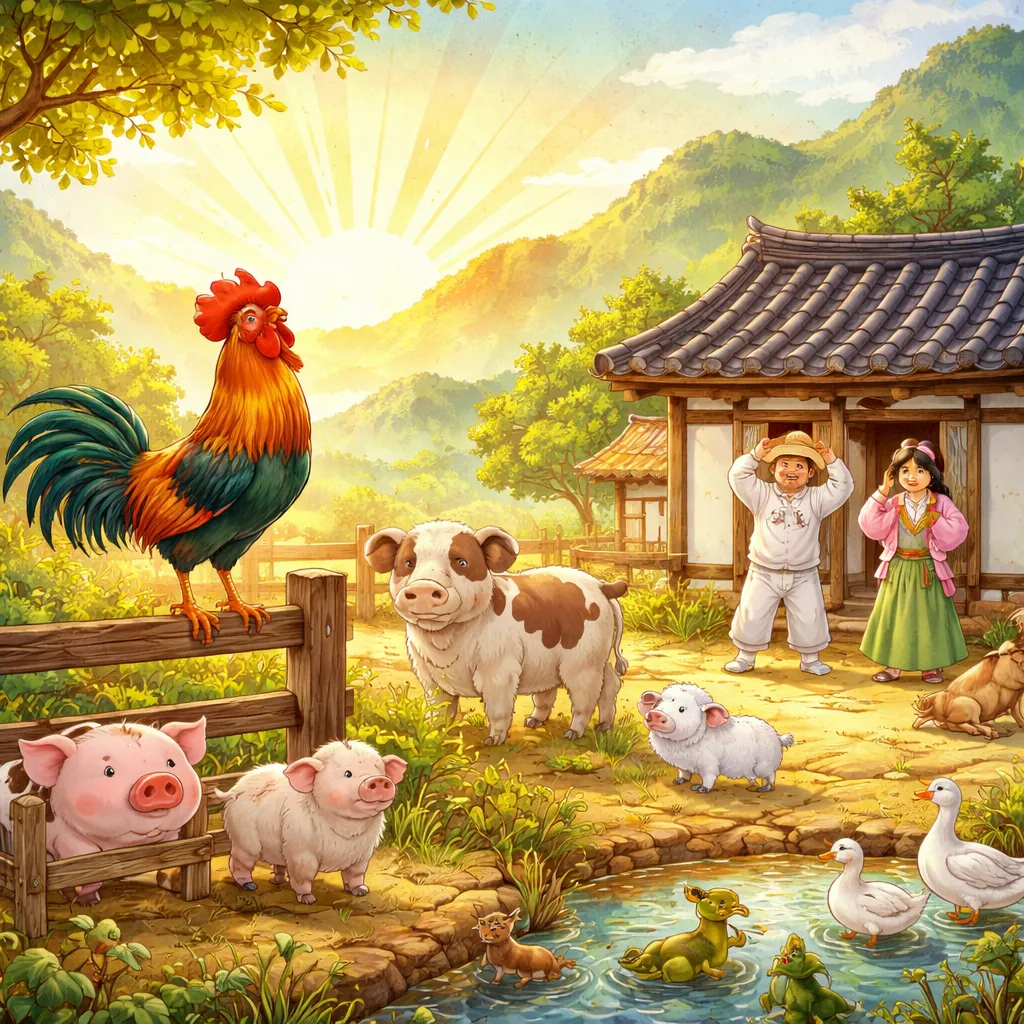

Have you ever woken up to a loud, cheerful sound outside your window? Cock-a-doodle-doo! In many places, especially on farms, that sound is the rooster’s morning song. It’s his job to tell everyone, “The sun is rising! Time to start the day!” In Korea, a country with a long agricultural history, there is a famous song about this feathered alarm clock. Let’s wake up with the Korean Song: The Little Rooster (수탉).
About the Song
Here is a classic verse from this beloved song in Korean and English:
수탉 수탉 빨간 수탉
(Sutak sutak ppalgan sutak)
Rooster, rooster, red rooster
아침 해가 뜰 때
(Achim haega tteul ttae)
When the morning sun rises
꼬끼오 꼬끼오 큰 소리로
(Kkokkio kkokkio keun soriro)
Cock-a-doodle-doo, in a loud voice
우리를 깨워 주네
(Urireul ggaewo june)
You wake us up
This song’s original Korean name is “수탉” (Sutak), which means “rooster.” It is a very popular and traditional Korean children’s song. The song is a thankful shout-out to the rooster for its important job. The music is often bright, bold, and includes the crowing sound “꼬끼오.” The Korean Song: The Little Rooster (수탉) is a musical alarm clock, celebrating the start of a new day and the reliable rhythm of farm life.
What the Song is About
The song is a cheerful description of the rooster’s duty. First, we greet him and note his look: “Rooster, rooster, red rooster.” We learn the time of his job: “When the morning sun rises.” He is perfectly in tune with nature. We hear his powerful call: “Cock-a-doodle-doo, in a loud voice.” Finally, we see the result: “You wake us up.” The rooster’s crow is a service to the whole farm, making sure everyone starts their day on time. The whole song is about reliability, punctuality, and the rooster’s proud, important role.
Who Made It & Its Story
This song is a traditional Korean folk song, passed down through generations. The original creator is unknown, as it comes from the daily life of Korean farming communities. The rooster is a classic symbol of dawn and hard work. The Korean Song: The Little Rooster (수탉) is loved for three crowing reasons. First, it introduces children to the concept of timekeeping in nature and the importance of a morning routine. Second, it is fun to sing because you get to make loud, funny animal sounds. Third, its melody is clear and declarative, easy to remember and perfect for singing first thing in the morning to get energized.
When to Sing It
You can sing this song as soon as you wake up, stretching your arms and pretending to crow like a rooster. It’s perfect to chant during a pretend farm play, taking turns being the rooster who announces the day. You could also sing it on a car ride early in the morning, greeting the rising sun.
The Korean Song: The Little Rooster (수탉) teaches us about starting the day with purpose. But to be as reliable as a rooster, we need to learn too. This song is our morning lesson. It introduces us to new words, shows us how to talk about time, and shares a slice of Korean farm culture. Let’s rise and shine with this learning.
What Children Can Learn
Vocabulary
This song helps us learn words for time, animals, and responsibility.
Dawn: The time of day when light first appears; sunrise. The rooster crows at dawn.
Punctual: Happening or doing something at the agreed or proper time. The rooster is very punctual.
Poultry: Domesticated birds kept for eggs or meat. Roosters and hens are poultry.
Announcement: A public and typically formal statement. The crow is the rooster’s announcement.
Combed: The red, fleshy crest on top of a rooster’s head. The rooster has a bright red comb.
Routine: A sequence of actions regularly followed. The rooster’s crow starts the daily routine.
Language Skills
This song is a great example of using Time Clauses with “When” to show the specific time an action happens. We use “when” to connect two events that occur at the same time.
What Is It?: Think of “when” as your time connector. It tells you the exact moment something occurs. The rooster crows when the sun rises.
Finding the Secret: Look for the word “when” followed by a subject and verb. It sets the time for the main action. Ask: “Does this sentence tell me the time that the main action happens?”
Using It:
◦   Formula: When + [time event], + [main event]. or [Main event] + when + [time event].

◦   Examples: “When the bell rings, we go inside.” “I eat breakfast when I am hungry.”

◦   In the song: “When the morning sun rises, you wake us up.” The sunrise is the time for the rooster’s crow.
Sounds & Rhythm Fun
Listen to the crowing rhythm! The Korean Song: The Little Rooster (수탉) has a clear, strong, and declarative beat. The “꼬끼오” is a fun onomatopoeia that mimics the rooster’s crow. This bold, repetitive rhythm makes the song exciting to sing and easy to remember. It captures the feeling of a loud, important announcement. You can use this same bold, announcing rhythm to make up a song about any important daily event, like announcing dinner time or cleanup time.
Culture & Big Ideas
This song connects to the traditional Korean agricultural calendar and the value of starting the day early. In Korean folklore, the rooster is often seen as a positive creature that wards off evil spirits with its crow. The Korean Song: The Little Rooster (수탉) teaches three important ideas. First, The Importance of Routine: A predictable start to the day brings order and productivity to a home or farm. Second, Natural Timekeepers: Before alarm clocks, people relied on animals like roosters to know the time, showing how humans and nature work together. Third, Pride in Your Role: The rooster performs its job with confidence, teaching us to take pride in our own responsibilities, big or small.
Values & Imagination
Imagine you are the little red rooster. You perch on the highest fence post. How does it feel to see the first light of day? Why is it important that your call is loud and clear? This song teaches you the value of being dependable and the importance of a good morning routine. It shows that everyone has a role to play in their community. A simple idea: Tomorrow morning, try to be the “rooster” for your family. Wake up and gently tell everyone, “Good morning! The day is starting!” See how it feels to help start the day.
Your Core Takeaways
The Korean Song: The Little Rooster (수탉) is a bold, cheerful lesson in punctuality, responsibility, and the start of a new day. You learned words like “dawn,” “punctual,” and “announcement.” You discovered how to use time clauses with “when” to talk about simultaneous events. You crowed to the song’s strong, clear rhythm. You also connected the rooster to Korean farming life and folklore. Most importantly, the song teaches that being reliable is a great gift to others, that mornings are a fresh start, and that taking pride in your job, even crowing, makes the whole world run smoothly.
Your Practice Missions
- Be a “When” Detective. For one day, notice one thing that always happens at a specific time (e.g., the school bell rings at 9 a.m., you eat lunch at noon). Report it using a “when” clause. Example: “When the clock says nine, my class starts.” This helps you observe routines and practice time clauses.
- Create a “Morning Announcement” Poster. Draw a large rooster in the center. Around it, draw or write the different things that happen in the morning routine it announces: the sun rising, a farmer milking a cow, a child brushing teeth. Present your poster and explain, “When the rooster crows, all of this starts!” This shows how one signal can begin many important activities.