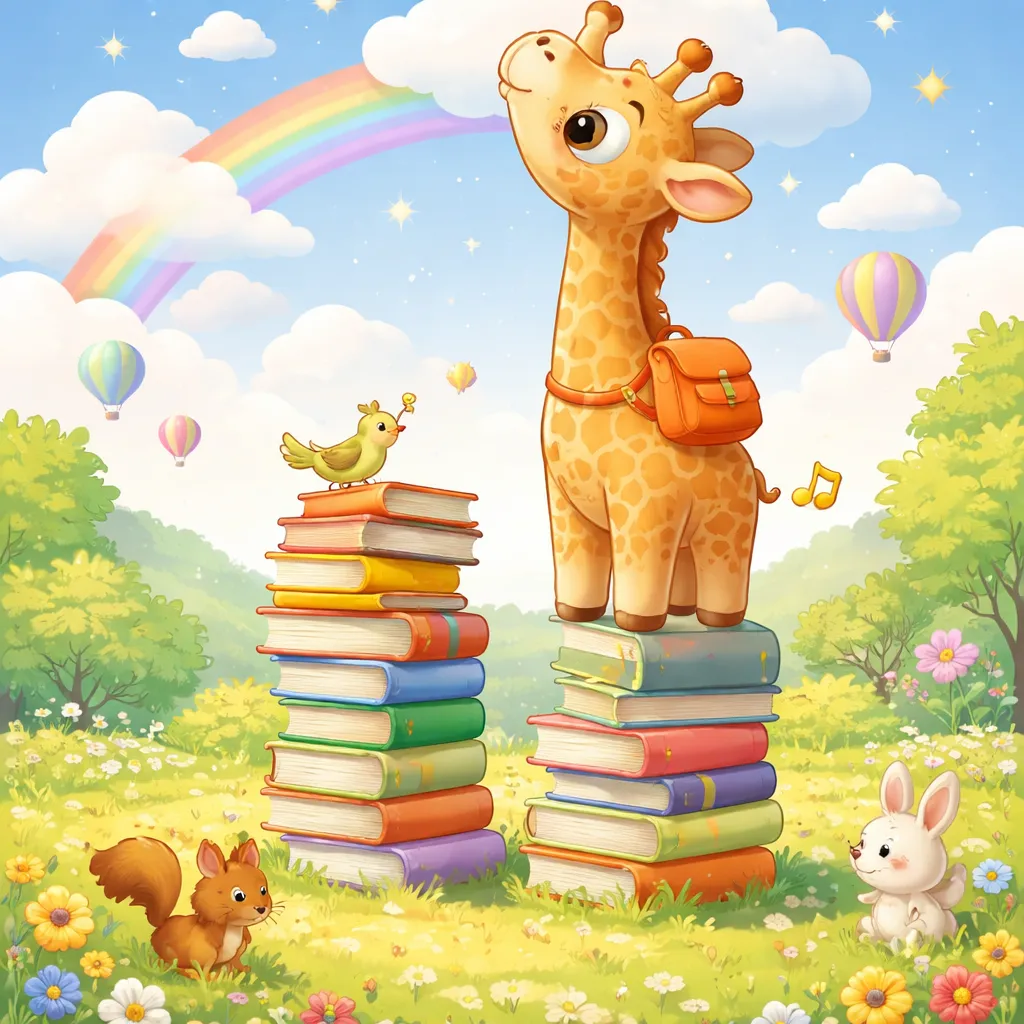

Have you ever tried to reach something on a very high shelf? Or looked up at a tall tree and wondered what the view is like from the top? Some creatures have a natural advantage. In Korea, a country that loves learning about the world, there is a wonderful song about the tallest animal on Earth. Let’s look up to the Korean Song: The Little Giraffe (기린).
About the Song
Here is a cheerful verse from this beloved song in Korean and English:
기린 기린 키큰 기린
(Girin girin kikeun girin)
Giraffe, giraffe, tall giraffe
하늘 가까이 목을 빼고
(Haneul gakkai mokeul ppaego)
Stretching its neck close to the sky
나뭇잎을 맛있게 먹고
(Namut-ipeul masitge meokgo)
Eating leaves deliciously
우아하게 걸어가네
(Uahage georeogane)
Walking elegantly
This song’s original Korean name is “기린” (Girin), which means “giraffe.” It is a popular and educational Korean children’s song. The song is a joyful observation of a giraffe’s most famous features. The music is often smooth, graceful, and has a sense of upward motion. The Korean Song: The Little Giraffe (기린) is a musical sketch, celebrating the giraffe’s unique height, peaceful eating habits, and elegant way of moving.
What the Song is About
The song is a simple, happy description. First, we call the giraffe and state its main feature: “Giraffe, giraffe, tall giraffe.” We see how it uses its height: “Stretching its neck close to the sky.” The giraffe can reach leaves that no other animal can. We learn about its food: “Eating leaves deliciously.” It enjoys the tender leaves at the tops of trees. Finally, we admire its movement: “Walking elegantly.” Even though it is very tall, it moves with grace and poise. The whole song is about appreciating how the giraffe is perfectly designed for its life in the savanna, high above the ground.
Who Made It & Its Story
This song is a modern Korean children’s song, likely created for educational purposes in the 20th century. While the specific creator isn’t widely known, it reflects Korea’s curiosity about global wildlife. Giraffes are not native to Asia, so the song comes from a place of fascination with exotic animals seen in books, zoos, and media. The Korean Song: The Little Giraffe (기린) is loved for three lofty reasons. First, it captures the wonder of the giraffe’s incredible height in a way that is easy for children to understand and imagine. Second, it uses gentle, positive words (“elegantly,” “deliciously”) to create a feeling of admiration rather than just surprise. Third, its melody is often flowing and calm, easy to remember, and perfect for singing while stretching or pretending to be tall.
When to Sing It
You can sing this song while stretching your arms high above your head, trying to touch the ceiling. It’s perfect to hum during a walk, looking up at tall trees and imagining a giraffe eating the leaves. You could also sing it with a friend, walking slowly and gracefully on tiptoe, being tall and elegant giraffes.
The Korean Song: The Little Giraffe (기린) gives us a new, high-up perspective. But to see the whole picture, we can learn more. This song is a stepping stone to knowledge. It teaches us new words, how to describe actions, and the value of seeing things from a different point of view. Let’s stretch our minds and see what we can learn.
What Children Can Learn
Vocabulary
This song helps us learn words for anatomy, movement, and description.
Savanna: A grassy plain with scattered trees, found in Africa. The giraffe’s home is the savanna.
Perspective: A particular way of viewing things. The giraffe has a high perspective.
Graceful: Moving in a smooth, relaxed, and attractive way. The giraffe walks in a graceful manner.
Herbivore: An animal that eats only plants. The giraffe is a herbivore.
Unique: Being the only one of its kind; very special. The giraffe’s long neck is unique.
Adaptation: A special feature that helps a living thing survive. A long neck is an adaptation for reaching food.
Language Skills
This song is a great example of using Adverbs to Describe How an Action is Done. Adverbs are words that describe verbs (actions). They tell us how something is done.
What Are They?: Think of adverbs as your “how” words. They add detail to an action. How does it eat? Deliciously. How does it walk? Elegantly.
Finding the Secret: Look for words that end in “-ly” and are near an action word (verb). They answer the question “How?” Ask: “How is this action being performed?”
Using It:
◦   Formula: [Subject] + [verb] + [adverb]. or [Subject] + [adverb] + [verb].

◦   Examples: “She sings beautifully. He runs quickly.”

◦   In the song: “Eating deliciously. Walking elegantly.” These adverbs tell us how the giraffe eats and walks.
Sounds & Rhythm Fun
Listen to the tall, graceful rhythm. The Korean Song: The Little Giraffe (기린) often has a slow, swaying, and deliberate beat. It might sound like the long, slow steps of a giraffe. The melody might have notes that rise higher, like a neck stretching upward. This smooth, elegant rhythm makes the song calming and helps the descriptive lyrics float easily in your memory. You can use this same flowing, upward rhythm to make up a song about any tall or graceful thing, like a growing sunflower or a slow-moving cloud.
Culture & Big Ideas
While giraffes are not part of traditional Korean wildlife, the song reflects a global curiosity and the modern way Korean children learn about the world. It connects to the joy of visiting a zoo (동물원, dongmulwon) and seeing amazing animals from other continents. The Korean Song: The Little Giraffe (기린) teaches three important ideas. First, Different Perspectives: Being tall gives the giraffe a different view of the world, reminding us that our own viewpoint is shaped by who we are and where we stand. Second, Elegance in Difference: What makes the giraffe different (its height) is also what makes it beautiful and successful. Third, Peaceful Adaptation: The giraffe doesn’t fight for food; it has adapted to reach a peaceful, plentiful supply high up, showing that problems can be solved with clever design, not conflict.
Values & Imagination
Imagine you are the little giraffe. What do you see from up there? Can you spot rivers and far-off trees that other animals can’t? How does it feel to take such long, slow steps? This song teaches you to appreciate your own unique qualities and to see the world from other perspectives. It encourages kindness and curiosity about those who are different. A simple idea: Try to do a routine activity, like brushing your teeth, from a different height—maybe by sitting on the floor or standing on a safe stool. Notice how the perspective changes. You are practicing seeing the world in a new way.
Your Core Takeaways
The Korean Song: The Little Giraffe (기린) is a graceful, uplifting lesson in perspective, uniqueness, and peaceful living. You learned words like “savanna,” “perspective,” and “herbivore.” You discovered how to use adverbs like “elegantly” to describe how an action is done. You moved to the song’s smooth, swaying rhythm. You also connected the giraffe to the modern, global curiosity of Korean children. Most importantly, the song teaches that our differences are our strengths, that a new perspective can be beautiful, and that living in harmony with nature often means finding clever, peaceful solutions.
Your Practice Missions
- Be an “Adverb Adventurer.” Choose a simple action, like walking or speaking. Do that action in three different ways and describe each with an adverb. Example: “Walk slowly. Walk quickly. Walk happily.” This helps you practice describing how things are done.
- Create a “Giraffe’s-Eye View” Drawing. On a piece of paper, draw a horizon line. Below it, draw the world as a small animal might see it (grass, bushes). Above the line, draw the world as a giraffe sees it (treetops, clouds, birds, the sun). Label your drawing. This shows the different perspectives the song talks about.














