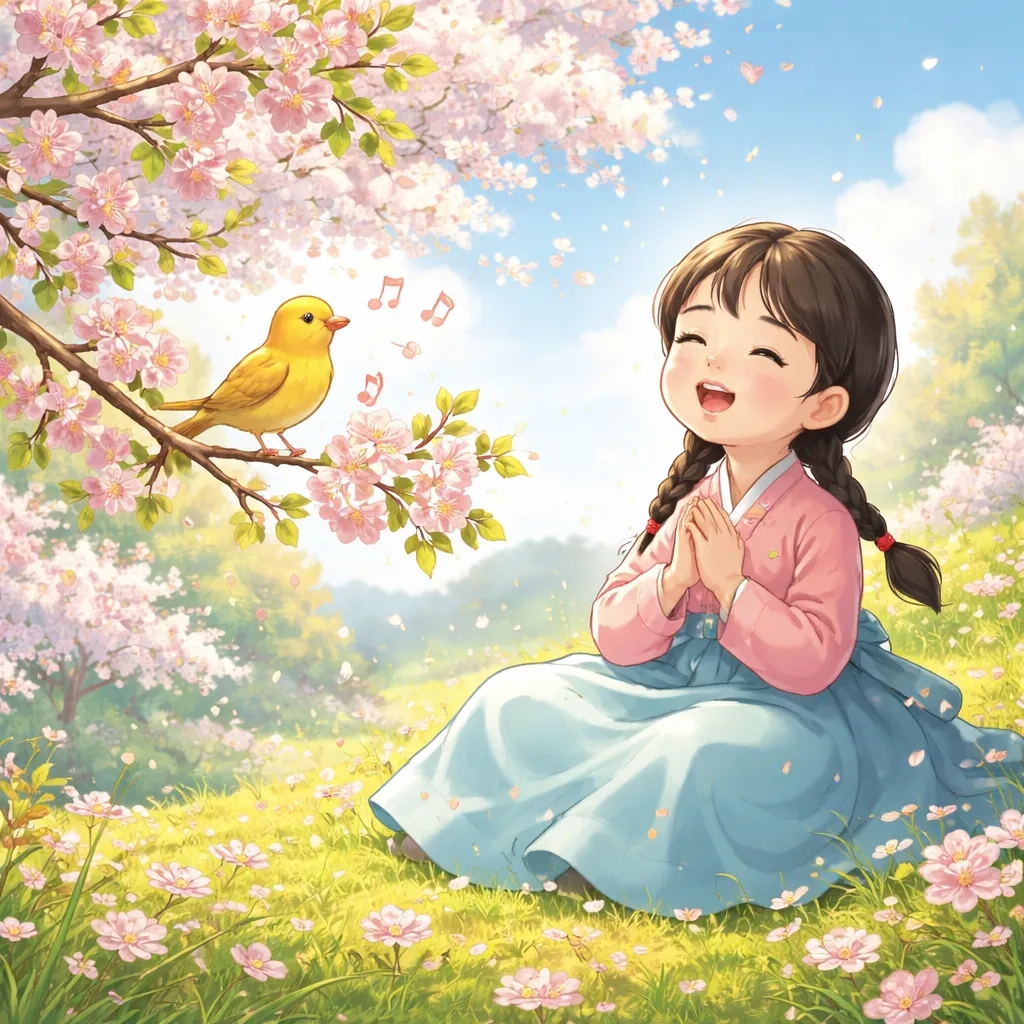

Have you ever woken up to the cheerful sound of birds singing outside your window? Have you watched a bird spread its wings and soar high into the sky, becoming a tiny dot? Birds are messengers of the air, bringing music and color to our world. In Korea, a country with beautiful mountains and changing seasons, there is a happy song that celebrates this free spirit. Let’s look up and learn the Korean Song: The Little Bird (새).
About the Song
Here is a classic verse from this beloved song in Korean and English:
새야 새야 작은 새야
(Saeya saeya jageun saeya)
Bird, bird, little bird
하늘 높이 날아봐
(Haneul nopi narabwa)
Fly high in the sky
즐거운 노래를 불러봐
(Jeulgeoun noraereul bulleobwa)
Sing a joyful song
나무 위에 앉아서
(Namu wie anjaseo)
Sitting on a tree
세상을 향해 웃어봐
(Sesangeul hyanghye useobwa)
Smile towards the world
This song’s original Korean name is “새” (Sae), which means “bird.” It is a very popular and traditional Korean children’s song. The song is a cheerful, encouraging message to a little bird. The music is often light, soaring, and full of hope. The Korean Song: The Little Bird (새) is a musical wish, celebrating freedom, joyful expression, and the simple happiness of sharing your song with the world.
What the Song is About
The song is a friendly conversation with a bird. First, we call to it: “Bird, bird, little bird.” We encourage it to be free: “Fly high in the sky.” We want it to use its voice: “Sing a joyful song.” The song then pictures the bird resting: “Sitting on a tree.” From this safe perch, the bird can do one more wonderful thing: “Smile towards the world.” Birds don’t really smile, but this means to share its happiness and beauty with everyone. The whole song is about the joy of freedom, the beauty of music, and sharing a positive spirit with the whole world.
Who Made It & Its Story
This song is a traditional Korean folk song, passed down through many generations. The original creator is unknown, as it comes from the people’s love for nature and its creatures. Birds are deeply woven into Korean culture, appearing in art, poetry, and folklore as symbols of good luck and happiness. The Korean Song: The Little Bird (새) is adored for three uplifting reasons. First, it encourages children to be brave, joyful, and to share their own “song” (or talents) with the world. Second, it connects the listener to the beauty of the natural world and the sky above. Third, its melody is often simple, sweet, and easy to remember, making it a favorite for singing outdoors or when feeling happy.
When to Sing It
You can sing this song while looking out the window, waving to the birds you see. It’s perfect to chant on a walk, especially if you hear real birds singing. You could also sing it with your arms outstretched, pretending to fly around the room like a joyful bird.
The Korean Song: The Little Bird (새) lifts our spirits with its message of freedom. But to really appreciate the bird’s world, we can learn more. This song is a nest of knowledge. It teaches us new words, how to give encouraging commands, and shares the cultural love for nature. Let’s spread our wings of curiosity and see what we can discover.
What Children Can Learn
Vocabulary
This song helps us learn words for nature, actions, and feelings.
Perch: A place where a bird can rest or stand, like a branch. The bird sits on a perch in the tree.
Melody: A sequence of musical notes that is pleasant to hear; a tune. The bird’s song is a happy melody.
Soar: To fly or rise high in the air. An eagle can soar on the wind.
Joyful: Feeling or expressing great happiness. The song encourages a joyful heart.
Expression: The act of making your thoughts or feelings known. Singing is a form of expression.
Horizon: The line where the earth seems to meet the sky. The bird flies toward the horizon.
Language Skills
This song is a great example of using the Imperative Mood for Encouragement. We use the imperative (command form) not just to order, but to cheer someone on, like saying “Go for it!”
What Is It?: Think of the imperative as the “You Can Do It!” form. It’s used to give advice, instructions, or friendly encouragement. The structure is the base form of the verb.
Finding the Secret: Look for sentences that tell someone to do something. They often start with the verb and have no subject. To be encouraging, they are said with a happy, supportive tone. Ask: “Is this sentence cheering someone on to take an action?”
Using It:
◦   Formula: [Verb] + [the rest of the sentence].

◦   For encouragement: “Fly high!” “Sing loudly!” “Try your best!”

◦   In the song: “Fly high in the sky. Sing a joyful song. Smile towards the world.” These are all encouraging cheers for the little bird.
Sounds & Rhythm Fun
Listen to the soaring melody. The Korean Song: The Little Bird (새) often has a light, flowing, and uplifting rhythm. It might sound like the flapping of wings or a happy whistle. The melody is usually simple and repeats, making it easy to learn and sing like a bird’s call. This light, cheerful rhythm makes the encouraging lyrics easy to remember and fills you with a positive feeling. You can use this same uplifting, flowing rhythm to make up a song to encourage a friend or to celebrate a happy day.
Culture & Big Ideas
This song connects to the Korean appreciation for nature and the changing seasons. A beautiful tradition is flying kites, or 연 (yeon), which dance in the sky like colorful birds, especially during the Lunar New Year. The song reflects the joy found in nature’s simple gifts. The Korean Song: The Little Bird (새) teaches three important ideas. First, Freedom and Joy: True happiness often comes from feeling free to be yourself and to express your inner song. Second, Sharing Your Gift: Your unique voice, your smile, your talents—these are gifts you can share to make the world brighter. Third, A Higher Perspective: Flying high and smiling at the world encourages us to look at the bigger picture and stay hopeful.
Values & Imagination
Imagine you are the little bird. What does the wind feel like under your wings? What song would you sing to make people happy? This song teaches you to be brave, to use your voice, and to share your happiness. It shows that even a small creature can have a big, joyful impact. A simple idea: The next time you see a bird, try to whistle or hum back to it. You are having a conversation with nature. Or, draw a picture of a bird and write the song you think it would sing on a speech bubble.
Your Core Takeaways
The Korean Song: The Little Bird (새) is an uplifting lesson in freedom, expression, and joy. You learned words like “perch,” “melody,” and “soar.” You discovered how to use the imperative mood to give friendly encouragement and cheer someone on. You felt the song’s light, soaring rhythm. You also connected the bird to Korean traditions like kite flying. Most importantly, the song teaches that we should be brave and free, that sharing our unique voice makes the world better, and that a joyful heart can smile at the whole world.
Your Practice Missions
- Be an “Encouraging Coach.” Find a toy or a family member. Give them three encouraging commands using the imperative, just like cheering on the bird. Example: “Jump high!” “Draw a beautiful picture!” “Laugh out loud!” This practices using language to support others.
- Create a “Joyful Song for the World.” Sit quietly for a minute and think of one thing that makes you very happy. It could be your family, your pet, or ice cream. Now, make up a very short, simple song (just two lines) about it. Sing it softly to yourself or share it with someone. You are being like the little bird, sharing your joyful song.