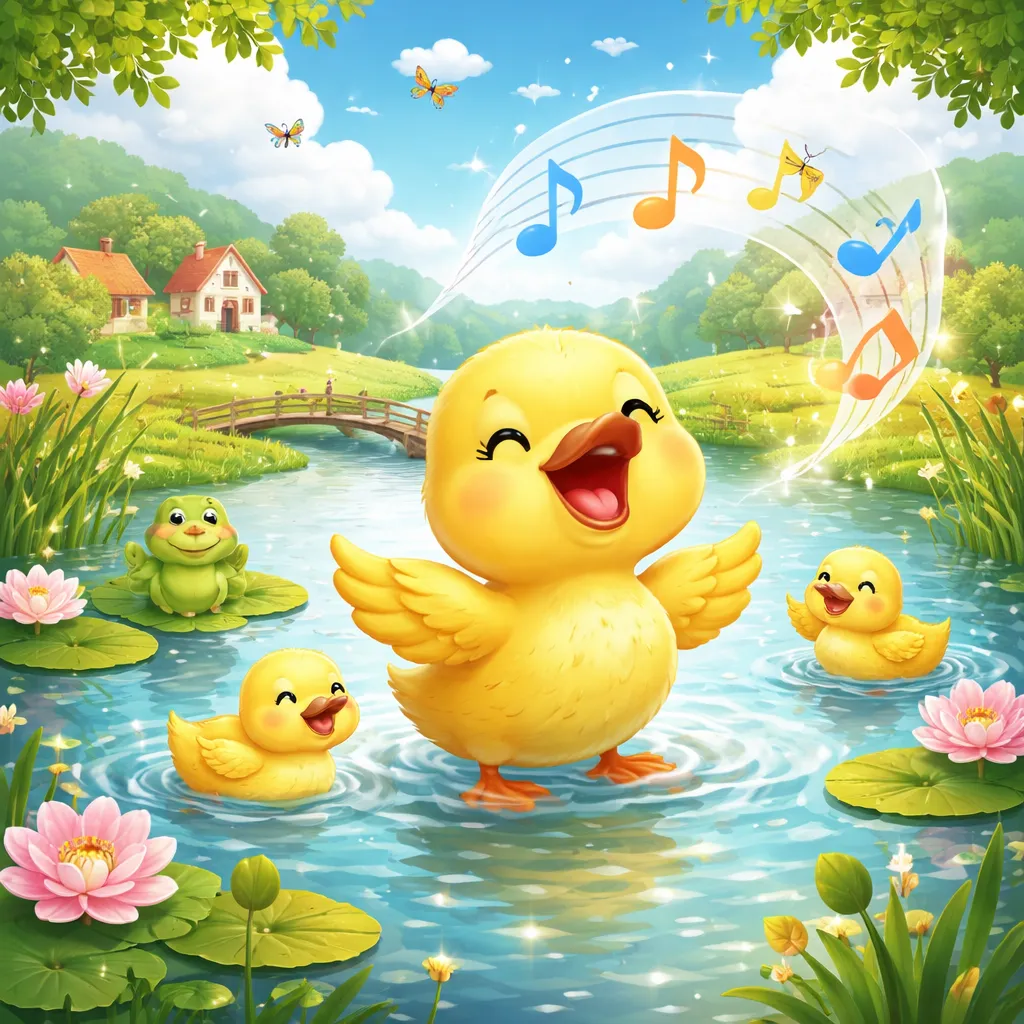

Have you ever watched a family of ducks glide across a pond? The babies follow their mom in a perfect line, sometimes dipping their heads underwater. They make a funny “quack” sound and waddle on land. In Korea, a country with many rivers and parks, there is a playful song about these friendly birds. Let’s waddle along with the Korean Song: The Little Duck (오리).
About the Song
Here is a verse from this cheerful song in Korean and English:
오리야 오리야 작은 오리
(Oriya oriya jageun ori)
Little duck, little duck, small duck
꽥꽥꽥 하고 울어요
(Kkwangkkwanggkwang hago ureoyo)
It cries quack quack quack
물에서 헤엄치며
(Mulueseo heeomchimyeo)
Swimming in the water
엄마 따라 다녀요
(Eomma ddara danyeoyo)
Following its mother
This song’s original Korean name is “오리” (Ori), which means “duck.” It is a very popular traditional Korean children’s song. The song is a happy snapshot of a duckling’s life. The music is often bouncy, light, and includes the fun sound “꽥꽥꽥” for a duck’s quack. The Korean Song: The Little Duck (오리) is a musical picture of family, fun in the water, and the special bond between a mother duck and her ducklings.
What the Song is About
The song is a simple, happy story about a baby duck. First, we call to it: “Little duck, little duck, small duck.” We hear its voice: “It cries quack quack quack.” Then, we see what it does all day: “Swimming in the water.” Ducks are great swimmers! Most importantly, we see it is not alone: “Following its mother.” The little duck stays close to its mom, learning how to find food and stay safe. The whole song is about the joy of being in the water, the sound of a duck, and the security of following a loving parent.
Who Made It & Its Story
This song is a traditional Korean folk song, shared by many generations of children. The original creator is unknown, as it comes from people watching ducks in parks, rivers, and rice fields. Ducks are common in Korea, and they are often seen as cute and funny animals. The Korean Song: The Little Duck (오리) is loved for three quacking reasons. First, it is about a very familiar and friendly animal that children can easily see and imitate. Second, it teaches about family bonds and following guidance in a gentle way. Third, the song is very catchy and fun to act out, with easy sounds and motions that kids love.
When to Sing It
You can sing this song during bath time, pretending your hands are little ducks swimming in the water. It’s perfect to chant while walking in a line with your family or friends, waddling and quacking like ducks. You could also sing it at a park or near a pond when you see real ducks.
The Korean Song: The Little Duck (오리) gives us a peek into a duck’s world. But to understand ducks better, we can learn more from the song. This song is a small pond of knowledge. It teaches us new words, how sounds become words, and a little about Korean nature. Let’s dip our toes in and learn.
What Children Can Learn
Vocabulary
This song helps us learn words for animals, water, and family.
Waddle: To walk with short steps, swaying from side to side, like a duck. Ducks waddle on land.
Pond: A small area of still water. Ducks often swim in a pond.
Waterfowl: Birds that live on or near water, like ducks and geese. A duck is a type of waterfowl.
Feathers: The soft, light covering that grows on a bird’s body. Duck feathers are waterproof.
Brood: A family of young birds hatched at one time. A mother duck leads her brood.
Adaptation: A special skill or feature that helps a living thing survive. Webbed feet are an adaptation for swimming.
Language Skills
This song is a perfect example of Onomatopoeia, which are words that sound like the noise they describe.
What Is It?: Think of onomatopoeia as “sound words.” The word sounds like the noise it names. “Quack” sounds like a duck. “Buzz” sounds like a bee.
Finding the Secret: Listen to the word. Does it sound like a real-life noise? If yes, it’s probably onomatopoeia.
Using It:
◦   In the song, “꽥꽥꽥” (kkwanggkwanggkwang) is the Korean onomatopoeia for a duck’s quack, just like “quack” in English.

◦   Other examples: “Splash” for water, “meow” for a cat, “boom” for thunder.
Sounds & Rhythm Fun
Listen to the waddling rhythm! The Korean Song: The Little Duck (오리) often has a bouncy, up-and-down beat. It might sound like the way a duck moves on land. The “꽥꽥꽥” part is fun to say and repeats like a duck’s call. This simple, playful rhythm makes the song easy to remember and turns singing into a game. You can use this same bouncy rhythm to make up a song about any animal that has a funny walk or sound.
Culture & Big Ideas
This song connects to the Korean love for nature and family. Ducks are often seen in Korean folk tales as clever characters. A time when families enjoy the outdoors is during Chuseok (Korean Thanksgiving), when people often visit their hometowns and spend time together. The Korean Song: The Little Duck (오리) teaches three simple ideas. First, The Importance of Family: The duckling is safe and happy because it follows and learns from its mother. Second, Joy in Simple Things: Swimming and playing in the water is a simple, pure joy for the duck. Third, Every Creature Has a Home: Ducks are perfectly at home in the water, reminding us that every animal has a place where it belongs and thrives.
Values & Imagination
Imagine you are the little duck. What does the cool water feel like on your feathers? How do you know which way your mom is going? This song teaches you to appreciate your family and to enjoy simple, fun activities. It encourages you to be curious about how animals live. A simple idea: The next time you are with your family, play “follow the leader” like the ducks. Take turns being the mother duck. See how it feels to lead and to follow.
Your Core Takeaways
The Korean Song: The Little Duck (오리) is a joyful, waddling lesson in family, fun, and animal sounds. You learned words like “waddle,” “pond,” and “waterfowl.” You discovered what onomatopoeia is and how words can imitate sounds like “quack.” You moved to the song’s bouncy, playful rhythm. You also connected the duck to Korean family time during holidays. Most importantly, the song teaches that family guides and protects us, that playing in nature is fun, and that we can learn a lot by watching and listening to the animals around us.
Your Practice Missions
- Be a “Sound Detective.” Go outside or listen from a window. Close your eyes and try to hear three different sounds. Can you make an onomatopoeic word for each one? For example, a car might go “vroom,” leaves might go “rustle.” Share your sound words with someone.
- Create a “Duck Pond” Diorama. Find a small box or tray. Make a pond with blue paper or cloth. Use toy ducks or draw and cut out a mother duck and a few ducklings. Arrange them so the ducklings are following the mother. You can even add other pond things like paper lilies or stones. Tell a short story about your duck family’s day. This brings the song to life.