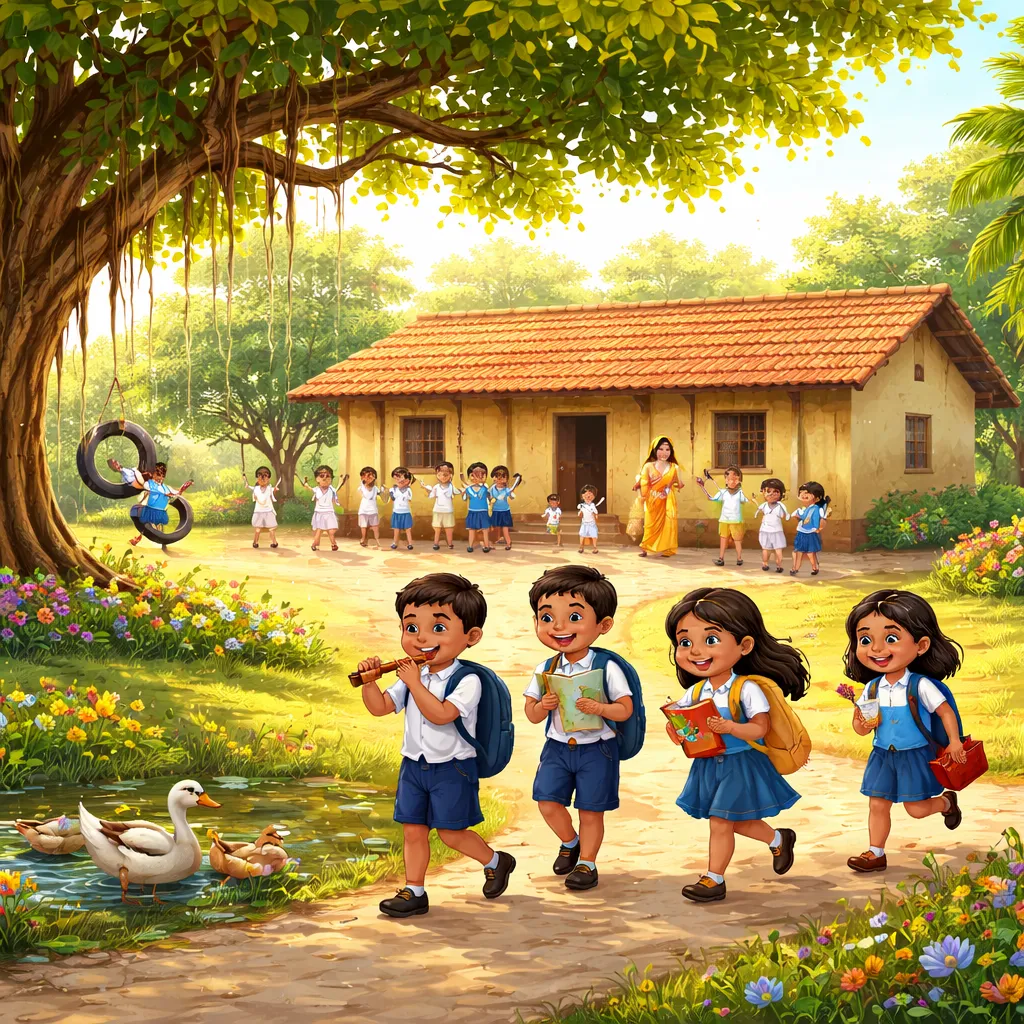

Do you have a place you go to every morning, where you meet your friends, learn new things, and share stories? A place that feels like a second home, full of chatter, laughter, and discovery? For many children, that place is school. In Bangladesh and West Bengal, a region that deeply values knowledge, there is a happy song that celebrates this wonderful place. Let’s walk through the gates of the Bengali Song: The Little School (আমার স্কুল).
About the Song
Here is a cheerful verse from this beloved children’s song in Bengali and English:
আমার স্কুল, আমার স্কুল, ছোট্ট স্কুলটি
(Amar skul, amar skul, chhoto skulti)
My school, my school, the little school
সেখানে যাই রোজ সকালে
(Sekhane jai roz sokale)
I go there every morning
শিখি অক্ষর, শিখি গান
(Shikhi okkhor, shikhi gaan)
I learn letters, I learn songs
সবাই মিলে করি খেলা
(Shobai mile kori khela)
Everyone together, we play
This song’s original name is “আমার স্কুল” (Amar Skul), which means “My School” in Bengali. It is a popular and heartwarming Bengali children’s song. The song is a proud and joyful declaration from a child about their school. The music is often upbeat, clear, and full of the positive energy of a school day. The Bengali Song: The Little School (আমার স্কুল) is a musical thank-you note, celebrating the daily routine of learning, friendship, and fun that happens within the school’s walls.
What the Song is About
The song is a child’s happy report about their day. First, they claim their school with pride, saying “my school” twice. They call it “the little school,” which feels cozy and personal. They describe their reliable routine: “I go there every morning.” The song then tells us what happens inside. The child learns useful things: “I learn letters, I learn songs.” We can picture them practicing the alphabet and singing with their class. But school isn’t just about sitting and listening. The best part is community: “Everyone together, we play.” The song shows that school is a balanced place for growing your mind and your heart, all while being with friends.
Who Made It & Its Story
This song is a staple of modern Bengali children’s culture, commonly sung in schools and heard on children’s programming. While the specific creators aren’t widely listed, the song reflects a core value in Bengali society: the importance of education, or শিক্ষা (shikkha). From poems by Nobel laureate Rabindranath Tagore to modern initiatives, education is seen as a bright light for the future. The Bengali Song: The Little School (আমার স্কুল) makes this value relatable and exciting for young children. It is cherished for three important reasons. First, it builds a positive association with school, turning the daily routine into something to sing about. Second, it highlights both academic (letters) and creative (songs, play) learning, showing a well-rounded view of education. Third, its melody is simple, repetitive, and perfect for group singing, fostering a sense of unity and shared experience among students.
When to Sing It
You can sing this song on your way to school in the morning, getting excited for the day ahead. It’s perfect to chant with your classmates during a break or at a school assembly. You could also sing it at home while pretending to teach your toys, setting up your own “little school.”
The Bengali Song: The Little School (আমার স্কুল) shows us the joy of a learning community. But school itself is all about learning! This song is our friendly textbook. It teaches us words for education and routine, shows us how to talk about daily habits, and shares the cultural importance of learning. Let’s open this book and see what’s inside.
What Children Can Learn
Vocabulary
This song helps us learn words for education, routine, and community.
Routine: A regular way of doing things in a particular order. Going to school every morning is a routine.
Knowledge: Information, understanding, and skills that you gain through education. We go to school to gain knowledge.
Literacy: The ability to read and write. Learning letters is the first step to literacy.
Community: A group of people living in the same place or having a particular characteristic in common. A school is a community of learners.
Education: The process of receiving or giving systematic instruction. Education happens at school and at home.
Collaboration: The action of working with someone to produce something. Playing and learning together is a form of collaboration.
Language Skills
This song is a clear example of using the Simple Present Tense for Daily Routines. We use this tense to talk about habits and things we do regularly.
What Is It?: Think of the Simple Present Tense as the “Usually Does” tense. It’s for routines, habits, and general facts. The child’s school day is a perfect routine.
Finding the Secret: Look for verbs (action words) that describe regular activities. They often don’t have “-ing” or “will” in front. Ask: “Does this action happen regularly or as a habit?”
Using It:
◦   For routines: [I/You/We/They] + [base verb]. or [He/She/It] + [verb with ‘s’].

◦   Examples: “I go to school. She learns songs. We play together.”

◦   In the song: “I go there every morning. I learn letters. We play.” These are the child’s daily habits.
Sounds & Rhythm Fun
Listen to the orderly rhythm. The Bengali Song: The Little School (আমার স্কুল) often has a steady, marching, and clear beat. It sounds like the predictable rhythm of a school day—organized and reliable. The melody is usually simple and easy for a group to sing in unison, just like a class reciting something together. This steady, communal rhythm makes the lyrics about daily routines easy to remember and helps create a feeling of togetherness. You can use this same steady, group-friendly rhythm to make up a song about any daily routine, like your bedtime or mealtime habits.
Culture & Big Ideas
This song connects to Bengal’s profound respect for education. A key figure is Ishwar Chandra Vidyasagar, a 19th-century Bengali reformer who worked tirelessly to make modern education accessible to all. A special day is জন্মদিন (Janmadhin) or birthday of such great teachers, celebrated in schools. The Bengali Song: The Little School (আমার স্কুল) teaches three foundational ideas. First, School as a Shared Home: It’s a communal space (“my school”) that belongs to every child, providing safety, structure, and friendship. Second, The Balance of Learning: True education includes the mind (letters), the heart (songs), and the body (play). Third, The Joy of Routine: Having a predictable, positive routine, like going to school every morning, provides security and a foundation for happy growth.
Values & Imagination
Imagine you are the singer of this song. What is your favorite corner of your school? The library? The art room? The playground? Who is the friend you play with? This song teaches you to appreciate the structure and opportunities school gives you. It shows that learning is an active, shared adventure. A simple idea: Create a “Thank You” drawing for your school. It could be a picture of the building, your teacher, or you playing with friends. Share it with your family and tell them one thing you “learn” and one thing you “play” at your school, just like in the song.
Your Core Takeaways
The Bengali Song: The Little School (আমার স্কুল) is a joyful anthem for education, community, and daily growth. You learned school words like “routine,” “knowledge,” and “community.” You discovered how to use the Simple Present Tense to talk about your daily habits and routines. You marched to the song’s steady, communal rhythm. You also connected the song to Bengal’s cultural value of education and reformers like Vidyasagar. Most importantly, the song teaches that school is a special place to grow, that learning and playing are both important, and that sharing each day with friends makes everything more meaningful.
Your Practice Missions
- Be a “Routine Reporter.” Tell a family member about your school day using the Simple Present Tense. Say three things you usually do: “I greet my teacher. I read books. I eat lunch with my friends.” You are describing your own “little school” story.
- Design a “My School Community” Poster. Draw a large picture of your school in the center. Around it, draw or write the different people who make it special (teachers, friends, the principal, the helper). Draw bubbles showing what you do: one for learning (letters/numbers), one for creating (song/art), and one for playing. Present your poster. This shows how your school is a whole community for growing.