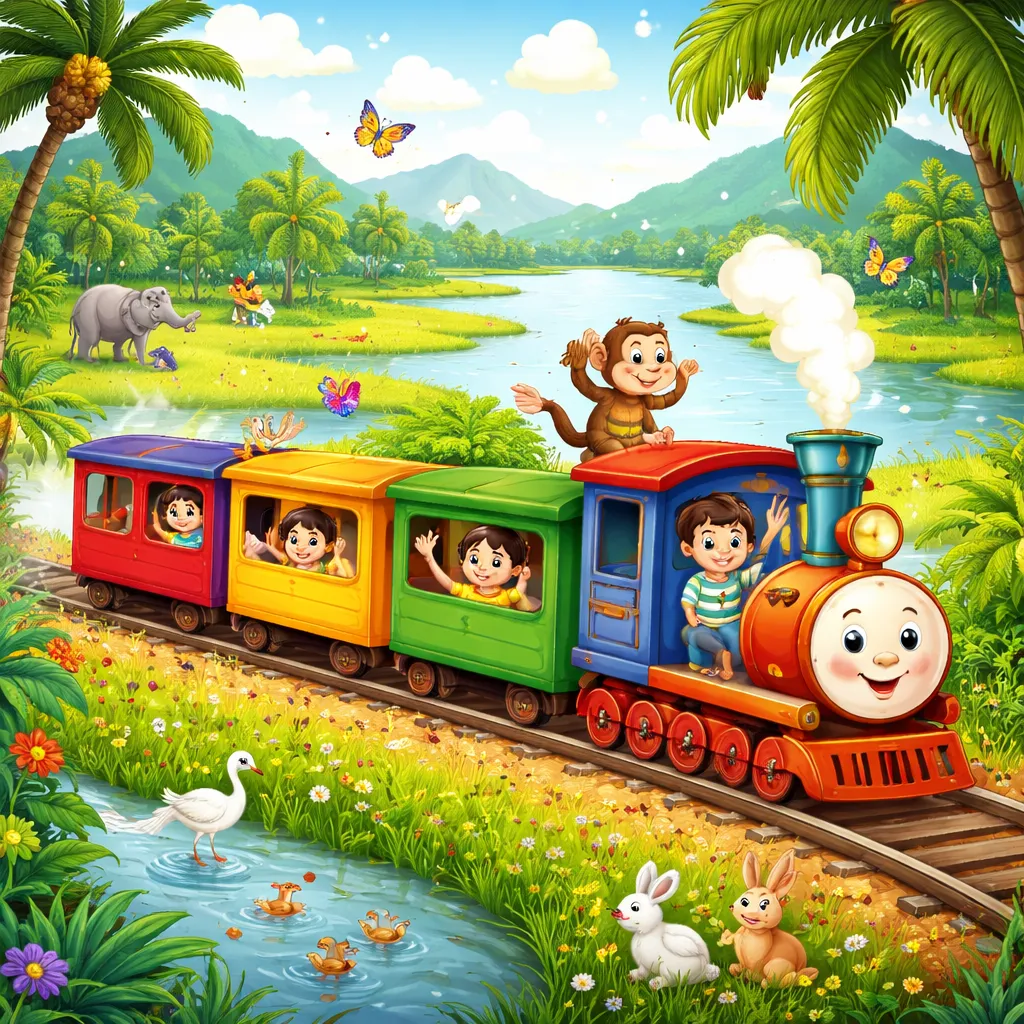

Have you ever watched a train chug along the tracks, getting smaller and smaller until it disappears? Have you wondered about all the places it goes and the people inside? Trains are like long, metal snakes that connect towns and cities, carrying stories in every carriage. In Bangladesh and West Bengal, a region famous for its rivers and green fields, there is a happy song that sounds just like a train ride. Let’s climb aboard the Bengali Song: The Little Train (গাড়ি গাড়ি).
About the Song Here is a joyful verse from this classic children’s song in Bengali and English: গাড়ি গাড়ি গাড়ি, ছোট্ট গাড়ি (Gaari gaari gaari, chhoto gaari) Train, train, train, little train কোথায় যাও, বলো না (Kothay jao, bolona) Where are you going, tell me পাহাড় ডাঙা পার হয়ে (Pahar danga par hoye) Crossing hills and plains ছুটে চলেছে রে (Chhute choloche re) It is running swiftly
This song’s original name is “গাড়ি গাড়ি” (Gaari Gaari), which means “Train, Train” in Bengali. It is a beloved traditional children’s song from the Bengal region, which includes Bangladesh and the Indian state of West Bengal. The song talks to a little train, asking it a friendly question. The music mimics the sound of a train starting slowly and then picking up speed, with a rhythmic “chug-a-chug” feeling. The Bengali Song: The Little Train (গাড়ি গাড়ি) is a musical journey, full of curiosity and the excitement of travel.
What the Song is About The song is a cheerful conversation with a train. First, we call out to it three times, like waving hello as it approaches: “Train, train, train, little train!” We are curious about its journey, so we ask, “Where are you going, tell me?” The song then paints a picture of the train’s adventurous path. It is “crossing hills and plains,” meaning it chugs over tall mountains and across wide, flat fields. The train doesn’t stop; it is “running swiftly,” full of purpose and energy. The whole song feels like standing by the tracks, watching the train speed by and imagining all the faraway places it will visit by the end of the day.
Who Made It & Its Story This song is a traditional Bengali folk song for children, passed down through generations. The original creator is unknown, as it comes from the shared culture of Bengali childhood. The Bengal region has a vast network of rivers, and trains are a vital way for people to travel across the land. This song captures the sense of wonder and movement that trains bring to daily life. The Bengali Song: The Little Train (গাড়ি গাড়ি) is cherished for three rhythmic reasons. First, its simple, repetitive lyrics and catchy tune make it very easy for young children to learn and sing. Second, it encourages imagination about travel, geography, and the wider world. Third, the song’s rhythm perfectly imitates the sound and motion of a train, making it incredibly fun to act out, building a direct connection between music and movement.
When to Sing It You can sing this song while building a long train with chairs or cushions, pretending to be the engine and carriages chugging around the room. It’s perfect to chant during a family car trip, watching the scenery go by and imagining you are on a train crossing “hills and plains.” You could also sing it with friends in a line, holding each other’s shoulders and moving together like a train, taking turns being the engine.
The Bengali Song: The Little Train (গাড়ি গাড়ি) takes us on a ride through sound and words. But every good journey teaches us something new. This song is our ticket to learning. It introduces us to travel words, shows us how to ask questions politely, and shares a piece of Bengali culture. Let’s get our tickets ready and see what we can discover on this educational trip.
What Children Can Learn
Vocabulary This song helps us learn words about travel, geography, and movement. Journey: A trip from one place to another. The train is on a long journey.
Plain: A large area of flat land with few trees. The train speeds across the plain.
Swiftly: Quickly and with speed. The train moves swiftly down the track.
Destination: The place where someone or something is going. The train’s destination is a mystery.
Connect: To bring together or link two things. Trains connect different towns and people.
Transport: To carry people or goods from one place to another. A train is a form of transport.
Language Skills This song is a great example of asking Polite Questions using Interrogatives. We use question words like “where,” “what,” and “how” to ask for information in a friendly way. What Is It?: Think of interrogatives as your “curiosity words.” They help you ask for specific information. “Where” asks about a place. “What” asks about a thing. “How” asks about manner.
Finding the Secret: Look for sentences that begin with a question word (where, what, why, how) and end with a question mark. The word order often changes. Ask: “Is this sentence trying to find out a piece of information?”
Using It:
◦   Formula for “where”: Where + [auxiliary verb] + [subject] + [main verb]?

◦   Examples: “Where are you going?” (from the song). “Where is the station?” “Where do you live?”

◦   The song’s question is polite and curious: “Where are you going, tell me?” It’s asking the train to share its story.
Sounds & Rhythm Fun All aboard for the train rhythm! The Bengali Song: The Little Train (গাড়ি গাড়ি) has a wonderful, steady, chugging beat. It often starts slower, like a train leaving the station (“Gaari… gaari… gaari…”), and then speeds up. The repetition of words mimics the sound of wheels on tracks. This strong, rhythmic pattern is easy to clap or stomp to, and it helps you remember the lyrics and feel the motion of the train. You can use this same building, chugging rhythm to make up a song about any vehicle that starts slow and goes fast, like a bicycle, a boat, or a rocket.
Culture & Big Ideas This song connects to the importance of railways in Bengal’s history and daily life. A major celebration is Pohela Boishakh (Bengali New Year), where people travel by trains, buses, and boats to return to their village homes to celebrate with family. The train symbolizes reunion and connection. The Bengali Song: The Little Train (গাড়ি গাড়ি) teaches three big ideas. First, The World is Connected: Trains show us that places are linked, and we can travel to see new things and people. Second, The Joy of the Journey: Sometimes, the trip itself—watching the world go by—is just as exciting as arriving. Third, Curiosity About Others: Asking “where are you going?” is a friendly way to show interest in the world around us, whether it’s a train or a person.
Values & Imagination Imagine you are on the little train. What do you see from your window? Rice fields? Rivers? Mountains? Who are the other passengers, and where are they going? This song teaches you to be curious about the world and the people in it. It shows that travel is an adventure that broadens our minds. A simple idea: Draw a long, winding train track on a big piece of paper. At one end, draw your home. At the other, draw a place you dream of visiting. In between, draw all the things your train might see on its way. This is your imaginary journey map.
Your Core Takeaways The Bengali Song: The Little Train (গাড়ি গাড়ি) is a rhythmic celebration of journey, curiosity, and connection. You learned travel words like “journey,” “plain,” and “destination.” You discovered how to ask polite questions using “where” and other interrogatives. You moved to the song’s steady, chugging rhythm. You also connected the train to Bengali culture and the importance of travel during festivals like Pohela Boishakh. Most importantly, the song teaches that the world is full of interesting places to explore, that asking questions is a wonderful habit, and that the journey—with all its sights and sounds—is a gift.
Your Practice Missions
- Be a “Where?” Detective. With a family member, look at a map (a world map, a country map, or even a map of your town). Take turns pointing to a place and asking, “Where is this?” The other person answers. Then, ask a bigger question: “Where would you like to go, and why?” This practices using the question word “where.”
- Build a “Journey Train.” Line up several shoes, books, or toys to make a long train on the floor. Each item is a carriage. Decide where your train is going. As you move the “engine” forward, say what it is passing (e.g., “Now we are crossing the blue rug river! Now we are going through the pillow mountain!”). Say the train’s destination at the end. You are the conductor of your imagination.