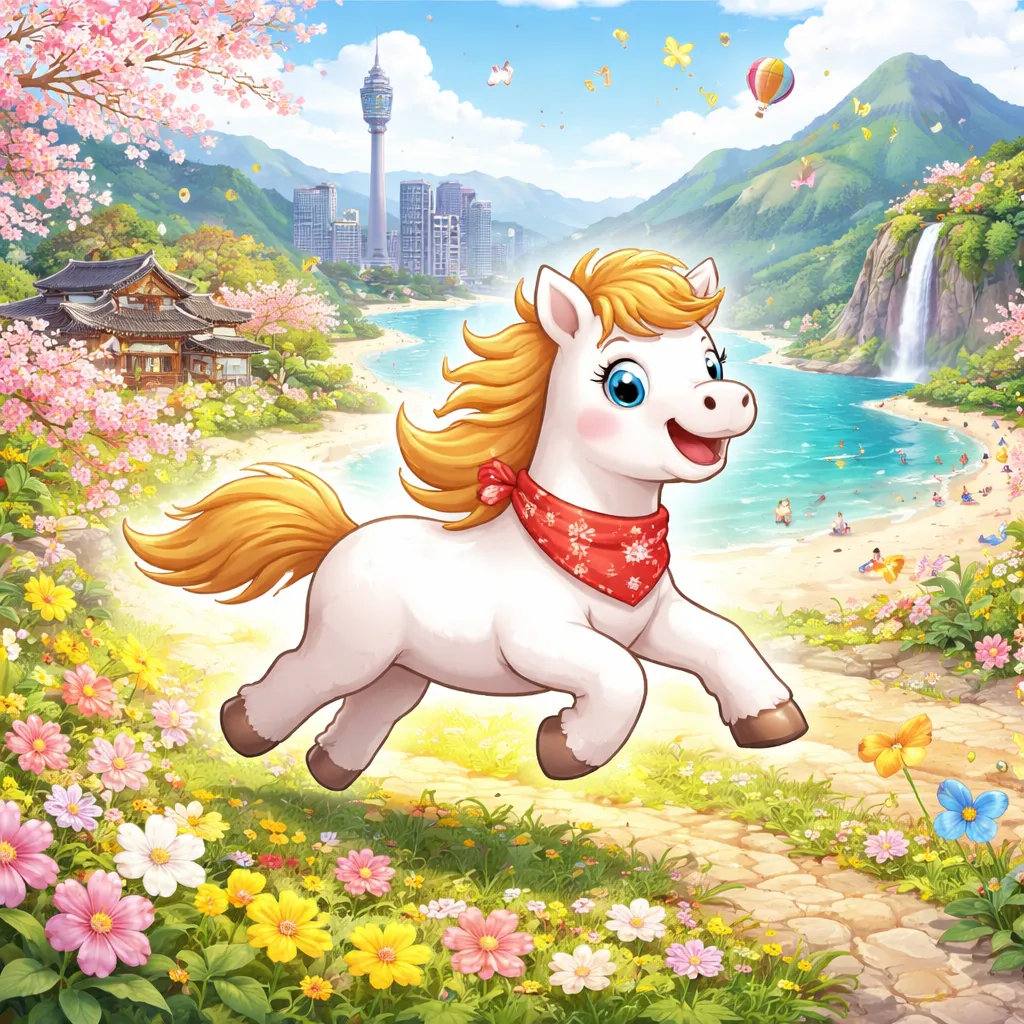

Do you ever feel like running as fast as you can, with your heart pounding and the wind rushing past your ears? Have you imagined having a loyal friend who could carry you on an adventure, strong and fast? In Korea, a land of mountains and open fields, there is a song that captures that feeling of pure freedom and friendship. Let’s race with the wind to the Korean Song: The Little Horse (말).
About the Song
Here is a joyful verse from this beloved song in Korean and English:
말아 말아 우리 말아
(Mara mara uri mara)
Little horse, little horse, our horse
푸른 들판 위를 달려
(Pureun deulpan wireul dallyeo)
Run across the green field
바람보다 빠르게
(Baramboda ppareuge)
Faster than the wind
나와 함께 자유를 찾아
(Nawa hamkke jayureul chaja)
Find freedom with me
This song’s original Korean name is “말” (Mal), which means “horse.” It is a cherished traditional Korean children’s song. The song is an exuberant call to a horse, inviting it to share in a race for freedom. The music is fast, uplifting, and full of unbounded energy. The Korean Song: The Little Horse (말) is a musical sprint, celebrating the thrill of speed, the bond between rider and steed, and the boundless feeling of being free in a wide, open space.
What the Song is About
The song is a burst of excitement and companionship. First, we call the horse “our horse,” showing a sense of shared ownership and friendship. We picture the setting: “Run across the green field.” We imagine a vast, sunny meadow. We challenge the horse to incredible speed: “Faster than the wind.” Finally, we share the goal: “Find freedom with me.” The run isn’t just for exercise; it’s a shared quest for the ultimate feeling of liberty. The whole song is about the joy of moving without limits, the trust between friends, and the shared pursuit of a beautiful, free feeling.
Who Made It & Its Story
This song is a traditional Korean folk song, passed down through generations. The original creator is unknown, as it springs from the universal human love for horses and the Korean appreciation for the beauty of its landscapes. Horses have historical significance in Korea, used in farming, travel, and by warriors. A special place is Jeju Island, known for its unique, small Jeju horses. The Korean Song: The Little Horse (말) captures the spirit of these hardy animals. It is beloved for three spirited reasons. First, it perfectly expresses the exhilarating feeling of speed and freedom that resonates with every child’s desire to run and play. Second, it frames the horse as a loyal companion on an adventure, teaching about partnership. Third, its melody is energetic and galloping, impossible to sing while sitting still, making it a perfect song for active play and imagination.
When to Sing It
You can sing this song at the top of your lungs while running full speed across a playground or a field. It’s perfect to chant on a swing, pumping your legs to go “faster than the wind.” You could also sing it with a friend, holding hands and running together, pretending to be a horse and rider.
The Korean Song: The Little Horse (말) fills us with the spirit of adventure. But every great adventurer needs a good guide. This song is our guide to learning. It teaches us new words about motion and friendship, shows us how to make comparisons, and shares a bit of Korean culture. Let’s race into this lesson.
What Children Can Learn
Vocabulary
This song helps us learn words for speed, nature, and feelings.
Gallop: The fastest gait of a horse, where all four hooves leave the ground. The horse gallops across the field.
Mane: The long hair growing from the top of a horse’s neck. The wind blows the horse’s mane.
Unbridled: Not controlled or limited; free. The song is about unbridled joy and freedom.
Horizon: The line where the earth seems to meet the sky. The horse runs toward the horizon.
Liberty: The state of being free. The song is a search for liberty.
Steed: A spirited horse, especially for riding. The little horse is a noble steed.
Language Skills
This song uses a Comparative with “Faster Than” to show a higher degree of a quality. We use “-er than” (or “more … than”) to compare two things.
What Is It?: Think of comparatives as your “measurement” words. They compare the amount of a quality between two things. The horse is faster than the wind.
Finding the Secret: Look for adjectives with “-er” (like faster, taller, stronger) followed by the word “than.” Ask: “Is this sentence comparing two things and showing one has more of a quality?”
Using It:
◦   Formula: [Thing 1] + is + [adjective-er] + than + [Thing 2].

◦   Examples: “My dad is taller than me.” “Summer is hotter than spring.”

◦   In the song: “Faster than the wind.” This hyperbole shows the horse’s incredible, almost magical speed.
Sounds & Rhythm Fun
Listen to the rushing, galloping rhythm! The Korean Song: The Little Horse (말) has a driving, urgent, and fast-paced beat. It sounds like hooves pounding the earth in a steady rhythm. The melody often climbs and sweeps, mimicking the motion of running. This exhilarating rhythm makes you want to move and makes the lyrics about speed and freedom unforgettable. You can use this same rushing, rhythmic beat to make up a song about anything fast—a racing car, a flowing river, or even your own heartbeat when you’re excited.
Culture & Big Ideas
This song connects to the imagery of freedom and the expansive Korean landscape. A traditional activity is flying a kite, or 연날리기 (yeon nalligi), which captures the feeling of something dancing freely in the wind, much like the running horse. The Korean Song: The Little Horse (말) teaches three powerful ideas. First, Freedom as a Shared Journey: True freedom feels even better when you experience it with a trusted friend. Second, Harmony with Nature: The horse isn’t fighting the wind; it’s trying to become one with it, showing a desire to move in harmony with natural forces. Third, The Power of Metaphor: Comparing the horse’s speed to the wind uses figurative language to paint a much more exciting picture than just saying “very fast.”
Values & Imagination
Imagine you are the little horse. What does the grass feel like under your hooves? Can you really outrun the wind? Where would you go to find true freedom? This song teaches you to value loyalty and shared joy. It encourages you to appreciate the feeling of your own body in motion and to dream big, boundless dreams. A simple idea: The next time you run, try to notice how the air feels against your skin. Are you “faster than the wind”? Close your eyes and imagine your loyal horse running beside you.
Your Core Takeaways
The Korean Song: The Little Horse (말) is a thrilling, galloping lesson in freedom, friendship, and the joy of motion. You learned words like “gallop,” “unbridled,” and “horizon.” You discovered how to use comparatives like “faster than” to make exciting descriptions. You moved to the song’s rushing, energetic rhythm. You also connected the horse to Korean traditions like kite flying. Most importantly, the song teaches that the best adventures are shared, that true freedom is a feeling to be cherished, and that sometimes, running just for the joy of it is the most important journey of all.
Your Practice Missions
- Be a “Faster Than” Challenger. Look at two objects (e.g., a car and a bicycle, a rabbit and a turtle). Make a comparative sentence using “faster than” or another “-er than” phrase. Example: “A car is faster than a bike. An eagle is higher than a tree.” This practices making comparisons.
- Map a “Freedom Journey.” Draw a simple map of your neighborhood or a park. Choose a starting point and an ending point that feels like “freedom” to you (a hilltop, a big tree, a playground). Draw a path between them. Walk or run that path with a friend or family member. As you go, talk about what “freedom” means to you. You are acting out the song’s quest.