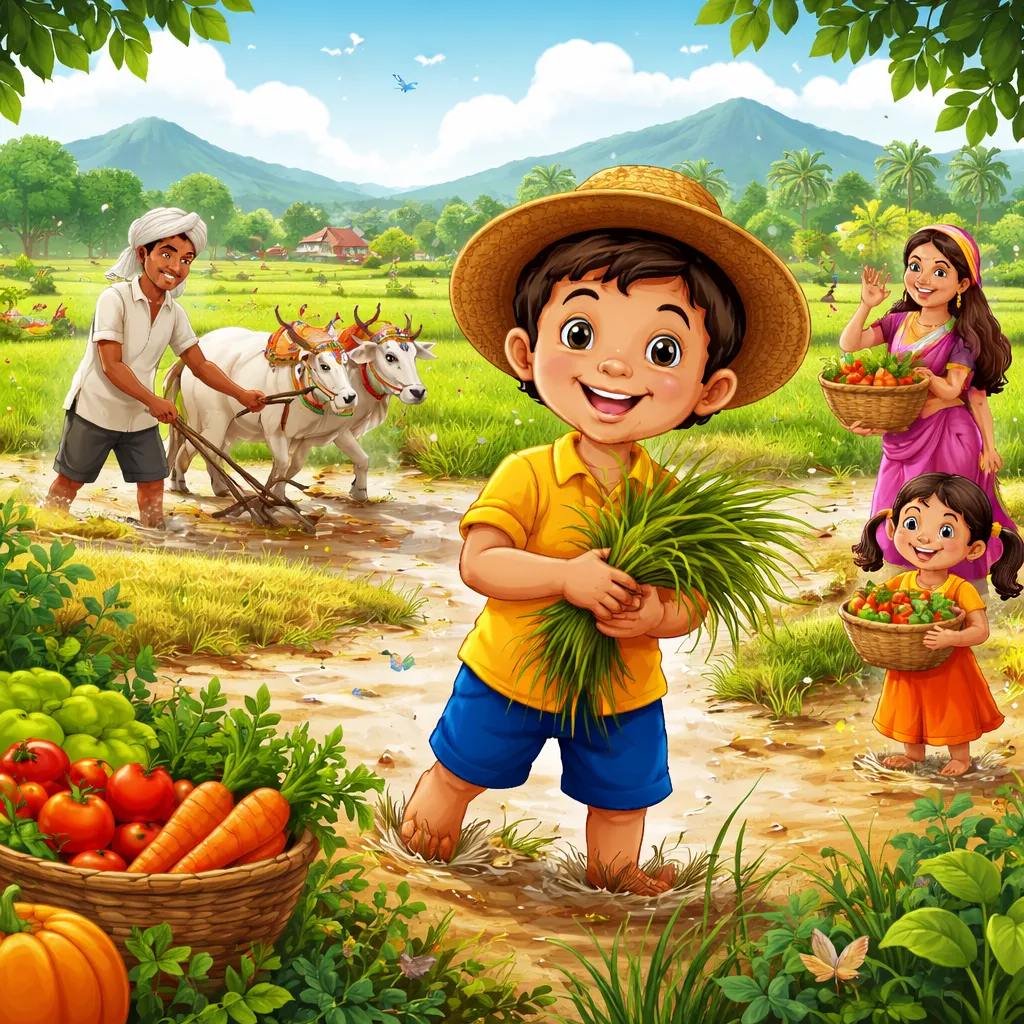

Have you ever helped in a garden, pushing a tiny seed into the soft, dark soil? Have you watched a plant grow taller each day, waiting for the first flower or the first ripe tomato? The food on our plates starts with someone’s care, long before it reaches the kitchen. In India, a country where farming is a way of life for millions, there’s a song that celebrates this essential work. Let’s dig into the earth with the Hindi Song: The Little Farmer (किसान).
About the Song Here is a verse from this grounded and joyful song in Hindi and English: मैं एक छोटा किसान, मेरे खेत हरे-भरे (Main ek chhota kisaan, mere khet hare-bhare) I am a little farmer, my fields are green and lush बीज बोऊंगा ज़मीन में, पानी दूंगा धीरे (Beej bounga zameen mein, paani doonga dheere) I will sow seeds in the earth, I will water them gently मेहनत करूंगा रोज़, देखूंगा बढ़ते पौधे (Mehnat karunga roz, dekhoonga badhte paudhe) I will work hard every day, I will watch the plants grow फसल आएगी खुशियों की, यही है मेरा गान (Fasal aayegi khushiyon ki, yahi hai mera gaan) The harvest of happiness will come, this is my song
This song’s original name uses the Hindi word “किसान” (Kisaan), which means “farmer.” It is a popular and beloved Indian children’s song. The song is sung from the proud perspective of a child who imagines tending their own field. The music is often steady, cheerful, and connected to the rhythms of nature. The Hindi Song: The Little Farmer (किसान) is a musical celebration of patience, hard work, and the simple, profound joy of helping something grow.
What the Song is About The song is a patient promise to the land. First, the little farmer looks over their field, which is already green and full of life. They know the work begins with a small act: “I will sow seeds in the earth, I will water them gently.” We can picture them carefully dropping seeds into neat rows and sprinkling water so as not to disturb the soil. The farmer’s job is daily: “I will work hard every day, I will watch the plants grow.” This means pulling weeds, keeping pests away, and simply observing. The song doesn’t rush. It understands that growth takes time. The reward is the joyful harvest, but the true “song” is the entire process—the daily care, the waiting, and the final gathering of the “harvest of happiness” that feeds a family.
Who Made It & Its Story This song comes from the heart of Indian children’s culture, where the values of rural life and hard work are often celebrated. While specific creators aren’t widely listed, the song reflects a fundamental truth of India: it is a country with a deep agricultural heritage. For many children, a grandparent or relative might be a farmer. The Hindi Song: The Little Farmer (किसान) makes this vital profession relatable and honorable. It is popular for three important reasons. First, it teaches children directly and respectfully where their food comes from. Second, it highlights positive values like daily effort, patience, and caring for the environment. Third, its melody is often simple, repetitive, and easy to sing while pretending to work, making the lesson active and memorable.
When to Sing It You can sing this song while helping to water plants in your home or garden, making each watering can a promise to the “little seeds.” It’s perfect to hum while helping an adult in the kitchen washing vegetables, thinking about the farmer who grew them. You could also sing it on a walk in the park or countryside, noticing all the different plants and trees growing around you.
The Hindi Song: The Little Farmer (किसान) plants a seed of understanding about where our food comes from. But to help that seed grow, it needs the right conditions. This song provides the sunlight and water of learning. It teaches us the language of growth, how to describe sequences of events, and the deep cultural connection between people and the land. Let’s tend to this garden of knowledge.
What Children Can Learn
Vocabulary This song helps us grow our vocabulary with words for farming, growth, and care. Cultivate: To prepare and use land for growing crops. A farmer cultivates the soil before planting.
Irrigate: To supply water to land or crops to help growth. Channels or hoses are used to irrigate fields.
Seedling: A very young plant that has grown from a seed. The farmer watches the seedlings grow.
Nourish: To provide food or substances needed for growth, health, and strength. Good soil and water nourish plants.
Yield: The amount of crop produced. A good harvest has a high yield.
Grateful: Feeling or showing thanks. We should be grateful to farmers for our food.
Language Skills This song is a perfect field for learning about Sequencing Words to show the order of events. We use these words to explain steps in a process, like the steps of farming. What Are They?: Think of sequencing words as your “what happens first, next, and last” guides. They help you tell a story or explain a process in the right order.
Finding the Secret: Look for words that signal order. Common ones are: First, Then, Next, After that, Finally. They often come at the beginning of a sentence or clause.
Using Them:
◦   The farmer’s process is a perfect sequence: “First, I sow the seeds. Then, I water them gently. Next, I work hard every day. Finally, the harvest of happiness comes.”

◦   Use the pattern: [Sequencing Word] + [subject] + [action]. “First, I wash my hands. Then, I set the table.”
Sounds & Rhythm Fun Listen to the steady, earthy rhythm. The Hindi Song: The Little Farmer (किसान) often has a repetitive, work-song-like beat. It might sound like the rhythmic motion of digging or sowing. The melody is usually simple and easy to repeat, like a chant you might sing to make the work feel lighter. This steady, repetitive rhythm mimics the patient, daily routine of farm work and helps the steps of the farming process stick in your mind in the correct order. You can use this same chant-like rhythm to make up a song about any step-by-step process, like cleaning your room or getting ready for bed.
Culture & Big Ideas This song is deeply connected to India’s agricultural soul. A major festival that celebrates this is Pongal (in South India) or Makar Sankranti/Lohri (in other regions), a multi-day harvest festival. Families give thanks to the sun, the rain, and farm animals for a successful harvest, and a special dish of freshly harvested rice is prepared. The Hindi Song: The Little Farmer (किसान) teaches three big ideas. First, Patience and Process: Everything valuable—like food—takes time and follows a natural process that cannot be rushed. Second, The Dignity of Labor: Hard work, especially work that feeds and sustains others, is deeply honorable and worthy of respect. Third, Interdependence with Nature: Farmers work with nature, understanding sun, soil, and water. We depend on farmers, and farmers depend on the earth.
Values & Imagination Imagine you are the little farmer. Feel the soil in your hands. Watch the first green shoots break through. What does it feel like to see the first ripe fruit? This song teaches you to appreciate the effort behind your food and to never waste it. It shows the value of consistency—showing up every day to care for something. A simple idea: The next time you eat a meal, pause for a second. Think of the farmer who grew the grains, the vegetables, or the fruits. You can even say a quiet “thank you” in your mind. This is a way to practice gratitude.
Your Core Takeaways The Hindi Song: The Little Farmer (किसान) is a heartfelt tribute to patience, hard work, and our connection to the earth. You learned farming words like “cultivate,” “seedling,” and “yield.” You discovered how to use sequencing words like “First,” “Then,” and “Finally” to explain steps in order. You moved to the song’s steady, work-song rhythm. You also connected the song to India’s agricultural celebrations like Pongal. Most importantly, the song teaches that good things take time and care, that growing food is important and respectful work, and that we should always be grateful for the harvest and the hands that make it possible.
Your Practice Missions
- Be a “Sequencing” Chef’s Helper. Help a grown-up prepare a simple part of a meal, like a salad. As you do it, say the steps in order using sequencing words. “First, I wash the lettuce. Then, I tear it into pieces. Next, I add the tomatoes. Finally, I put on the dressing.” You are explaining your “cooking harvest” process.
- Grow a “Patience Jar.” Plant a bean or lentil seed in a small jar with damp cotton wool or soil. Place it by a window. For one week, be the “little farmer.” Check it daily, keep it moist, and watch. Draw or write one thing you notice each day. On the last day, tell someone the sequence of what you saw using “First, Then, Next.” This is your own tiny harvest of learning.