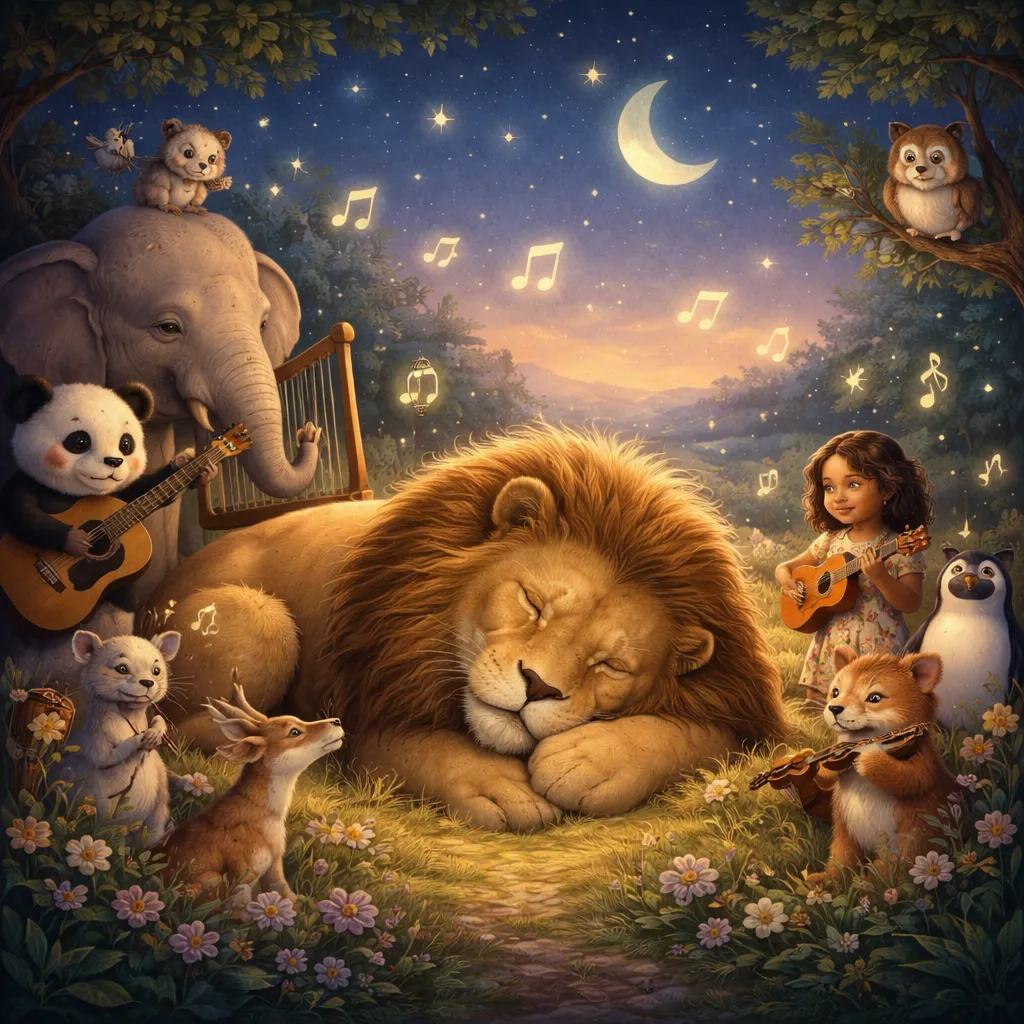

Have you ever felt a little scared of a loud noise in the dark? Maybe a branch tapping the window or the wind howling. Now, imagine the loudest, mightiest roar of all—a lion’s roar—is suddenly quiet. The jungle becomes peaceful, and everyone can rest. There is a magical, world-famous song about that exact peaceful moment. Let’s learn about the lullaby for the jungle, “The Lion Sleeps Tonight,” also known by its Zulu chorus, “Wimoweh.”
About the Song
Let’s read the gentle, repeating words of this famous song.
In the jungle, the mighty jungle, the lion sleeps tonight. In the jungle, the quiet jungle, the lion sleeps tonight.
Near the village, the peaceful village, the lion sleeps tonight. Near the village, the quiet village, the lion sleeps tonight.
Hush, my darling, don’t fear, my darling, the lion sleeps tonight. Hush, my darling, don’t fear, my darling, the lion sleeps tonight.
Chorus: Wimoweh, wimoweh, wimoweh, wimoweh Wimoweh, wimoweh, wimoweh, wimoweh Wimoweh, wimoweh, wimoweh, wimoweh Wimoweh, wimoweh, wimoweh, wimoweh
This song has an incredible journey. It is originally a Zulu song from South Africa called “Mbube” (meaning “Lion”), written and performed by Solomon Linda and his group, The Evening Birds, in 1939. The song told the story of a lion hunt. In the 1950s, the song was adapted by American folk singer Pete Seeger, who misinterpreted the Zulu words “Uyimbube” (You are a lion) as “Wimoweh” and turned it into a wordless, beautiful chorus. The version we know best, with the English lyrics “In the jungle…,” was recorded by the doo-wop group The Tokens in 1961. It became a global number one hit, turning a powerful Zulu song into a gentle pop lullaby about peace and safety.
What the Song is About
The song paints a picture of a peaceful, safe night in Africa. The scene is a jungle, described as “mighty” and “quiet.” The most powerful animal, the lion, is not roaring or hunting. It is sleeping. This brings a feeling of calm to the whole land.
The song then mentions a village near the jungle. The village is “peaceful” and “quiet” because the lion sleeps. A parent or loved one then sings to a child, “Hush, my darling, don’t fear, my darling.” They are reassuring the child that everything is safe; the king of the jungle is asleep, so they can rest too. The famous “Wimoweh” chorus doesn’t have a direct English meaning. It is a soothing, wordless melody that feels like a gentle hum or a sigh of relief. The whole song is a musical wish for a quiet, fearless night for everyone, from the mightiest lion to the smallest child.
Who Made It & Its Story
The original creator of the song was Solomon Linda, a Zulu musician from South Africa. He recorded “Mbube” in 1939, and it was a huge hit in Southern Africa. The song’s journey to the world is a story of both musical inspiration and, sadly, a lack of fair credit for a long time. American folklorist Pete Seeger heard a recording and popularized it as “Wimoweh” with his group, The Weavers. Later, a group of songwriters added the English “In the jungle” lyrics, and the doo-wop group The Tokens turned it into the global smash hit in 1961. The song’s history teaches us about how music travels and changes, and the importance of honoring original artists. It gained new fame from Disney’s The Lion King.
This song has captivated the world for three beautiful reasons. First, its “Wimoweh” melody is instantly recognizable, incredibly catchy, and perfect for humming or singing in harmony. Second, it creates a powerful, comforting contrast between the mighty lion and the peaceful sleep, which feels magical. Third, it is a masterpiece of vocal layering and harmony, especially in The Tokens’ version, which sounds rich, warm, and soothing.
When to Sing It
This song is perfect for calm, comforting moments. You can sing it softly as a lullaby at bedtime, letting the “wimoweh” chorus soothe you to sleep. You can hum it on a quiet family evening, creating a feeling of safety and togetherness. You can also sing it gently on a walk through a park, imagining the trees as a peaceful jungle where all the animals are resting.
What Children Can Learn
This globally-traveled song is a wonderful teacher about music, language, and the world.
Vocabulary
The song teaches us descriptive and emotional words. A “jungle” is a tropical forest with thick, dense plants and trees. “Mighty” means very strong and powerful. “Quiet” means making little or no noise. A “village” is a small community in a rural area. “Peaceful” means calm and without disturbance. “Hush” is a word used to tell someone to be quiet. A “darling” is a loving name for someone you care about.
Let’s use these words! You can say, “The mighty river flowed through the valley.” Or, “We spent a peaceful afternoon reading.” New word: Lullaby. This is a quiet, gentle song sung to help a child fall asleep. This song is like a lullaby for the jungle.
Language Skills
This song is a great lesson in using adjectives to describe nouns and the present simple tense for stating facts. The song uses two adjectives before each noun: “the mighty jungle,” “the quiet jungle,” “the peaceful village.” This makes the descriptions richer.
The entire song is in the present simple tense, stating a fact about right now: “The lion sleeps tonight.” This tense is used for habits and facts. The command “Hush… don’t fear” uses the imperative mood to give gentle advice. The repetition of phrases makes the grammar pattern easy to remember.
Sounds & Rhythm Fun
Listen to the gentle, swaying, rhythmic melody. The song has a calm, rolling rhythm. The most famous part is the layered, wordless chorus: “Wimoweh.” This is a brilliant example of vocal harmony, where different notes sung together create a beautiful, full sound. The lyrics use repetition to create a soothing, hypnotic effect.
The rhythm is steady and calming, like a heartbeat. Try a slow, even sway: IN the JUN-gle, the MIGHT-y JUN-gle, the LI-on SLEEPS to-NIGHT. The “Wimoweh” part is based on a simple, repeating four-note pattern that is incredibly easy to learn and sing in a round. This simple, repetitive, and harmonious musical pattern is what makes the song so unforgettable. You can create your own peaceful animal song! Use the same structure. Try: “In the forest, the deep green forest, the owl sleeps tonight. In the forest, the silent forest, the owl sleeps tonight. Hoot, hoot, hoot, hoot, hoot, hoot, hoot, hoot…”
Culture & Big Ideas
“The Lion Sleeps Tonight” is a powerful example of global cultural exchange. It started as a Zulu song about strength (“Mbube”), traveled to America, and was transformed into a pop song about peace. This journey reflects the history of the 20th century and how art crosses borders. The song connects to the universal need for safety and rest. It also introduces the musical tradition of a cappella (singing without instruments) and close harmony, which is important in both Zulu isicathamiya music and American doo-wop. The song’s story also teaches about the importance of recognizing and respecting the origins of artistic work.
The song conveys three profound ideas. First, it’s about peace and safety for all. When the strongest creature is at rest, everyone else can be at peace too. Second, it expresses the comfort of protection and reassurance. The singer tells the “darling” not to fear, which is a message of love and care. Third, it highlights the beauty of cultural blending. The song is a mix of Zulu melody, American folk adaptation, and pop production, showing how shared creativity can make something new and beloved by the whole world.
Values & Imagination
Imagine the mighty jungle at night. What does it look like under the moon? Is it dark? Are there shadows? Now, imagine the lion sleeping. Where is it? In a den? Under a tree? How does it look when it’s peaceful? Now, imagine the quiet village. Are there small, glowing fires? Are people listening to the silence? Draw a picture of the song’s world. Divide your paper. On one side, draw the mighty, but now quiet, jungle with a sleeping lion. On the other, draw the peaceful village with happy, resting people. Connect them with a path of musical notes labeled “Wimoweh,” showing the song links them in peace.
The song encourages appreciation for peace, reassurance for those who are afraid, and respect for the stories and origins of music from around the world. A lovely idea is to have a “Peaceful Chorus” sing-along. With your family, listen to two versions: Solomon Linda’s original “Mbube” and The Tokens’ “The Lion Sleeps Tonight.” Talk about how they are different and how they are the same. Then, try to sing the “Wimoweh” chorus together in a simple round. This honors the song’s journey and its power to bring people together in harmony.
So, as the last “wimoweh” fades into the quiet, think about the global lullaby this song has become. It is a vocabulary lesson in descriptive peace. It is a grammar lesson in using adjectives and the present tense. It is a music lesson in unforgettable harmony. From the Zulu plains to bedrooms around the world, it wraps lessons in safety, cultural connection, and vocal beauty in a melody that feels like a universal goodnight wish. “The Lion Sleeps Tonight” teaches us that even the mightiest can be at peace, that a simple melody can travel the world, and that a song can be a gentle, protective hug for everyone who hears it.
Your Core Takeaways
You are now an expert on “The Lion Sleeps Tonight (Wimoweh).” You know it originated as a Zulu song by Solomon Linda, was adapted by Pete Seeger, and became a global hit with The Tokens. You’ve learned words like “mighty,” “peaceful,” and “hush,” and you’ve practiced using descriptive adjectives and the present simple tense. You’ve felt its swaying rhythm and created your own peaceful verse. You’ve also discovered the song’s incredible cultural journey and its messages about universal peace, reassurance, and the beautiful blending of musical traditions.
Your Practice Missions
First, stage a “Jungle Lullaby” concert. Gather your family. Assign parts: one person sings the main verses (“In the jungle…”), and the others hum or sing the “Wimoweh” chorus as a background harmony. Perform it softly in a cozy, dimly lit room. This lets you experience the song’s beautiful layered harmony.
Second, create a “Song Journey” map. On a piece of paper or with a digital tool, draw a simple map of the world. Mark South Africa and the United States. Draw the song’s journey from Solomon Linda in 1939 to The Tokens in 1961. Add illustrations or notes about what changed (the language, the style). This helps you visualize and remember the song’s amazing global story.