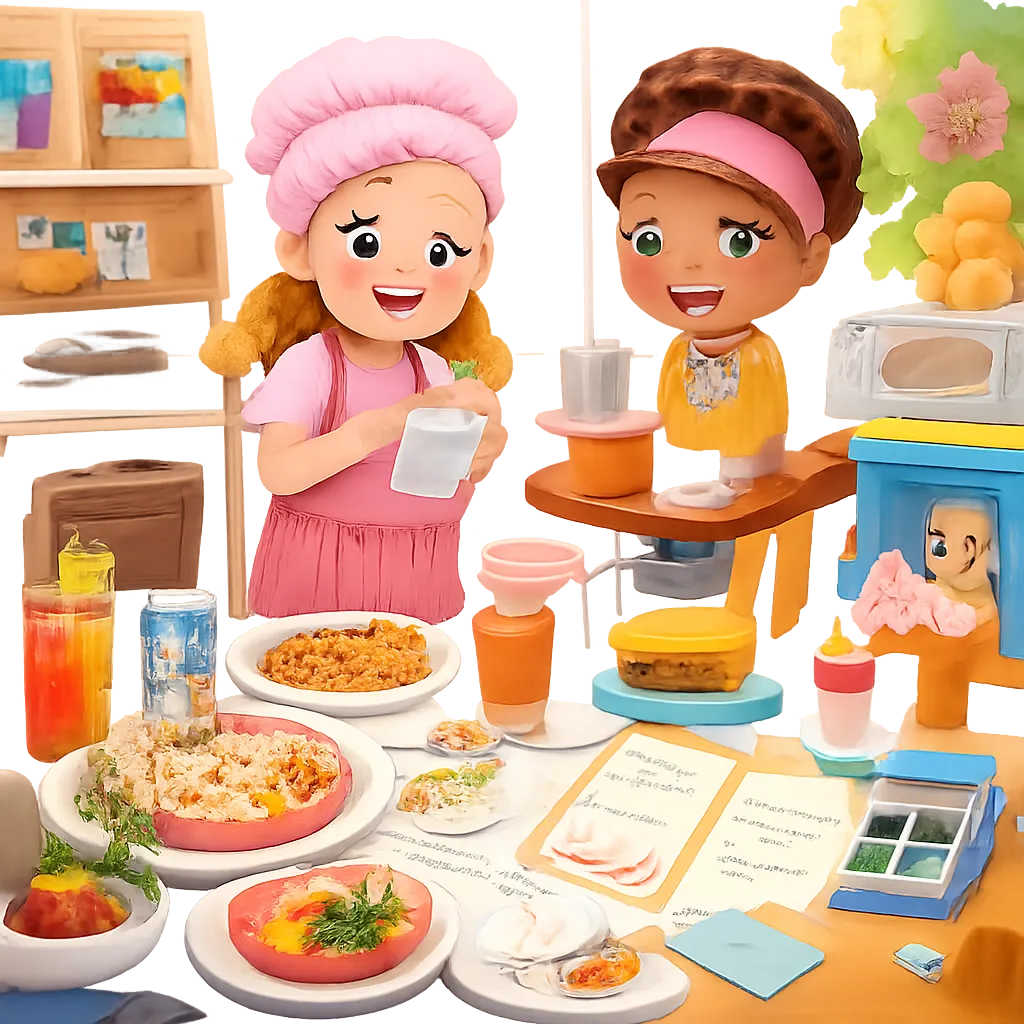

It’s Saturday afternoon! You and your friend Lily want to play restaurant. You grab toy plates and cups, but wait—no menu! How will customers order? Suddenly, Mom hands you a colorful sheet: “This is a free printable menu for pretend play!” Your eyes light up. What food words are on it? How do you talk like a waiter or customer? Let’s dive in and turn your playtime into fun English learning!
Core Knowledge Explanation First, let’s learn about the free printable menu for pretend play. It’s a special sheet with food names, prices, and categories. It helps you play restaurant easily and learn English at the same time.
Menus have different categories. Let’s explore the four main ones: breakfast, lunch, dinner, snacks, and drinks. Each category has yummy foods we eat at different times.
Let’s start with breakfast foods. Breakfast is the first meal of the day, usually eaten in the morning. Here are common breakfast words with phonics and examples: Egg /eɡ/: A round food from chickens. “I eat an egg for breakfast.” Pancake /ˈpænkeɪk/: A flat, sweet cake. “Mom makes delicious pancakes on Sundays.” Toast /təʊst/: Bread cooked until crispy. “I put jam on my toast.” Milk /mɪlk/: White drink from cows. “Drink milk to grow strong.” Cereal /ˈsɪəriəl/: Crunchy food eaten with milk. “My favorite cereal has colorful loops.” Yogurt /ˈjəʊɡərt/: Creamy, tangy food. “I like yogurt with berries.” Bacon /ˈbeɪkən/: Salty, crispy meat. “Dad cooks bacon for breakfast sometimes.” Orange juice /ˈɒrɪndʒ dʒuːs/: Juice from oranges. “Orange juice is sweet and refreshing.”
Next is lunch—we eat lunch in the middle of the day, around noon. Lunch foods are often filling: Sandwich /ˈsændwɪtʃ/: Bread with food inside. “I have a ham sandwich for lunch.” Hamburger /ˈhæmbɜːɡə(r)/: Beef patty in a bun. “Kids love hamburgers with fries.” French fries /frentʃ fraɪz/: Crispy potato sticks. “French fries go well with ketchup.” Soup /suːp/: Warm liquid food. “Tomato soup is my favorite on cold days.” Salad /ˈsæləd/: Fresh vegetables with dressing. “I eat salad to stay healthy.” Pasta /ˈpɑːstə/: Long, thin food made from flour. “My mom makes pasta with cheese.” Chicken nuggets /ˈtʃɪkɪn ˈnʌɡɪts/: Small pieces of fried chicken. “Chicken nuggets are fun to eat.” Rice /raɪs/: White or brown grains. “Many people eat rice with dinner.”
Dinner is the evening meal, eaten with family. Here are dinner foods: Steak /steɪk/: Thick piece of beef. “Dad grills steak for dinner on weekends.” Fish /fɪʃ/: Animal that lives in water. “Fish is healthy and tasty.” Vegetables /ˈvedʒtəbəlz/: Carrots, broccoli, peas, etc. “Eat your vegetables to be strong.” Potatoes /pəˈteɪtəʊz/: Round, brown vegetable. “Baked potatoes are soft and yummy.” Chicken /ˈtʃɪkɪn/: Meat from chickens. “Roast chicken smells amazing.” Pork /pɔːk/: Meat from pigs. “Pork chops are delicious with applesauce.” Bread /bred/: Soft food made from flour. “We eat bread with butter for dinner.” Soup /suːp/: Warm soup is perfect for dinner too. “I have vegetable soup before dinner.”
Snacks are small foods eaten between meals. Let’s learn snack words: Cookie /ˈkʊki/: Sweet, small cake. “I eat a cookie after school.” Candy /ˈkændi/: Sweet food like lollipops. “Candy is a special snack.” Chips /tʃɪps/: Crispy potato slices. “We eat chips while watching movies.” Fruit /fruːt/: Apples, bananas, grapes, etc. “Fruit is a healthy snack.” Popcorn /ˈpɒpkɔːn/: Puffed corn. “Popcorn is fun to eat at the cinema.” Chocolate /ˈtʃɒklət/: Sweet brown food. “Dark chocolate is my favorite.” Ice cream /aɪs kriːm/: Cold sweet food. “I love vanilla ice cream.” Crackers /ˈkrækəz/: Dry, crispy biscuits. “Crackers with cheese are tasty.”
Drinks are liquids we drink with meals or snacks: Water /ˈwɔːtə(r)/: Clear liquid. “Drink water every day.” Juice /dʒuːs/: Fruit or vegetable juice. “Apple juice is sweet.” Milk /mɪlk/: We drink milk with breakfast. “Milk makes bones strong.” Soda /ˈsəʊdə/: Fizzy drink like cola. “Soda is a special drink.” Tea /tiː/: Hot drink with leaves. “Mom drinks tea in the afternoon.” Coffee /ˈkɒfi/: Hot drink for adults. “Dad drinks coffee in the morning.” Smoothie /ˈsmuːði/: Blended fruit drink. “Banana smoothie is creamy.” Lemonade /ˌleməˈneɪd/: Cold lemon drink. “Lemonade is refreshing in summer.”
Now, let’s meet the two main restaurant roles: waiter/waitress and customer. A waiter/waitress helps customers order and get food. A customer comes to the restaurant to eat and pay.
The (ordering process) has simple steps. Let’s learn each step with easy words:
- Greeting: The waiter says hello to the customer.
- Taking the order: The customer says what they want to eat or drink.
- Confirming the order: The waiter repeats the order to make sure it’s right.
- Serving the food: The waiter brings the food to the customer.
- Saying thank you: The customer thanks the waiter.
- Paying: The customer gives money (pretend money for play!) to the waiter.
Here are 8+ core ordering sentences—these are magic words for your restaurant play: “Hello! Can I help you?” (Waiter greets customer) “What would you like to eat?” (Waiter asks about food) “What would you like to drink?” (Waiter asks about drinks) “I’d like a hamburger, please.” (Customer orders food) “Can I have some juice, please?” (Customer asks for drinks) “Anything else?” (Waiter asks if customer wants more) “No, thank you. That’s all.” (Customer says no more) “Here’s your food/drink.” (Waiter gives food/drink) “Thank you very much!” (Customer thanks waiter) “You’re welcome! Enjoy your meal!” (Waiter responds)
Fun Interactive Learning Let’s start with the menu (menu filling task). Get your free printable menu for pretend play and follow these steps:
- Look at the menu categories: Breakfast, Lunch, Dinner, Snacks, Drinks.
- Choose 5 foods for each category from our word list.
- Write the food name next to the blank. Use big, clear letters.
- Draw a small picture of the food next to the name (e.g., a pancake for breakfast).
- Add a pretend price (like 1, 2, or 3 coins) next to each food.
Now, let’s practice 3+ mock ordering dialogues. You can play the waiter or customer—invite a friend or family member to join!
Dialogue 1: Breakfast Restaurant Waiter: Hello! Can I help you? Customer: Yes, please. What would you recommend for breakfast? Waiter: We have pancakes, eggs, and toast. They’re very popular! Customer: I’d like pancakes and orange juice, please. Waiter: Anything else? Customer: No, thank you. Waiter: Okay! One pancake and one orange juice. Here you are! Customer: Thank you very much! Waiter: You’re welcome! Enjoy your breakfast!
Dialogue 2: Fast Food Restaurant Waiter: Hi there! What would you like to eat? Customer: I’d like a hamburger and French fries, please. Waiter: Great choice! What would you like to drink? Customer: Can I have a soda, please? Waiter: Sure! A hamburger, French fries, and a soda. Is that all? Customer: Yes, thank you. Waiter: Here’s your food. Enjoy! Customer: Thanks a lot! Waiter: No problem!
Dialogue 3: Snack Shop Waiter: Hello! Welcome to our snack shop. What can I get for you? Customer: I’d like some ice cream and a cookie, please. Waiter: What flavor of ice cream do you want? (Pretend flavors: vanilla, chocolate, strawberry) Customer: Vanilla, please. Waiter: And a cookie. Anything to drink? Customer: Can I have some lemonade, please? Waiter: Yes! One vanilla ice cream, one cookie, and one lemonade. Here you go! Customer: Thank you so much! Waiter: Enjoy your snacks!
Now, let’s learn table manners while playing. Good table manners make the restaurant play more real and fun: Always say “please” when ordering food or drinks. Say “thank you” when you get your food. Sit quietly while “eating” (no running around with the menu). Wait for the waiter to bring food—don’t grab it! If you need more water, say “Excuse me, can I have more water, please?”
Let’s do a role-play script with table manners. You’ll need two people: Waiter (W) and Customer (C).
Script: Family Dinner Restaurant W: Good evening! Welcome to Family Dinner Restaurant. Can I seat you here? C: Yes, thank you. That’s perfect. W: Here’s your menu. What would you like to drink first? C: Can I have some water, please? W: Sure! I’ll be right back with your water. (Pretend to bring water) C: Thank you! W: You’re welcome. Are you ready to order? C: Yes, please. I’d like chicken and vegetables, and a glass of juice. W: What kind of juice would you like? Apple or orange? C: Orange juice, please. W: Okay! Chicken, vegetables, and orange juice. Is that all? C: Yes, thank you. W: I’ll bring your food soon. (Pretend to get food) Here you are! Enjoy your meal. C: Thank you very much! This looks delicious. W: I’m glad you like it. Let me know if you need anything else. C: Will do! (Pretend to eat) Excuse me, can I have a little more rice, please? W: Of course! Here you go. C: Thanks a lot! W: You’re welcome. C: I’m full. Can I have the bill, please? W: Sure! Here’s your bill. (Pretend to give bill) C: (Pretend to pay) Here you are. W: Thank you! Come again soon. C: I will! Goodbye. W: Goodbye!
Expanded Learning Let’s learn about food from different countries. Food is fun, and knowing about other countries’ food makes your menu more exciting! USA: Hamburgers and French fries are famous in America. Kids love them for lunch. Italy: Pizza and pasta come from Italy. Pizza has cheese, tomato sauce, and toppings. Japan: Sushi is a Japanese food. It has rice and fish or vegetables. China: Dumplings (jiaozi) are popular in China. They’re filled with meat or vegetables. Mexico: Tacos are from Mexico. They’re soft shells with meat, cheese, and lettuce.
Add these foods to your free printable menu for pretend play—now you have an international restaurant!
Let’s sing a fun ordering song to remember the key words. Tune: “Row, Row, Row Your Boat” Order, order, in the shop, What would you like to eat? Hamburgers, fries, and juice so sweet, Please and thank you neat!
Waiter, waiter, can you help? I want some ice cream too. Vanilla, chocolate, strawberry, Yummy, yum, yum, woo!
Let’s learn more food-related words to expand your menu. These words help you describe food better: Flavors: Sweet /swiːt/ (candy), Sour /ˈsaʊə(r)/ (lemon), Salty /ˈsɔːlti/ (chips), Bitter /ˈbɪtə(r)/ (coffee) Textures: Crispy /ˈkrɪspi/ (fries), Soft /sɒft/ (pancake), Creamy /ˈkriːmi/ (yogurt), Crunchy /ˈkrʌntʃi/ (cereal) Cooking words: Fried /fraɪd/ (chicken nuggets), Baked /beɪkt/ (potato), Boiled /bɔɪld/ (egg), Grilled /ɡrɪld/ (steak)
Example sentences with these words: “This candy is sweet.” “French fries are crispy.” “Baked potatoes are soft.” “Grilled chicken is tasty.”
Let’s create a “My Favorite Food” section on your menu. Write down your top 3 favorite foods with a sentence:
- My favorite food is _______. It’s _______ (flavor/texture).
- I love _______ because it’s _______.
- I like to eat _______ for _______ (breakfast/lunch/dinner/snack).
Example:
- My favorite food is ice cream. It’s sweet and creamy.
- I love pancakes because they’re soft and yummy.
- I like to eat apples for snack.
What You Will Learn From this free printable menu for pretend play, you will learn so many useful things! First, you’ll master over 30 food words, including breakfast, lunch, dinner, snacks, and drinks. You can say their names, spell them, and know what they mean.
You’ll learn 10+ core ordering (sentence patterns) like “Can I help you?”, “What would you like to eat?”, “I’d like... please.”, and “Thank you very much!” These sentences let you talk like a real waiter or customer.
You’ll know two important restaurant roles: waiter/waitress and customer. You understand what each role does and how to act them out. You also learn good table manners that are polite and kind.
Your thinking skills will grow too! You can sort foods into different categories (breakfast, snacks, etc.). You learn to plan and fill out a menu, which helps with organization. You also practice listening and speaking when you do role-plays with friends.
You’ll develop great learning habits: You’ll practice writing by filling out the menu. You’ll be brave to speak English because the play is fun and low-pressure. You’ll learn to work with others when you do role-plays—teamwork is important!
You’ll also learn to describe food with flavor and texture words. You can talk about your favorite foods and why you like them. This helps you express your thoughts in English.
Using What You Learned in Life You can use your new English skills at home every day! Have a family pretend restaurant night. Print your free printable menu for pretend play, set the table with toy plates, and take turns being the waiter and customer.
When you eat breakfast with your family, say: “Mom, can I have some milk, please?” or “I’d like toast for breakfast.” Use the same sentences from your menu play—this makes English part of your daily life!
When you go to a real restaurant with your family, try using your new words. You can say to the waiter: “Can I have orange juice, please?” or “I’d like chicken nuggets.” Your family will be so proud of you for speaking English!
Play with friends at school or park. Bring your printed menu and ask: “Do you want to play restaurant?” You can take turns ordering food and practicing dialogues. It’s a fun way to learn and play at the same time.
Make a new menu for a special occasion, like a birthday party. Add birthday snacks (cake, candy) to your menu. Practice saying: “Would you like some birthday cake, please?” or “Can I have a piece of candy?”
You can also use the food words when you help mom or dad cook. Say: “We need eggs for breakfast.” or “Let’s make pancakes—they’re my favorite!” This connects English to real-life activities.
Closing Encouragement Wow! You’ve done an amazing job with your free printable menu for pretend play. You know so many food words, can talk like a waiter or customer, and even learned good table manners. That’s incredible!
Every time you play restaurant, you’re getting better at English. It’s okay if you forget a word—just look at your menu or ask for help. The more you practice, the easier it gets.
You’re a brave learner for trying new words and dialogues. Speaking English is like playing a game—keep having fun with it! Your menu is now a magic tool to learn English anytime, anywhere.
Invite your friends, siblings, or family to play with you often. The more you use your menu and words, the more confident you’ll feel. Remember, practice makes perfect, and you’re doing a fantastic job!
Keep being curious and having fun with English. Your free printable menu for pretend play is just the start—you’ll soon be able to talk about all kinds of foods and have longer conversations. We’re so proud of you—keep shining and playing