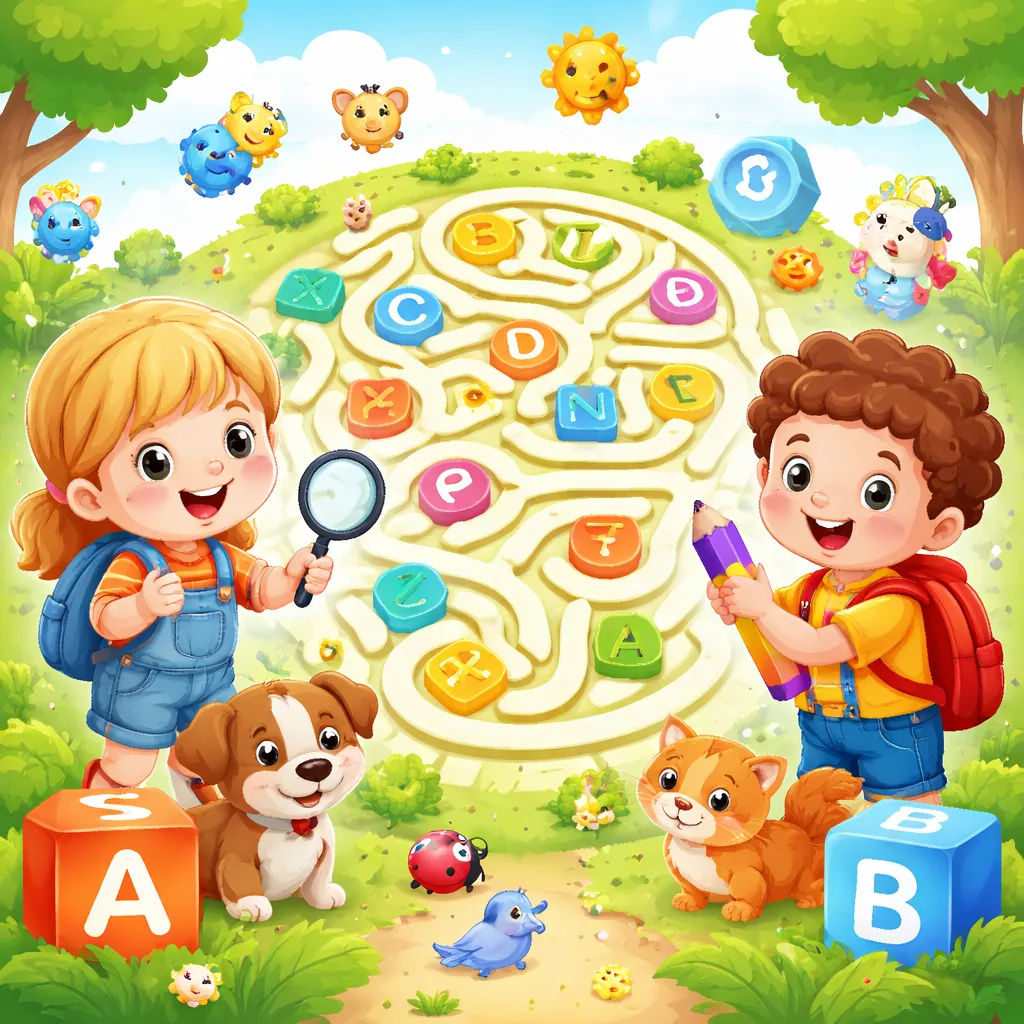

One rainy afternoon, you find a colorful sheet on your desk. It has twisty paths, big letters, and cute pictures of animals. Mom says, “This is alphabet maze worksheets for toddlers—let’s play and learn!” You lean in, touching the curvy lines. How do you get through the maze? What letters will you meet? Let’s jump into this fun adventure to learn letters, sounds, and words!
Core Knowledge Explanation First, let’s talk about alphabet maze worksheets for toddlers. They are special worksheets with mazes that focus on English letters. Each maze helps you learn one letter—its big (uppercase) and small (lowercase) form, how it sounds, and how to write it.
Let’s start with the first letter of the alphabet: Aa. The uppercase A looks like a triangle with two legs. The lowercase a looks like a little circle with a tail. The sound of Aa is /eɪ/ (like “ay” in “day”).
How to write uppercase A? Follow these simple steps: Start at the top, draw a line down to the left. Then go back to the top, draw a line down to the right. Finally, draw a horizontal line across the middle. Easy!
For lowercase a: Start at the top of the circle, draw a small circle clockwise. Then add a short tail down and to the right. Practice slowly—you’ll get it!
Now, let’s learn 7 words that start with Aa, with simple sentences: Apple /ˈæpl/: A red or green fruit. “I eat a juicy apple for snack.” Ant /ænt/: A tiny insect with six legs. “The ant walks on the grass.” Airplane /ˈeəpleɪn/: A big machine that flies. “We take an airplane to visit grandma.” Alligator /ˈælɪɡeɪtə(r)/: A big reptile with sharp teeth. “The alligator swims in the river.” Apricot /ˈeɪprɪkɒt/: A small orange fruit. “Apricots are sweet and soft.” Arrow /ˈærəʊ/: A thin stick with a point. “The arrow flies through the air.” Aunt /ɑːnt/: Your parent’s sister. “My aunt brings me toys on my birthday.”
Next letter: Bb. Uppercase B has two vertical lines and two rounded humps. Lowercase b is a vertical line with a rounded hump on the right. The sound of Bb is /biː/ (like “bee”).
Writing uppercase B: Draw a straight vertical line down. Then, starting at the top of the line, draw a rounded hump to the right. Go down a little, then draw another rounded hump to the right. Done!
Lowercase b: Draw a vertical line down. Near the top, draw a small rounded hump to the right. Keep the line straight and the hump soft.
Words starting with Bb (7 words with sentences): Ball /bɔːl/: A round toy you can throw or kick. “I bounce the red ball in the park.” Bear /beə(r)/: A big furry animal. “The teddy bear is my favorite toy.” Banana /bəˈnɑːnə/: A long yellow fruit. “Monkeys love to eat bananas.” Bird /bɜːd/: A small animal that can fly. “The bird sings a beautiful song.” Book /bʊk/: A thing with pages and stories. “I read a funny book before bed.” Butterfly /ˈbʌtəflaɪ/: A colorful insect with wings. “The butterfly flies from flower to flower.” Bread /bred/: Soft food made from flour. “I eat bread with butter for breakfast.”
Third letter: Cc. Uppercase C is a big curved line, like a half-circle. Lowercase c is a small curved line, just like the big one but tinier. The sound of Cc is /siː/ (like “see”).
Writing Cc is easy! For uppercase C: Start at the top, draw a smooth curve to the right and down, making a half-circle. End at the bottom, with the curve open on the right.
Lowercase c: Do the same as uppercase, but make it smaller. Keep the curve smooth and even.
Words starting with Cc (7 words with sentences): Cat /kæt/: A small furry pet. “My cat likes to sleep on the couch.” Car /kɑː(r)/: A vehicle with four wheels. “Dad drives a blue car to work.” Cake /keɪk/: A sweet food for parties. “We eat chocolate cake on birthdays.” Cup /kʌp/: A small container for drinks. “I drink milk from a red cup.” Cloud /klaʊd/: White fluffy things in the sky. “The cloud looks like a sheep.” Cookie /ˈkʊki/: A small sweet cake. “Mom bakes yummy cookies for us.” Carrot /ˈkærət/: An orange vegetable. “Rabbits love to eat carrots.”
Fourth letter: Dd. Uppercase D has a vertical line and a big rounded curve on the right. Lowercase d is a vertical line with a rounded curve on the left, plus a small tail down. The sound of Dd is /diː/ (like “dee”).
Writing uppercase D: Draw a straight vertical line down. Then, starting at the top of the line, draw a big rounded curve to the right, ending at the bottom of the line.
Lowercase d: Start with a small circle (like lowercase a), then draw a vertical line down from the circle. Add a tiny tail to the left at the bottom.
Words starting with Dd (7 words with sentences): Dog /dɒɡ/: A furry pet that barks. “My dog plays fetch in the yard.” Duck /dʌk/: A bird that swims. “The duck quacks and swims in the pond.” Doll /dɒl/: A toy that looks like a baby. “My doll has pink hair and a dress.” Desk /desk/: A table for studying. “I do my homework on my desk.” Donut /ˈdəʊnʌt/: A sweet round food with a hole. “I eat a glazed donut for snack.” Dragon /ˈdræɡən/: A mythical animal with wings. “The dragon breathes fire in stories.” Door /dɔː(r)/: A thing you open to enter a room. “Please close the door quietly.”
Fifth letter: Ee. Uppercase E has a vertical line and three horizontal lines across it. Lowercase e is a small curve with a short horizontal line across the middle. The sound of Ee is /iː/ (like “ee” in “bee”).
Writing uppercase E: Draw a vertical line down. Then draw three horizontal lines across it—one at the top, one in the middle, one at the bottom. All lines should be straight.
Lowercase e: Start with a small curve (like lowercase c), then draw a short horizontal line across the middle of the curve.
Words starting with Ee (7 words with sentences): Elephant /ˈelɪfənt/: A big animal with a long trunk. “The elephant drinks water with its trunk.” Egg /eɡ/: A round food from chickens. “I eat a boiled egg for breakfast.” Eagle /ˈiːɡl/: A big bird that flies high. “The eagle soars in the blue sky.” Ear /ɪə(r)/: The part of your body you hear with. “I listen to music with my ears.” Eye /aɪ/: The part of your body you see with. “My eyes are brown.” Eraser /ɪˈreɪzə(r)/: A thing to rub out mistakes. “I use an eraser to fix my drawing.” Elevator /ˈelɪveɪtə(r)/: A machine that goes up and down in buildings. “We take the elevator to the top floor.”
Let’s learn a fun (pronunciation rhyme) for each letter to remember their sounds: Aa: “A, A, /eɪ/, apple and ant—Aa sounds like ‘ay’!” Bb: “B, B, /biː/, ball and bear—Bb sounds like ‘bee’!” Cc: “C, C, /siː/, cat and car—Cc sounds like ‘see’!” Dd: “D, D, /diː/, dog and duck—Dd sounds like ‘dee’!” Ee: “E, E, /iː/, elephant and egg—Ee sounds like ‘ee’!”
Fun Interactive Learning First, let’s learn how to play the maze on alphabet maze worksheets for toddlers. Follow these clear rules:
- Look at the top of the worksheet—what letter is the maze about? It will say “Find the path of Aa” or “Follow Bb to the end.”
- Find the START arrow on the maze. That’s where your journey begins.
- The maze has many paths, but only one path is made of the target letter (uppercase or lowercase).
- Use your finger or a pencil to trace the path of the letter. Don’t cross lines that have other letters!
- Follow the letter path until you reach the FINISH picture. That’s your treasure!
Let’s try a sample Aa maze. The start is at the bottom left, and the finish is a picture of an apple. The path is made of uppercase A and lowercase a. Trace from A → a → A → a until you get to the apple. Say the letter sound /eɪ/ each time you touch a letter.
Now, let’s play the “Letter & Word Collection (Adventure Task)”. You’ll need your alphabet maze worksheets for toddlers and some small stickers or markers.
- Choose one maze (e.g., Bb maze). Before tracing, list 3 words that start with Bb (ball, bear, banana).
- Trace the maze path slowly. Every time you pass a Bb, put a sticker next to it.
- When you reach the finish, count your stickers—how many Bb’s did you find?
- For each sticker, say the word and sentence: “Ball—I bounce the ball.”
- If you collect all Bb’s and say all words, you win a “Letter Master” badge (draw one on your worksheet)!
Next, let’s do the “Uppercase and Lowercase Matching” game. You’ll need cut-outs of uppercase and lowercase letters (A-a, B-b, C-c, D-d, E-e) or use the letters on your maze worksheets.
- Spread all uppercase letters on one side of the table.
- Spread all lowercase letters on the other side.
- Pick an uppercase letter (e.g., A) and say: “Uppercase A—where is your lowercase friend?”
- Find the lowercase a and match them. Say: “A and a are friends!”
- Repeat for all letters. To make it fun, pretend the letters are hiding—“Where is lowercase b? Is it here?”
Let’s play “Maze Race” with a friend or family member. Take two same alphabet maze worksheets for toddlers (e.g., Cc maze).
- Set a timer for 2 minutes.
- Both players start tracing the Cc path at the same time.
- While tracing, say the letter sound /siː/ and a Cc word (cat, car) every 5 seconds.
- The first player to reach the finish and say 3 Cc words wins!
- If it’s a tie, play a quick matching round—who can match C and c first?
Another fun activity: “Draw the Letter Path.” After finishing a maze, take a blank paper.
- Write the target letter (e.g., Dd) at the start and a Dd word picture (duck) at the end.
- Draw your own maze path using uppercase D and lowercase d.
- Ask a friend to trace your maze and say Dd words.
- Help them if they get stuck—“Look for the Dd’s! There’s one on the left.”
Expanded Learning Let’s learn a fun alphabet song to remember letters, sounds, and words. Tune: “Twinkle, Twinkle Little Star” A is for apple, /eɪ/ /eɪ/ apple, B is for ball, /biː/ /biː/ ball, C is for cat, /siː/ /siː/ cat, D is for dog, /diː/ /diː/ dog, E is for elephant, /iː/ /iː/ elephant, Letters are fun, one by one!
Did you know that English letters come from old symbols? Long ago, people used pictures to write. The letter A came from a picture of an ox’s head! Over time, the picture changed into the A we know today. How cool is that?
Let’s expand our letter words. Here are 3 more words for each letter, with simple sentences: Aa: Avocado /ˌævəˈkɑːdəʊ/ (“I eat avocado on toast.”), Acorn /ˈeɪkɔːn/ (“The squirrel hides the acorn.”), Actor /ˈæktə(r)/ (“The actor plays in movies.”) Bb: Boat /bəʊt/ (“We sail a boat on the lake.”), Bell /bel/ (“The bell rings for school.”), Berry /ˈberi/ (“I pick blueberries in the garden.”) Cc: Candle /ˈkændl/ (“We light a candle on the cake.”), Castle /ˈkɑːsl/ (“The prince lives in a castle.”), Cherry /ˈtʃeri/ (“Cherries are red and sweet.”) Dd: Drum /drʌm/ (“I play the drum loudly.”), Deer /dɪə(r)/ (“The deer runs in the forest.”), Dinner /ˈdɪnə(r)/ (“We eat dinner with family.”) Ee: Exit /ˈeksɪt/ (“The exit is by the door.”), Honey /ˈhʌni/ (“Bees make honey.”), Engine /ˈendʒɪn/ (“The car’s engine makes noise.”)
Let’s learn about “Letter Hunt” in the world around us. Letters are everywhere—on signs, books, toys, and clothes. Look at cereal boxes: Can you find the letter Aa? It might be in “Apple Jacks” or “Alpha Bits.” Check your clothes: Many shirts have letters on them—look for Bb or Cc. Walk outside: Street signs have letters. Can you spot Dd in “Dog Park” or Ee in “Elementary School”? Keep a “Letter Journal”: Draw or cut out letters you find and glue them in a notebook. Write a word next to each letter.
Let’s make “Letter Puppets” to practice sounds. Take a paper bag or sock, and draw a letter on it (e.g., Aa).
- Put your hand in the puppet. Make the puppet “talk” in the letter sound: “Hi! I’m Puppet Aa. /eɪ/ /eɪ/!”
- The puppet says a word: “I like apples! Apple starts with Aa.”
- Have a conversation with the puppet: “Puppet Aa, what other words start with you?”
- The puppet answers: “Ant, airplane, and apricot! All start with /eɪ/.”
What You Will Learn From alphabet maze worksheets for toddlers, you will learn so much! First, you’ll master 5 core letters: Aa, Bb, Cc, Dd, Ee. You can recognize their uppercase and lowercase forms easily.
You’ll know the sounds of each letter: /eɪ/ for Aa, /biː/ for Bb, /siː/ for Cc, /diː/ for Dd, /iː/ for Ee. The fun rhymes will help you remember these sounds forever.
You’ll learn over 35 words that start with these letters. You can say the words, spell them, and use them in simple sentences like “I eat an apple” or “The dog barks.”
You’ll master important writing skills. You can write uppercase and lowercase letters correctly, following the right steps. Your hand will get stronger and more steady for future writing.
Your thinking skills will grow too! You’ll learn to focus and follow paths in the maze, which helps with concentration. Matching uppercase and lowercase letters teaches you to see differences and similarities.
You’ll develop great learning habits. You’ll learn to be patient when tracing mazes—taking time to find the right path. You’ll also get excited to practice English because it feels like playing a game.
You’ll learn simple句型 (sentence patterns) like “What letter is this?” “It’s letter A.” “What starts with A?” “Apple starts with A.” These sentences let you talk about letters and words with friends.
Using What You Learned in Life You can use your new letter skills at home every day! Grab your alphabet maze worksheets for toddlers and practice with family. Ask mom: “What letter is on my cup? Is it C?”
Play “Letter Dinner” with your family. At mealtime, take turns saying a letter and a food that starts with it: “A is for apple, B is for bread, C is for carrot.” Everyone can join in—it makes dinner fun!
Go on a “Letter Walk” outside. Take a notebook and a pencil. Walk around your neighborhood and look for letters A-E. When you find one, write it down and a word that starts with it. “I saw a D on the ‘Dog Park’ sign—D is for dog!”
Practice writing letters in fun ways. Instead of just pencils, use crayons, markers, or even sidewalk chalk. Write uppercase A on the sidewalk and say: “A, /eɪ/, apple!” Let your little sibling trace it with you.
Play “Letter Hide-and-Seek” at home. Hide small toys that start with your letters (e.g., a toy apple for A, a ball for B). Ask a friend: “Can you find something that starts with C?” When they find it, say the word and sentence.
Use letters when you draw. Draw a picture of a park, then label things with your letters: “A for airplane, B for bench, C for cat.” Show your picture to family and tell them about each letter.
Closing Encouragement Wow! You’ve had such a wonderful adventure with alphabet maze worksheets for toddlers. You can recognize letters, say their sounds, write them, and use so many new words—you’re amazing!
Every time you traced a maze, said a letter sound, or matched uppercase and lowercase, you got better at English. It’s okay if you made mistakes or took time to find the path—trying your best is what matters.
Keep practicing with your worksheets and playing the fun games. Letters are the building blocks of words, and words are the building blocks of stories. Soon, you’ll be reading and writing whole sentences!
Remember, letters are everywhere—look for them when you play, eat, or walk. Talk about them with your friends and family. The more you practice, the more confident you’ll feel.
You’re a brave and smart learner. We’re so proud of how hard you’ve worked. Keep exploring, keep playing, and keep learning—you’re on your way to being an English letter master! Happy tracing and learning