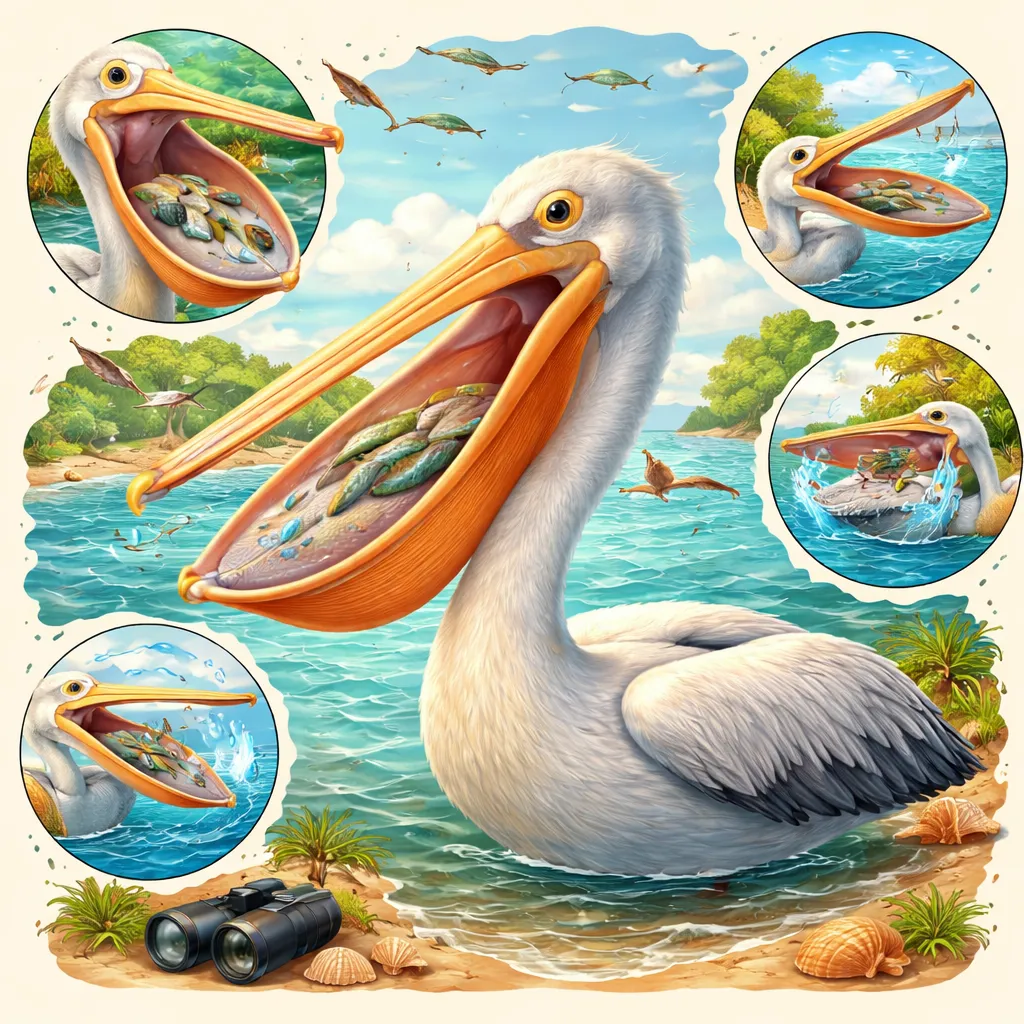

Have you ever seen a picture of a very large bird with a huge, long bill and a stretchy pouch underneath, flying over the ocean or a lake? That’s a pelican! These impressive birds are expert fishers and graceful fliers. Learning about pelicans is a splashy adventure that takes us to coastlines and lakes around the world. Let’s begin our journey of learning about pelican power and their special skills.
English Language Learning
Vocabulary and Spelling Our large-billed friend is called a pelican. The word "pelican" is a noun. A noun names a person, place, or thing. So, a pelican is a thing—a large, living bird. Spelling "pelican" is straightforward: P-E-L-I-C-A-N. The 'P' starts the word, the 'E' and 'L' are in the middle, and it ends with 'I-C-A-N'. P-E-L-I-C-A-N spells pelican.
Sound and Pronunciation Let’s say the word correctly. It sounds like this: /ˈpel.ɪ.kən/. We can say it in three clear parts. First, say "pell". It rhymes with "bell". Next, say "ih". It’s a quick, short sound. Last, say "can". It’s just like the word "can". Now, put it together! "Pell" "ih" "can". Pelican! Great! The word "pelican" has three beats, or three syllables. Clap three times: Pel-i-can. It’s a smooth, rolling word.
Related Words Learning about pelicans is more fun with new words! Here are some important ones. Body Part: The stretchy skin under a pelican’s bill is called a pouch or a gular sac. A baby pelican is called a chick. Action: The way a pelican flies in a line with others is called flying in formation. Home: A place where many pelicans live and nest together is called a colony or a rookery.
A Famous Saying While there isn't a famous old saying, there is a fun and true fact: "A pelican’s pouch holds more than its belly can!" This is a playful way to remember that a pelican can hold a lot of fish and water in its stretchy pouch. It reminds us that nature can be both surprising and efficient. Say the fact with me: "A pelican’s pouch holds more than its belly can!" It’s a cool piece of information.
Now you know the word "pelican"! Are you ready to dive into some amazing facts? Let’s soar from words to wonderful knowledge!
Animal Knowledge
Who Are They? – Family and Group What kind of animal is a pelican? Pelicans are birds. They are warm-blooded, have feathers, and lay eggs. They are part of the Pelecanidae family. There are eight different species, like the Brown Pelican and the American White Pelican. They are some of the largest flying birds.
What Do They Look Like? – Amazing Bodies Pelicans are very large birds with a wingspan as wide as a car is long! They have a long neck and a very long bill. Their most famous feature is their huge bill with a stretchy pouch. The bill and pouch are super tools! The pouch is like a fishing net. It can hold up to three gallons of water and fish. The pelican uses it to scoop up fish. After scooping, it lets the water drain out and then swallows the fish. Pelicans have special adaptations. They are excellent fliers and can soar on air currents for hours. They have webbed feet for swimming. Their bones are filled with air, which makes them lighter for flying.
Where Do They Live and How? – Home and Habits Pelicans live on every continent except Antarctica. Their homes are coasts, lakes, and rivers. They need large bodies of water with plenty of fish. Pelicans are piscivores. This means they are fish-eaters. They are expert fishers. Some, like the Brown Pelican, dive from the air to catch fish. Others, like the White Pelican, work together in groups to herd fish into shallow water. Pelicans are very social and live in large colonies. They are active during the day. They spend their time fishing, resting on sandbars, and flying in graceful lines. A group of pelicans is called a pod, a scoop, or a squadron.
A Pelican’s Life Story – Growing Up A baby pelican is called a chick. Pelicans are birds, so chicks hatch from eggs. Pelicans usually lay one to three eggs in a nest on the ground or in a tree, depending on the species. Both parents take care of the chicks. They take turns keeping the eggs warm and then feeding the chicks. The parents feed the chicks by regurgitating (bringing up) partially digested fish. Chicks are born without feathers and are completely dependent. They grow quickly and are very hungry. They stay in the nest for about two to three months. The parents care for them until they learn to fly and fish for themselves.
How Do They "Talk"? – Communication Pelicans are usually quiet, but they can make sounds. They grunt, hiss, or croak, especially at their nesting colonies. The chicks make loud begging calls for food. They use a lot of body language. Stretching their necks, flapping their wings, or bowing are ways to communicate with each other, especially during courtship. Their best sense is their excellent eyesight. They have very good vision to spot fish from high in the air. Their sense of touch in their bill pouch helps them feel when they have caught a fish.
Are They Okay? – Taking Care of Them Many pelican species are doing better now, but they have faced big problems. Some, like the Brown Pelican, were once endangered but have made a good comeback. The main threats are pollution (especially oil spills and plastic), loss of nesting areas, and getting tangled in fishing lines. Pesticides in the past also made their eggshells too thin. You can be a pelican protector! You can keep beaches and waterways clean by not littering. You can properly dispose of fishing line. You can support groups that protect coastal habitats and rescue birds hurt by pollution.
Life Connections and Inspiration
How to Be With Them – Safety and Love Pelicans are large, wild birds. They are generally not aggressive, but we must always give them plenty of space, especially at their nesting sites. The rule is: Admire from a very respectful distance. If you see pelicans on a beach or dock, watch them from far away. Never try to touch, feed, or get close to a pelican. Never chase them or get between them and the water. If you are boating, go slowly around them. We show our love by protecting the clean oceans, lakes, and coasts they need to survive. We can be voices for clean water and safe wildlife.
Super Qualities We Learn from Them Pelicans teach us wonderful things. One super quality is graceful efficiency and teamwork. Pelicans fly in formation to save energy, and some species fish together to catch more food. They teach us the power of working together smoothly and using our energy in smart ways. Another quality is adaptability and resilience. Pelicans have recovered from serious threats because people helped protect them. They adapt to live near us. This reminds us that we can overcome challenges, especially when we help each other, and that we can live in harmony with nature. Think about it: How can you work with others in a graceful and efficient way, like pelicans flying together? How can you show resilience when you face a problem, and how can you help others do the same?
Take Action! – Your "Pelican Pouch" Project Let’s do a fun and creative activity! Your project is to make a model of a pelican’s bill and pouch. Take a large piece of paper. Draw and cut out the shape of a pelican’s head with a long, straight bill. Now, attach a small net bag or a piece of stretchy fabric (like an old sock) to the bottom of the bill as the pouch. Decorate your pelican. You can use your model to gently "scoop up" lightweight objects like crumpled paper "fish." This shows how the pelican uses its amazing pouch.
Closing Learning about pelican wonders is a majestic and important adventure! We learned the word "pelican" and how to say its three-part name. We discovered amazing facts about their stretchy pouches, their skillful fishing, and their life in large, social colonies. We know that pelicans are graceful, resilient birds that need our help to keep their waters clean. You can use your new words to share the impressive story of these fishing birds. You can use your knowledge to be a responsible visitor to beaches and a champion for clean water. The animal world is full of graceful and cooperative teachers. Always remember to respect wildlife from a safe distance, work with others in harmony, and be resilient in the face of challenges. Keep exploring with curiosity, soar towards your goals with grace, and be a friend to the wild. Your caring actions and cooperative spirit make you a true friend to the amazing pelican.