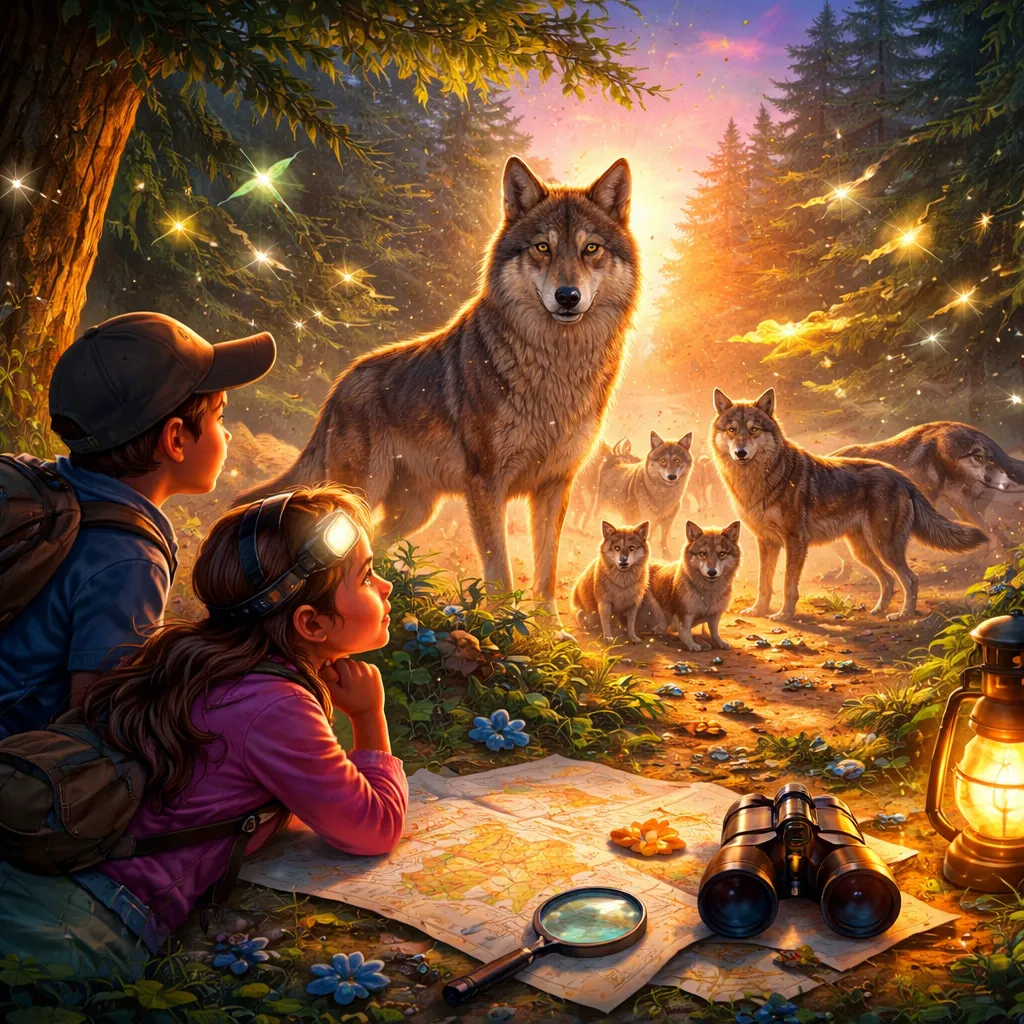

Have you ever heard a wolf’s howl in a movie or a storybook? It is a long, lonely, and beautiful sound that travels through forests and over mountains. Wolves are strong, smart, and live in close families called packs. Learning about wolves takes us on a journey to wild places where these amazing animals work together. Let’s begin our adventure of learning about wolf life and legends!
English Language Learning
Vocabulary and Spelling The word for this wild canine is wolf. The word "wolf" is a noun. A noun names a person, place, or thing. So, a wolf is a thing—a powerful, wild animal. Spelling "wolf" is short and strong: W-O-L-F. The 'W' starts the word like a wide-open mouth ready to howl. The 'O' is in the middle, and the 'L' and 'F' stand together at the end, like two wolves side by side. W-O-L-F spells wolf. Remember, more than one wolf are wolves!
Sound and Pronunciation Let’s say the word correctly. It sounds like this: /wʊlf/. We can say it in one clear part. First, say the sound "w". It’s the sound at the start of "we" or "water". Next, say "ool". It’s the sound in "book" or "look". Last, say "f". It’s the sound at the end of "leaf". Now, blend it together! "W" "ool" "f". Wolf! Excellent! The word "wolf" has just one beat, or one syllable. Clap your hands once: Wolf! It’s a short, powerful word.
Related Words Learning about wolves is more exciting with new words! Here are some cool ones. Sound: The long, calling sound a wolf makes is a howl. Wolves howl to talk to their pack from far away. Group: A wolf family is called a pack. They live, hunt, and play together. Home: A wolf’s safe place to sleep and raise pups is called a den. It is often a hole in the ground or a cave.
A Famous Saying There is a very wise saying about teamwork: "The strength of the pack is the wolf, and the strength of the wolf is the pack." This means that every single wolf is strong, but together in a pack, they are even stronger. It teaches us that we can do amazing things when we work together and help each other. Teamwork makes the dream work! Say the saying with me: "The strength of the pack is the wolf, and the strength of the wolf is the pack." It’s a great thing to remember when you are working on a team.
Now you know the word "wolf"! Are you ready to learn the secrets of the pack? Let’s run from words to wonderful wild facts!
Animal Knowledge
Who Are They? – Family and Group What kind of animal is a wolf? Wolves are mammals. They have thick fur, are warm-blooded, and mother wolves feed their babies milk. They are part of the canine family. This is the dog family! Their closest relatives are dogs, coyotes, and foxes. In fact, the dogs we have as pets today are descended from wolves long, long ago.
What Do They Look Like? – Amazing Bodies Wolves are about the size of a very large dog. They have thick fur that can be gray, brown, black, or even white. They have a long, bushy tail and pointed ears. Their most famous features are their strong jaws and sharp teeth, made for eating meat. They also have excellent eyes that glow in the dark, which helps them see at night. Wolves are built to be great travelers. They have long legs and big paws that are perfect for running fast and walking long distances through snow. Their fur is very thick to keep them warm in cold winters.
Where Do They Live and How? – Home and Habits Wolves live in many places in the world, like forests, mountains, and the cold Arctic. They need big, wild spaces to roam and hunt. Wolves are carnivores. This means they are meat-eaters. They hunt large animals like deer and elk. They work together as a pack to catch their food. Wolves are very social and live in family packs. The pack is led by two wolves called the alpha male and female. They are most active at dawn and dusk. The pack works together to hunt, raise pups, and protect their territory.
A Wolf’s Life Story – Growing Up A baby wolf is called a pup. Wolves are mammals, so pups are born live from their mother in the safe den. A mother wolf usually has four to six tiny, blind pups at a time. The whole pack helps take care of the pups! The mother feeds them milk. Other wolves bring food back to the den for the mother and the growing pups. They all play with and protect the pups. Pups grow up in the den for the first few weeks. Then they come out to play and learn. They learn how to hunt by playing with each other. They will stay with the pack for a few years, and some will leave to start their own pack.
How Do They "Talk"? – Communication Wolves are fantastic communicators. They are famous for their howls, but they also bark, whine, and growl. Howling helps the pack talk over long distances. It can mean, "I am here, where are you?" or "This is our place!" They also use body language, like the position of their ears and tail, to show how they feel. Their best senses are their hearing and smell. A wolf can hear another wolf howl from many miles away. Their sense of smell is 100 times better than a human’s! They can smell prey from a very long distance.
Are They Okay? – Taking Care of Them Wolves were once in big trouble in many places, but now they are coming back because of protection. Some groups are still endangered. The main threats were people hunting them and taking their wild land for farms and cities. Sometimes, wolves and farmers have problems if wolves try to eat farm animals. You can be a wolf friend! You can learn and teach others the truth about wolves—they are not big, bad villains, but important members of nature. You can support groups that protect wild lands and help wolves and people live safely together.
Life Connections and Inspiration
How to Be With Them – Safety and Love Wolves are magnificent wild animals. We must always admire them from a very, very safe distance. The rule is: Look, never approach. We see them in nature documentaries or at special wildlife centers that care for them. We never try to find or touch a wild wolf. If you ever see one in the wild, you stay calm, stay with an adult, and back away slowly. We do not feed them or leave our food out when camping. We show our love by wanting them to live free and wild, with plenty of forest and prey to keep their packs healthy. We can be a voice for wolves by protecting wilderness.
Super Qualities We Learn from Them Wolves teach us incredible lessons. One super quality is loyalty and teamwork. Every wolf in the pack has a role, and they depend on each other to survive. They teach us to be loyal friends, to work together, and to help our own "pack"—our family, friends, and team. Another quality is strong communication. Wolves are always talking to each other with sounds and body language. They remind us how important it is to talk clearly, to listen, and to understand each other. Think about it: How can you be a loyal team player in your family or with your friends? How can you use your words and listen well to communicate better, just like a wolf pack?
Take Action! – Your "Wolf Pack" Project Let’s do a fun activity! Your project is to create a wolf pack story and howl. Gather your family or a few friends. First, decide who will be the alpha leaders, the hunters, and the pups. Now, make up a story about your pack’s day. Are you going on a journey through the forest? Are you teaching the pups to hunt? Act it out with quiet movements. Then, at the end of your story, all stand together, tilt your heads back, and let out a long, pretend howl! Remember, it’s not about being loud, but about calling to your pack. You can also draw a picture of your wolf pack on an adventure.
Closing Learning about wolf packs is a thrilling adventure! We learned the word "wolf" and how to say its strong, one-syllable name. We discovered amazing facts about their howling communication, their loyal pack life, and their super senses. We know that wolves are intelligent, social animals who play a vital role in nature. You can use your new words to share the true story of wolves, not the scary fairy tale. You can use your knowledge to appreciate the power of teamwork and clear communication. The wild world is full of incredible teachers like the wolf. Always remember to respect wildlife from a safe distance and be a voice for balanced ecosystems. Keep exploring, be a loyal team player, and communicate with your pack. Your understanding and care help ensure these majestic creatures continue to howl in the wild for generations to come.