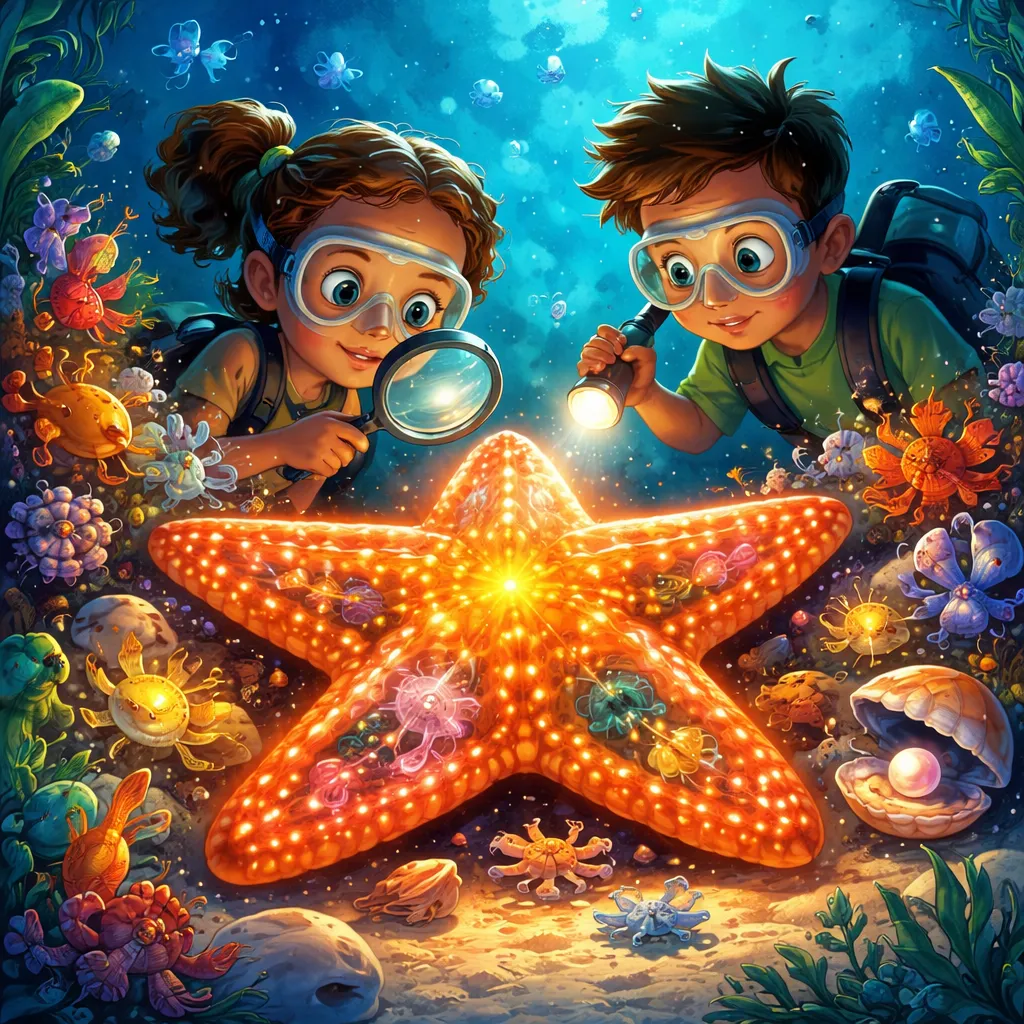

Have you ever been to a beach or an aquarium and seen a flat, star-shaped animal slowly moving along the bottom? It might be brightly colored and have five points. That’s a starfish! But did you know their real name is sea star? These fascinating creatures are not fish at all. Learning about starfish is a hands-on adventure that takes us to rocky tide pools and colorful coral reefs. Let’s begin our journey of learning about sea star wonders and superpowers.
English Language Learning
Vocabulary and Spelling Our star-shaped ocean friend is called a starfish or a sea star. The word "starfish" is a noun. A noun names a person, place, or thing. So, a starfish is a thing—a living animal of the ocean. Spelling "starfish" is two words together: S-T-A-R and F-I-S-H. S-T-A-R-F-I-S-H spells starfish.
Sound and Pronunciation Let’s say the word correctly. It sounds like this: /ˈstɑːr.fɪʃ/. We can say it in two clear parts. First, say "star". It’s just like the twinkling object in the night sky. Next, say "fish". It’s the same as the animal, a fish. Now, put it together! "Star" "fish". Starfish! Great! The word "starfish" has two beats, or two syllables. Clap your hands twice: Star-fish. It’s a familiar, friendly word.
Related Words Learning about starfish is more fun with new words! Here are some important ones. Body Part: The points of a starfish are called arms or rays. The tiny, suction-cup like feet on the bottom are tube feet. Action: The amazing ability to grow a new arm is called regeneration. Home: The starfish’s home on the ocean floor is the sea bed or tide pool.
A Famous Saying Because of their shape, people sometimes use the phrase: "Shaped like a starfish." This is a simple, descriptive way to talk about something that has a star-like shape with five or more points. It reminds us that nature creates beautiful and symmetrical forms. Say the phrase with me: "Shaped like a starfish." It’s a way to describe a lovely shape.
Now you know the word "starfish"! Are you ready to explore the life of this ocean star? Let’s move from words to wonderful knowledge!
Animal Knowledge
Who Are They? – Family and Group What kind of animal is a starfish? Starfish are echinoderms. This means "spiny-skinned" in Greek. They are not fish; they are more closely related to sea urchins and sand dollars. They are part of the Asteroidea class. There are about 2,000 different species, like the common five-armed sea star and the sun star with up to 40 arms! They are invertebrates, which means they have no backbone.
What Do They Look Like? – Amazing Bodies Starfish come in many colors—red, orange, blue, purple! They usually have five arms, but some have more. Their most famous features are their star shape and their hundreds of tiny tube feet on their underside. Their tube feet are super tools! They use them to walk, stick to rocks, and even open shellfish. The feet work with a special water system inside their body. Their mouth is on the underside, in the center. Starfish have special adaptations. They have a hard, bumpy or spiny skeleton just under their skin. They can regrow a lost arm. Sometimes, a lost arm can even grow a whole new starfish! They have eyespots at the tip of each arm that can sense light and dark.
Where Do They Live and How? – Home and Habits Starfish live in all the world’s oceans, from tropical reefs to cold seafloors. Their homes are rocky shores, coral reefs, sand, and mud. You can often find them in tide pools when the ocean goes out. Starfish are carnivores. This means they are meat-eaters. They love to eat clams, oysters, mussels, and snails. They are amazing hunters. They use their strong arms to pull open a clam’s shell, then push their stomach out of their mouth and into the shell to digest the soft animal inside! Starfish are usually solitary. They are active during the day and night. They spend their time slowly crawling on their tube feet, hunting for food, and clinging to rocks in waves. A group of starfish is called a galaxy.
A Starfish’s Life Story – Growing Up A baby starfish is called a larva. Starfish reproduce by releasing eggs and sperm into the water. The parents do not take care of the eggs or babies. The fertilized eggs hatch into tiny, swimming larvae that look nothing like a star. They float in the ocean plankton for weeks. After that, they settle to the bottom and change into their star shape. The larva transforms into a small, five-armed starfish. It grows slowly. If an arm is lost, it can take months or years to grow back. Some starfish can live for a very long time, up to 35 years!
How Do They "Talk"? – Communication Starfish are very simple animals. They do not talk with sounds. They communicate through chemical signals in the water. They can release chemicals to tell other starfish about food or danger. They also use their sense of touch to explore their world. They are not social animals, so they don’t have complex conversations. Their best senses are their sense of touch and smell. Their tube feet and skin are very sensitive. They can "smell" or detect chemicals in the water to find food. Their eyespots help them tell light from dark and sense shapes.
Are They Okay? – Taking Care of Them Many starfish species are common, but some are facing threats. Their populations can be affected by changes in the ocean. The main threats are pollution, habitat loss, and a disease called Sea Star Wasting Syndrome that has hurt many starfish. Also, some are collected for the souvenir trade or taken from the wild for aquariums. You can be a starfish saver! You can look but never touch a starfish in a tide pool. Never take a starfish from the ocean. You can help keep beaches and oceans clean by not littering. Support marine protected areas that keep their homes safe.
Life Connections and Inspiration
How to Be With Them – Safety and Love Starfish are wild ocean animals. They are delicate and can be hurt by human touch. We must admire them with care and without disturbing them. The rule is: Look with your eyes, not with your hands. If you see a starfish in a tide pool or while snorkeling, look but do not touch, pick up, or move it. Taking a starfish out of the water can harm it. If you find one on the beach, it is best to leave it where it is. We show our love by being respectful visitors to their habitat and by protecting the health of the coastlines and oceans they call home.
Super Qualities We Learn from Them Starfish teach us wonderful lessons. One super quality is incredible regeneration and resilience. A starfish can lose an arm and grow it back. It teaches us about resilience—the ability to recover from setbacks, to heal, and to grow again. It reminds us that we can bounce back from difficulties. Another quality is steady, determined movement. A starfish moves very slowly but with great determination, using hundreds of tiny feet. It doesn’t give up. This teaches us the value of patience, persistence, and that slow, steady effort can help us reach our goals. Think about it: How can you show resilience when something is hard, like a starfish regrowing an arm? How can you use patience and steady effort to achieve something you want?
Take Action! – Your "Starfish Design" Project Let’s do a resilient and creative activity! Your project is to design your own species of starfish. On a piece of paper, draw the shape of a starfish. How many arms will it have? Five? Ten? Twenty? Now, color it in with your own brilliant pattern. What special power does it have? Can it glow? Can it change color? Write a name for your new species and one sentence about its superpower. This shows the diversity and wonder of these amazing animals.
Closing Learning about starfish secrets is a patient and inspiring adventure! We learned the word "starfish" and how to say its two-part name. We discovered amazing facts about their tube feet, their ability to regrow arms, and their life as slow but determined ocean crawlers. We know that starfish are resilient, unique animals that are an important part of ocean life. You can use your new words to share the true story of these sea stars. You can use your knowledge to be a respectful tide pool explorer and a guardian of marine life. The animal world is full of resilient and patient teachers. Always remember to respect wildlife from a safe distance, be resilient in the face of challenges, and move towards your goals with steady determination. Keep exploring with curiosity, reach for your goals with many small steps, and be a friend to the wild. Your caring actions and resilient spirit make you a true friend to the amazing starfish.