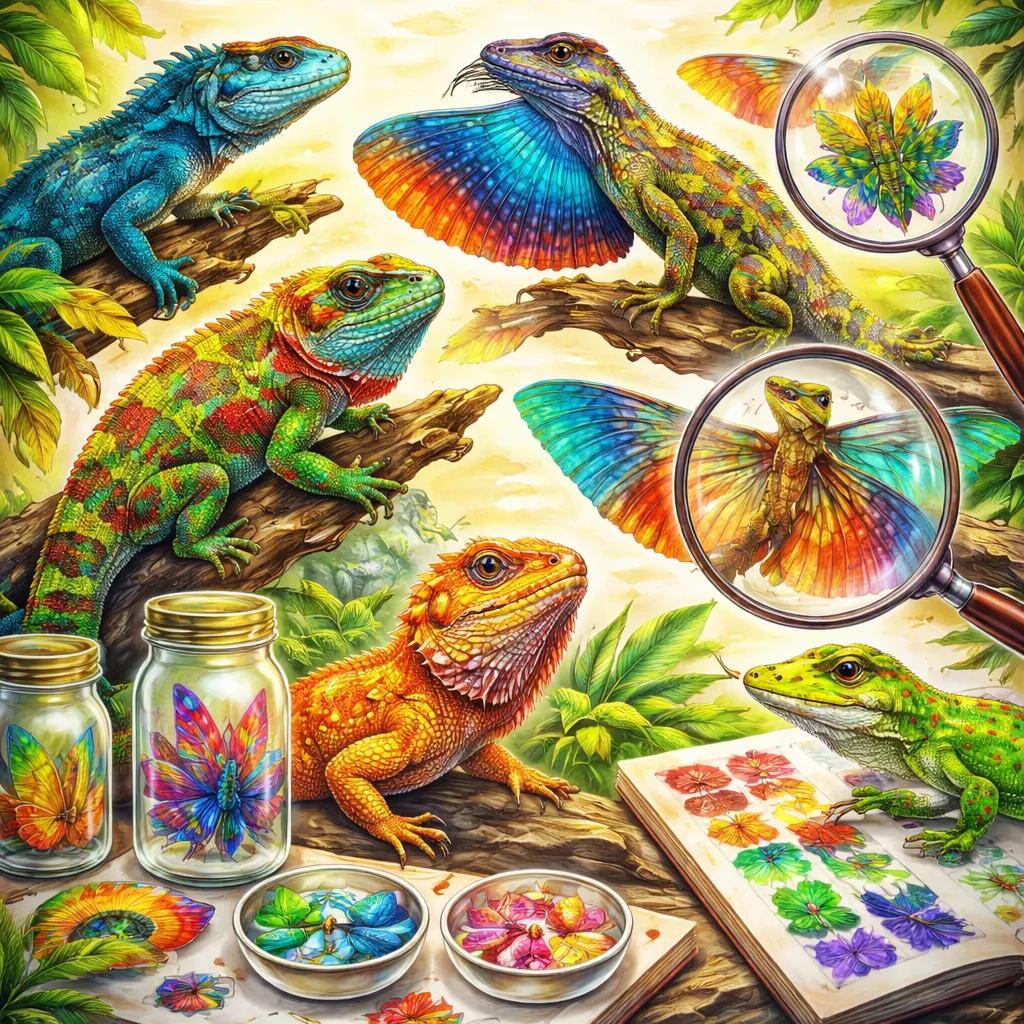

Have you ever been outside on a warm, sunny day and seen a small, quick creature with scaly skin dart across a rock or a wall? It might stop, puff out its throat, and then zip away in a flash! That’s a lizard! These incredible reptiles come in thousands of shapes, sizes, and colors, living on every continent except Antarctica. Learning about lizards is a fun adventure that takes us to deserts, forests, and even our own backyards. Let’s begin our journey of learning about lizard life and their cool tricks.
English Language Learning
Vocabulary and Spelling Our scaly, fast friend is called a lizard. The word "lizard" is a noun. A noun names a person, place, or thing. So, a lizard is a thing—a living reptile. Spelling "lizard" is simple: L-I-Z-A-R-D. The 'L' starts the word, the 'I' and 'Z' are in the middle, and it ends with 'A-R-D'. L-I-Z-A-R-D spells lizard.
Sound and Pronunciation Let’s say the word correctly. It sounds like this: /ˈlɪz.ɚd/. We can say it in two clear parts. First, say "liz". It rhymes with "fizz". Next, say "ard". It sounds like the end of "hard". Now, put it together! "Liz" "ard". Lizard! Great! The word "lizard" has two beats, or two syllables. Clap your hands twice: Liz-ard. It’s a quick, zippy word.
Related Words Learning about lizards is more fun with new words! Here are some important ones. Action: The way a lizard loses its old skin is called shedding. A baby lizard is a hatchling. Body Part: The flap of skin some lizards puff out under their neck is a dewlap. Home: A lizard’s home, like a crack in a rock or a hollow log, is its crevice or burrow.
A Famous Idea Because they are often seen basking in the sun, people sometimes say: "As quick as a lizard." This means someone or something is very fast and agile. It comes from the way lizards can dart away in the blink of an eye. It reminds us that being quick and nimble can be a great skill. Say the idea with me: "As quick as a lizard." It’s all about speed!
Now you know the word "lizard"! Are you ready to scurry into some amazing facts? Let’s crawl from words to wonderful knowledge!
Animal Knowledge
Who Are They? – Family and Group What kind of animal is a lizard? Lizards are reptiles. They are cold-blooded, have scaly skin, and most lay eggs. They belong to the Squamata order, and their suborder is called Lacertilia. Their closest cousins are snakes! There are over 6,000 species, from tiny geckos to huge Komodo dragons. They are one of the most common and diverse reptile groups.
What Do They Look Like? – Amazing Bodies Lizards come in all sizes, from smaller than your finger to longer than you are tall! They have four legs, a long tail, and dry, scaly skin. Their most famous features are their long tails and their amazing ability to change color or lose their tail. Their body is full of super tools! Many lizards can detach their tail if a predator grabs it. The tail wiggles to distract the enemy while the lizard runs away. It grows back later! Some, like chameleons, can change color to hide or talk. Lizards have special adaptations. They are cold-blooded, so they bask in the sun to warm up. They have excellent eyesight. Many have sticky toe pads to climb walls and even walk on ceilings! Their tongues are often long and sticky for catching insects.
Where Do They Live and How? – Home and Habits Lizards live almost everywhere on Earth except the very coldest places. Their homes are deserts, rainforests, mountains, and gardens. They love warm, sunny spots. Most lizards are insectivores. This means they eat insects like flies, crickets, and spiders. Bigger lizards might eat small animals, eggs, or plants. They are important because they help control insect populations. Lizards are often solitary. They are active during the day. They spend their time basking in the sun, hunting for food, and hiding from predators. A group of lizards is called a lounge.
A Lizard’s Life Story – Growing Up A baby lizard is called a hatchling. Most lizards hatch from eggs with leathery shells. Some species, like the Blue-tongued Skink, give birth to live young. Most lizard parents do not take care of their babies. The mother lays the eggs in a safe, warm place and leaves. The hatchlings are on their own from the moment they hatch or are born. Hatchlings look like tiny versions of their parents. They grow by shedding their skin as they get bigger. They must avoid predators and find food. It can take a few years for a lizard to become an adult. Some lizards can live for over 20 years.
How Do They "Talk"? – Communication Lizards are not very loud, but they do communicate. Some make soft chirps or hisses. Geckos are famous for their loud chirping calls. They use a lot of body language. A lizard might bob its head up and down, puff out its dewlap (throat fan), or do push-ups. This is how they say "This is my territory" or "I want to be your friend" to another lizard. Their best senses are their eyesight and their sense of smell. They have very good vision to spot moving insects. They use their tongue to "taste" the air and smell their surroundings, just like a snake does.
Are They Okay? – Taking Care of Them Many lizard species are common, but some are endangered or threatened. They face dangers from people and changes in their environment. The main threats are loss of their home habitat, pollution, and being caught for the pet trade. In some places, people are afraid of them and hurt them. Cats and cars are also big dangers for lizards. You can be a lizard friend! You can create a lizard-friendly garden with rocks and logs for them to hide under. Keep cats indoors. If you see a lizard, watch it but don’t try to catch it. Never take a lizard from the wild. Support zoos and groups that protect reptile habitats.
Life Connections and Inspiration
How to Be With Them – Safety and Love Lizards are wild animals. They can be fun to watch but are not toys. We must respect them and observe them safely. The rule is: Watch with your eyes, not with your hands. If you see a lizard in your yard or on a hike, watch it from a distance. Never try to grab or chase a lizard. You could hurt it, or it might drop its tail. Never take a wild lizard home as a pet. If you have a pet lizard, it must be one that was bred in captivity and you must learn how to care for it properly. We show our love by letting lizards live their wild lives and by protecting the sunny, rocky, and leafy places they need.
Super Qualities We Learn from Them Lizards teach us wonderful things. One super quality is incredible adaptability and quick thinking. Lizards live in so many different places and have amazing tricks like dropping their tail to escape. They teach us to adapt to our surroundings, to think fast, and to use our unique skills to solve problems. Another quality is renewal and growth. Lizards shed their old skin to grow new, bigger skin. This reminds us that it’s okay to let go of old things and to keep growing and changing. It’s a natural part of life. Think about it: How can you adapt and think quickly in a new situation? What is something you have outgrown or learned to let go of, like a lizard sheds its skin?
Take Action! – Your "Lizard Habitat" Project Let’s do an adaptive and creative activity! Your project is to build a mini lizard lounge in a box. Take a shoebox and turn it on its side. Create a sunny basking spot with a flat stone. Add twigs for climbing. Make a hiding place with a small paper cup or bark. You can draw or cut out pictures of insects for food. Create a paper lizard and place it in your habitat. This shows what a lizard needs to be happy: sun, shelter, climbing spots, and food.
Closing Learning about lizard diversity is a quick and fascinating adventure! We learned the word "lizard" and how to say its two-part name. We discovered amazing facts about their detachable tails, their sticky feet, and their life in sunny spots all over the world. We know that lizards are adaptable, quick reptiles that are important for healthy environments. You can use your new words to share the cool story of these scaly sun-lovers. You can use your knowledge to be a respectful wildlife watcher and a creator of safe spaces for nature. The animal world is full of adaptable and renewing teachers. Always remember to respect wildlife from a safe distance, adapt and think quickly when needed, and embrace growth and change in your own life. Keep exploring with curiosity, move through your world with agility, and be a friend to the wild. Your thoughtful actions and quick spirit make you a true friend to the amazing lizard.