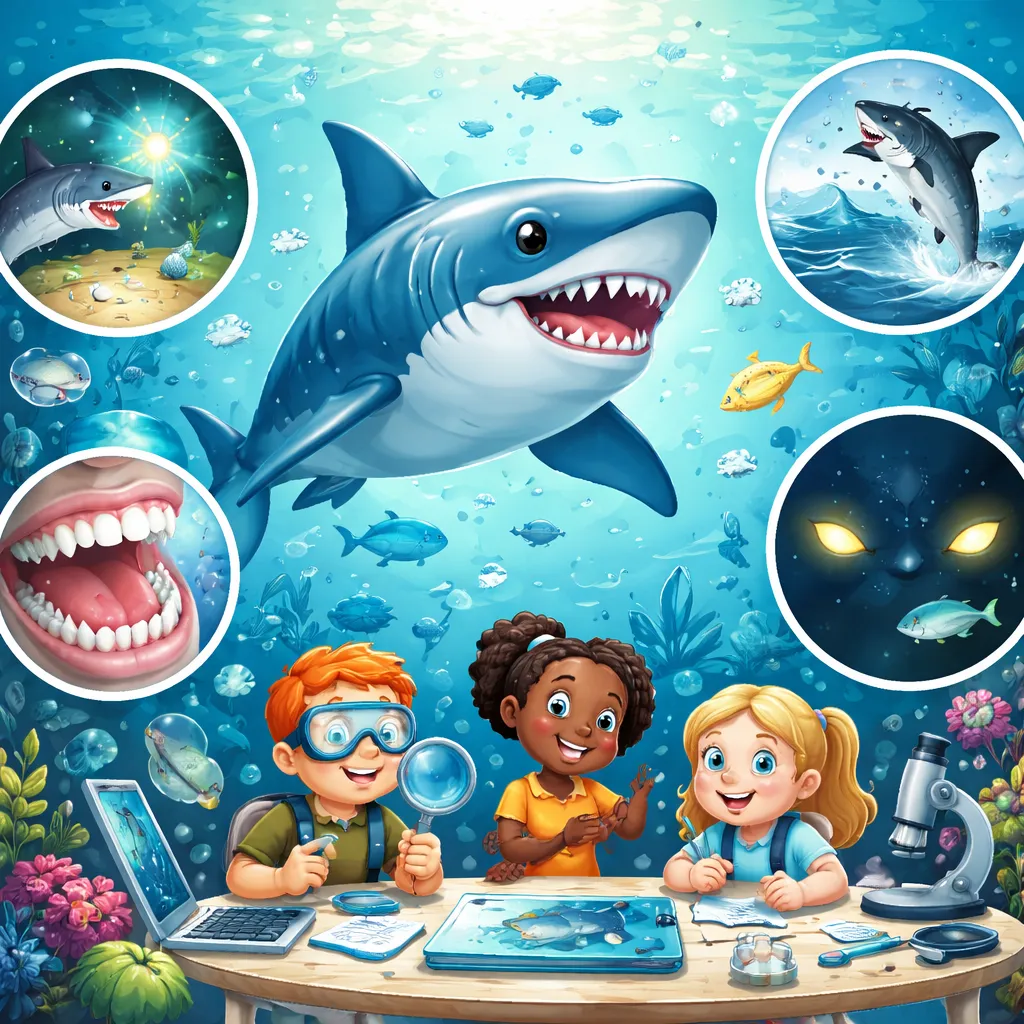

Have you ever seen a picture of a sleek, powerful fish with a tall fin cutting through the ocean waves? That’s a shark! Sharks are often in movies as scary creatures, but in reality, they are fascinating fish that are super important for a healthy ocean. Learning about sharks is a thrilling deep-sea adventure that shows us the true nature of these incredible animals. Let’s begin our journey of learning about shark secrets and skills.
English Language Learning
Vocabulary and Spelling Our powerful ocean friend is called a shark. The word "shark" is a noun. A noun names a person, place, or thing. So, a shark is a thing—a living fish. Spelling "shark" is simple: S-H-A-R-K. The 'S' starts the word, the 'H' and 'A' are in the middle, and it ends with 'R-K'. S-H-A-R-K spells shark.
Sound and Pronunciation Let’s say the word correctly. It sounds like this: /ʃɑːrk/. We can say it in one clear part. First, say "sh". It’s the sound you make to tell someone to be quiet. Then, say "ark". It rhymes with "park". Now, put it together! "Sh" "ark". Shark! Great! The word "shark" has just one beat, or one syllable. Clap your hands once: Shark! It’s a short, sharp word.
Related Words Learning about sharks is more fun with new words! Here are some important ones. Body Part: The triangle-shaped fin on a shark’s back is the dorsal fin. A baby shark is called a pup. Group: A group of sharks is called a shiver or a school. Action: The way sharks constantly move water over their gills to breathe is ram ventilation.
A Famous Saying There is a common phrase: "Like a shark in the water." This describes someone who moves with confidence, skill, and purpose in their environment. It comes from the shark’s graceful and powerful swimming. It reminds us to move through our own tasks with confidence and skill. Say the phrase with me: "Like a shark in the water." It’s about being capable and focused.
Now you know the word "shark"! Are you ready to dive into some amazing facts? Let’s swim from words to wonderful knowledge!
Animal Knowledge
Who Are They? – Family and Group What kind of animal is a shark? Sharks are fish. But they are a special kind of fish with a skeleton made of cartilage, not bone. This is the same bendy material as your ears and nose! They are part of the Selachimorpha group. There are over 500 species, from the tiny Dwarf Lanternshark to the giant Whale Shark. They are some of the oldest animals on Earth, even older than the dinosaurs!
What Do They Look Like? – Amazing Bodies Sharks come in many shapes and sizes. They have streamlined bodies, several fins, and skin covered in tiny tooth-like scales called dermal denticles. Their most famous features are their multiple rows of sharp teeth and their super senses. Their teeth are a super tool! They are constantly replaced throughout the shark’s life. If one falls out, a new one moves forward. They have excellent eyesight, even in low light. Their skin is rough like sandpaper. Sharks have special adaptations. They have special gel-filled pores on their snouts called the Ampullae of Lorenzini. These let them sense the tiny electrical fields made by all living things, helping them find hidden prey. This is like a sixth sense!
Where Do They Live and How? – Home and Habits Sharks live in all the world’s oceans, from the surface to the deep sea. A few even swim into rivers. Their home is the saltwater ocean, and some live in brackish or freshwater. Sharks are carnivores. This means they are meat-eaters. Their diet includes fish, seals, squid, and even plankton (for the biggest sharks). They are important apex predators, which means they are at the top of the food chain and help keep the ocean balanced. Some sharks are solitary, while others swim in shivers. They are active at all times of the day. They spend their time swimming (they must keep moving to breathe), hunting, and exploring. A shark must keep water moving over its gills to get oxygen.
A Shark’s Life Story – Growing Up A baby shark is called a pup. Sharks are fish, but they have different ways of having pups. Some lay eggs (called mermaid’s purses), some give birth to live pups, and some hatch eggs inside the mother. Most shark mothers do not take care of the pups after they are born. The pups are born ready to swim and hunt on their own. They are very small but fully formed. Pups look like tiny versions of their parents. They grow slowly and can take many years to become adults. A shark pup must be clever and fast to survive in the big ocean. Sharks can live for a very long time, some for over 100 years.
How Do They "Talk"? – Communication Sharks do not make sounds like dolphins or whales. They are mostly silent hunters. They communicate through body language. A shark might arch its back, swing its head, or swim in a zigzag pattern to send messages to other sharks. These signs can say "Go away" or "I am the boss here." Their best senses are their incredible smell and their electroreception. They can smell a single drop of blood in an ocean of water! Their special electro-sense helps them find prey buried in the sand. Their hearing is also very good for detecting vibrations.
Are They Okay? – Taking Care of Them Many shark species are in serious trouble. Over a third of all sharks are threatened with extinction. This is a very big problem for the ocean. The main threats are overfishing (caught for their fins, meat, or by accident), getting tangled in nets, pollution, and loss of habitat. Millions of sharks are killed every year, which is very bad for ocean health. You can be a shark hero! You can learn the truth about sharks and tell others they are not mindless monsters. You can choose seafood that is caught in shark-safe ways. You can support groups that protect sharks and create marine reserves. Never buy products made from sharks, like shark fin soup or jewelry.
Life Connections and Inspiration
How to Be With Them – Safety and Love Sharks are powerful, wild predators. We must always respect them and the ocean, which is their home. The rule is: Respect from a distance. If you are in the ocean, remember you are a visitor. Always swim in groups and near a lifeguard. Do not swim at dawn, dusk, or night when some sharks feed. If you see a shark, stay calm, keep eye contact, and slowly move back to shore. Never try to touch or feed a shark. We show our love by protecting the oceans they rule. We can be brave voices for misunderstood creatures and work to keep their home healthy.
Super Qualities We Learn from Them Sharks teach us powerful lessons. One super quality is perfect adaptation and ancient resilience. Sharks have lived on Earth for hundreds of millions of years, changing and adapting to survive. They teach us to be resilient, to adapt to changes, and to use our unique strengths to thrive. Another quality is vital balance and focus. As apex predators, sharks keep the ocean food web in balance. They are focused hunters. This reminds us that every creature, even ones that seem scary, has an important role. It also teaches us to stay focused on our goals and to understand our place in the bigger picture. Think about it: How can you be resilient and adapt when things change, like sharks have for millions of years? How can you help keep things in balance in your own world, at home or school?
Take Action! – Your "Shark Super-Sense" Project Let’s do a focused and creative activity! Your project is to design a shark with its super senses labeled. Draw a large picture of a shark. Now, label its superpowers! Draw an arrow to its nose and write "Super Smell." Draw an arrow to its head and write "Electro-Sense." Draw an arrow to its skin and write "Dermal Denticles for Smooth Swimming." Draw an arrow to its eyes and write "Great Eyesight." This helps you remember all the amazing ways a shark experiences its world.
Closing Learning about shark superpowers is an exciting and important adventure! We learned the word "shark" and how to say its one-syllable name. We discovered amazing facts about their electro-sense, their replaceable teeth, and their life as ancient ocean guardians. We know that sharks are resilient, focused fish that are in great danger and desperately need our understanding and protection. You can use your new words to share the true story of these magnificent predators. You can use your knowledge to make choices that help our oceans and stand up for misunderstood animals. The animal world is full of resilient and balanced teachers. Always remember to respect wildlife from a safe distance, be resilient in the face of challenges, and understand the importance of every creature’s role. Keep exploring with brave curiosity, navigate your world with focus, and be a friend to the wild. Your thoughtful actions and brave spirit make you a true friend to the amazing shark.