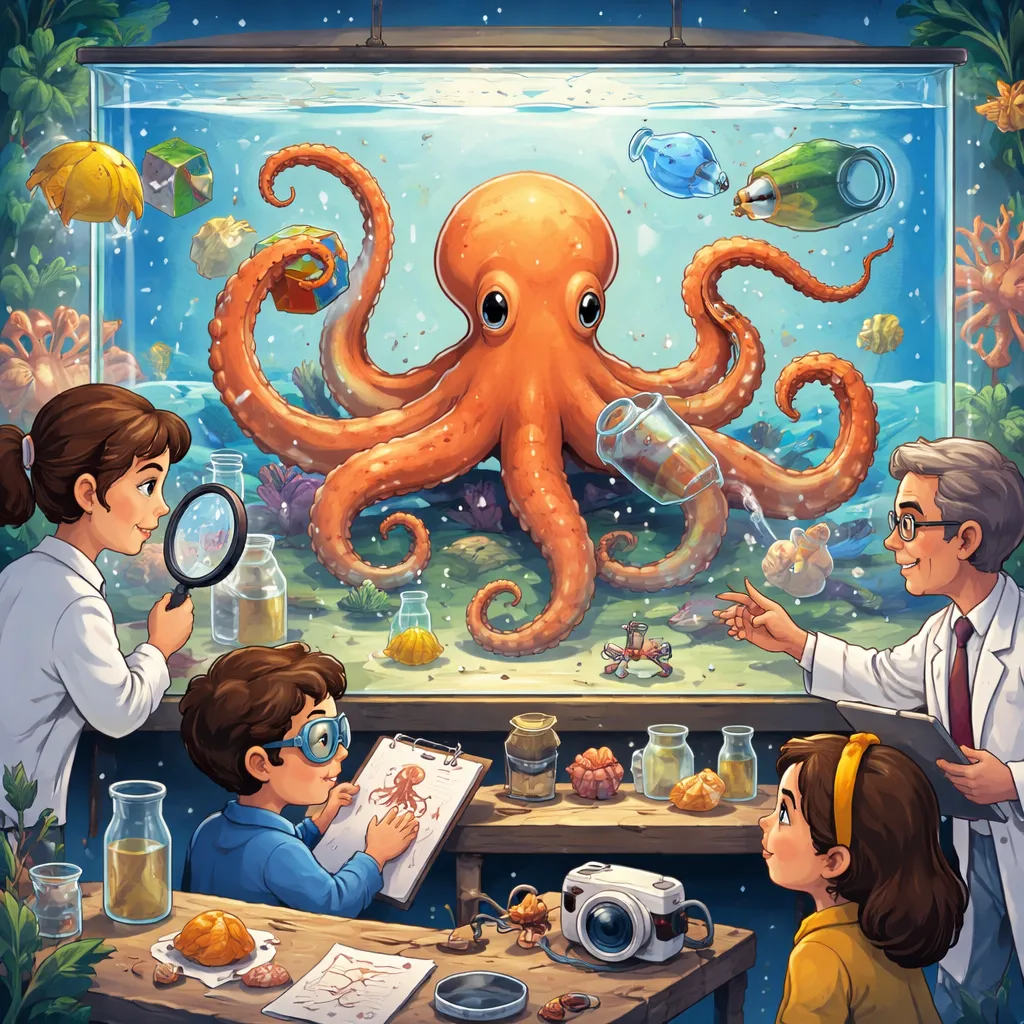

Imagine you’re at an aquarium, peering into a tank, and you see a creature that looks like it’s from another planet. It has a soft, bag-like body, large eyes, and eight long arms that move in every direction. It might even be changing color as you watch! That’s an octopus! These incredible animals are some of the smartest and most mysterious creatures in the sea. Learning about octopuses is a mind-bending adventure into the world of underwater intelligence. Let’s begin our journey of learning about octopus secrets and skills.
English Language Learning
Vocabulary and Spelling Our brilliant, eight-armed friend is called an octopus. The word "octopus" is a noun. A noun names a person, place, or thing. So, an octopus is a thing—a very smart, living animal of the ocean. Spelling "octopus" is interesting: O-C-T-O-P-U-S. The 'O' starts the word, the 'C' and 'T' are in the middle, and it ends with 'O-P-U-S'. O-C-T-O-P-U-S spells octopus.
Sound and Pronunciation Let’s say the word correctly. It sounds like this: /ˈɑːk.tə.pʊs/. We can say it in three clear parts. First, say "ahk". It sounds like "ock" in "lock". Next, say "tuh". It’s a soft, quick sound. Last, say "puhs". It rhymes with "bus". Now, put it together! "Ahk" "tuh" "puhs". Octopus! Great! The word "octopus" has three beats, or three syllables. Clap three times: Oc-to-pus. It’s a fun, bouncy word.
Related Words Learning about octopuses is more fun with new words! Here are some important ones. Body Parts: The eight long limbs of an octopus are called arms or tentacles. The tube it uses to swim and shoot water is a siphon. Defense: The dark cloud an octopus releases to hide is ink. Baby: A baby octopus is called a hatchling or a larva.
A Famous Idea Because they are so clever, people might say: "As clever as an octopus." This means someone is very smart, can solve tricky problems, and is good at figuring things out. It comes from the octopus’s amazing ability to learn, escape, and use tools. It reminds us that intelligence comes in many amazing forms. Say the idea with me: "As clever as an octopus." It’s a big compliment for being smart!
Now you know the word "octopus"! Are you ready to discover their incredible abilities? Let’s dive from words to wonderful knowledge!
Animal Knowledge
Who Are They? – Family and Group What kind of animal is an octopus? Octopuses are mollusks. They are invertebrates, which means they have no backbone. They are not fish! They are part of the cephalopod family. Their name means "head-foot"! Their cousins are squids, cuttlefish, and the nautilus. They are known as the geniuses of the invertebrate world.
What Do They Look Like? – Amazing Bodies Octopuses come in many sizes, from as small as your finger to as wide as a car! They have a soft, muscular body called a mantle, a large head, and eight strong arms. Their most famous features are their eight sucker-covered arms and their huge, intelligent eyes. Their arms are super tools! Each arm has a mind of its own and can taste and touch. The suckers are incredibly strong for holding onto things. Their eyes are as complex as a human’s and can see very well. Octopuses have special adaptations. They are masters of camouflage. They can change their skin color, pattern, and even texture in a flash to match rocks, sand, or coral. This is for hiding and for talking. They have three hearts and blue blood!
Where Do They Live and How? – Home and Habits Octopuses live in every ocean, from warm tropical reefs to the cold deep sea. Their homes are rocky crevices, coral reefs, and the ocean floor. They often make a den to hide in. Octopuses are carnivores. This means they are meat-eaters. They love to eat crabs, shrimp, clams, and lobsters. They are clever hunters, sometimes prying open shells or even sneaking up on their prey in disguise. Octopuses are mostly solitary and shy. They are active at night or during the day, depending on the species. They spend their time exploring, hunting, solving puzzles, and hiding in their dens. They are famous escape artists in aquariums!
An Octopus’s Life Story – Growing Up A baby octopus is called a hatchling. Octopuses lay eggs. A mother octopus lays thousands of tiny eggs in strings in her den and guards them fiercely. The mother octopus is a dedicated but sad parent. She stops eating to care for her eggs, cleaning them and blowing water on them for months. After they hatch, she dies. The father dies soon after mating. Hatchlings are tiny, the size of a grain of rice. They float in the ocean plankton, and very few survive. They grow quickly, learning to hunt and hide. An octopus’s life is short, usually just one to two years, but packed with learning.
How Do They "Talk"? – Communication Octopuses are usually quiet animals. They don’t make sounds, but they have a vivid visual language. They "talk" by changing their skin. They flash colors, create moving patterns, and change their skin texture to show if they are scared, angry, or trying to attract a mate. They can also squirt ink to say "Leave me alone!" Their best senses are their incredible eyesight and touch. Their eyes are excellent. Their arms are so sensitive they can "see" and taste with their suckers, helping them explore the world in a way we can’t imagine.
Are They Okay? – Taking Care of Them Most octopus species are not endangered, but they face growing threats. Their populations are healthy but sensitive to changes. The main threats are ocean pollution, habitat damage from fishing, and climate change. They are also caught for food in some parts of the world. Because they are so smart, it’s important they live in healthy, complex environments. You can be an octopus friend! You can learn and share how amazing they are. You can help keep the ocean clean by reducing plastic. Choose seafood that is caught in ways that don’t harm the ocean floor. Support marine protected areas that keep their homes safe.
Life Connections and Inspiration
How to Be With Them – Safety and Love Octopuses are wild, intelligent, and often shy animals. We must admire them with great respect and without causing them stress. The rule is: Observe with wonder, never disturb. If you see an octopus in the ocean while snorkeling or diving, watch from a distance. Never poke, chase, or try to pull an octopus from its den. Never take one from the wild. In an aquarium, follow the rules and be a quiet observer. We show our love by protecting the health and mystery of the ocean world they rule. We can be curious and respectful guests in their underwater home.
Super Qualities We Learn from Them Octopuses teach us astonishing lessons. One super quality is creative problem-solving and adaptability. An octopus can escape from a locked jar, use a coconut shell as a shelter, and change its entire appearance in a second. It teaches us to think outside the box, to adapt quickly to new situations, and to use our creativity to solve problems. Another quality is the power of observation and learning. Octopuses watch, learn, and remember. They can recognize different people. This reminds us of the importance of being observant, curious, and always willing to learn new things from the world around us. Think about it: How can you use creative thinking to solve a problem at home or school? How can you be a better observer and learner in your daily life?
Take Action! – Your "Octopus Escape" Project Let’s do a creative and problem-solving activity! Your project is to design a simple "puzzle" for a pretend octopus to solve. Take a clear plastic container with a lid. Put a small toy or a shiny stone inside. Now, can you figure out how to get it out without using your hands? Can you use a stick like an arm? Can you tip it over? Think like an octopus! This shows how octopuses have to think to get their food from tricky places.
Closing Learning about octopus intelligence is a thrilling and awe-inspiring adventure! We learned the word "octopus" and how to say its three-part name. We discovered amazing facts about their color-changing skin, their super-smart arms, and their life as solitary ocean geniuses. We know that octopuses are creative, adaptable animals that show us a different kind of brilliance. You can use your new words to share the incredible story of these eight-armed wonders. You can use your knowledge to appreciate the importance of all intelligent life and to make choices that protect our mysterious oceans. The animal world is full of creative and observant teachers. Always remember to respect wildlife from a safe distance, use your creativity to solve problems, and never stop observing and learning. Keep exploring with a curious mind, adapt to challenges with cleverness, and be a friend to the wild. Your thoughtful actions and creative spirit make you a true friend to the amazing octopus.