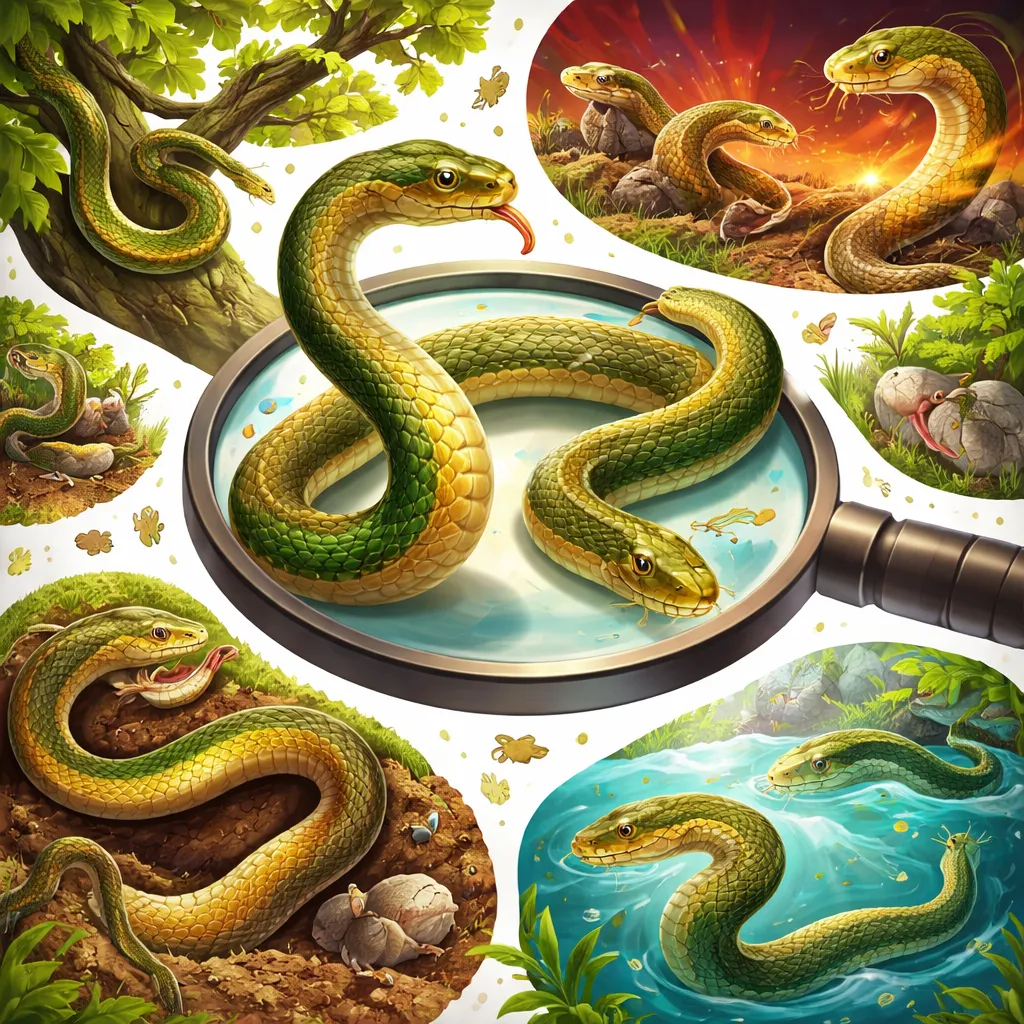

Imagine you’re walking in a garden, a forest, or even a desert, and you see a long, thin creature with no legs, gliding silently across the ground. It might flicker a forked tongue in and out. That’s a snake! These fascinating reptiles move in a way no other animal does and are found on every continent except Antarctica. Learning about snakes is a slithering adventure into a world of unique senses and survival. Let’s begin our journey of learning about snake movement and mystery.
English Language Learning
Vocabulary and Spelling
Our long, legless friend is called a snake.
The word "snake" is a noun. A noun names a person, place, or thing. So, a snake is a thing—a living reptile.
Spelling "snake" is simple: S-N-A-K-E. The 'S' starts the word, the 'N' and 'A' are in the middle, and it ends with 'K-E'. S-N-A-K-E spells snake.
Sound and Pronunciation
Let’s say the word correctly. It sounds like this: /sneɪk/.
We can say it in one clear part. It starts with a "sn" sound (like in "snap") and ends with a long "ake", like in "cake" or "lake".
Now, say it out loud! Snake! Great!
The word "snake" has just one beat, or one syllable. Clap your hands once: Snake! It’s a sleek, strong word.
Related Words
Learning about snakes is more fun with new words! Here are some important ones.
Baby: A baby snake is called a snakelet or a hatchling.
Action: The way a snake moves is called slithering.
Body Part: The clear layer that protects a snake’s eyes is an eye cap.
A Famous Saying
People sometimes say: "As sly as a snake."
This usually means someone is very clever, cautious, and good at moving without being noticed. It comes from the snake’s quiet, smooth way of moving and hunting. It reminds us that being observant and smart can be a strength.
Say the saying with me: "As sly as a snake." It’s about being clever and quiet.
Now you know the word "snake"! Are you ready to slither into some amazing facts? Let’s move from words to wonderful knowledge!
Animal Knowledge
Who Are They? – Family and Group
What kind of animal is a snake? Snakes are reptiles. They are cold-blooded, have scaly skin, and most lay eggs.
They belong to the Serpentes group. They are a type of lizard that lost its legs over millions of years! Their closest cousins are other reptiles like lizards and turtles. There are over 3,000 different species of snakes.
What Do They Look Like? – Amazing Bodies
Snakes come in all sizes, from as thin as a spaghetti noodle to longer than a school bus! They have a long, thin body with no legs, and they are covered in scales. Their most famous features are their forked tongue and their jaw that can open very wide.
Their body is a super moving machine! They have strong muscles and special scales on their belly to grip the ground and push forward. Their jaw is not fixed; it can stretch to swallow prey much bigger than their head!
Snakes have special adaptations. They don’t have eyelids, so they can’t blink. They have a clear scale over their eyes. They "smell" with their tongue, flicking it to collect scent particles from the air. Some snakes have special heat-sensing pits to find warm-blooded prey in the dark.
Where Do They Live and How? – Home and Habits
Snakes live almost everywhere on Earth, except in very cold places. Their homes are forests, deserts, grasslands, lakes, and even the ocean. They like to hide under rocks, in logs, or in tall grass.
Snakes are carnivores. This means they are meat-eaters. They eat mice, birds, eggs, insects, and other animals. Some snakes are constrictors (they squeeze their prey), and some are venomous (they use venom, or poison, to hunt). All snakes are very important for keeping rodent populations in balance.
Most snakes are solitary. They are active during the day or night, depending on the species. They spend their time basking in the sun to warm up, hunting for food, and hiding. A group of snakes is called a pit, a nest, or a bed.
A Snake’s Life Story – Growing Up
A baby snake is called a snakelet or a hatchling. Some snakes hatch from eggs, and some are born live from their mother. The mother usually leaves the eggs in a safe, warm place.
For most snakes, the parents do not take care of the babies after they are born or hatch. The snakelets are completely on their own. They know how to hunt and hide right away.
Snakelets look like tiny versions of their parents. They grow by shedding their skin. As they get bigger, they rub against something rough to peel their old skin off, starting at the head. This is called molting. A snake can shed its skin many times a year.
How Do They "Talk"? – Communication
Snakes are usually quiet. They don’t have vocal cords. Some snakes can hiss by forcing air out of a special opening. Rattlesnakes shake their rattle to warn others to stay away.
They use a lot of body language. Coiling up, flattening their head, or raising the front of their body are ways to say "I am scared" or "Go away, or I might bite."
Their best senses are their amazing sense of smell (using their tongue) and their ability to feel vibrations through the ground. They don’t have ears on the outside, but they can feel sounds vibrating through their jawbones.
Are They Okay? – Taking Care of Them
Many snake species are in trouble. Some are endangered or threatened. They are often misunderstood and harmed by people.
The main threats are people destroying their homes, being hit by cars, and being killed because of fear. Some are also caught for the pet trade or for their skin.
You can be a snake friend! You can learn and tell others that most snakes are harmless and helpful. You can slow down for wildlife on roads. Never kill a snake. If you see one in your yard, tell an adult and watch from a safe distance—it will usually slither away. Support groups that protect reptile habitats.
Life Connections and Inspiration
How to Be With Them – Safety and Love
Snakes are wild animals. Some are venomous and can be dangerous. We must always admire them with great respect and from a very safe distance.
The rule is: Look with your eyes, not with your hands. If you see a snake in the wild, stop, stay calm, and back away slowly. Never, ever try to touch, catch, or kill a snake. Never poke it with a stick. If you are hiking, stay on the trail and watch where you step. Teach an adult if you see a snake near your home.
We show our love by respecting their space, protecting their homes, and understanding their important role in nature.
Super Qualities We Learn from Them
Snakes teach us powerful lessons. One super quality is graceful adaptation and renewal. Snakes have adapted to live without legs, moving with silent grace. They also shed their old skin to grow, symbolizing renewal and new beginnings. They teach us to adapt to challenges and to embrace growth and change in our own lives.
Another quality is focused sensing and patience. A snake uses its tongue to sense the world patiently and waits calmly for the right moment to act. This reminds us to be observant, to use all our senses to understand our environment, and to practice patience.
Think about it: How can you adapt to a new situation with grace? How can you be more patient and observant, like a snake waiting and sensing?
Take Action! – Your "Snake Movement" Project
Let’s do a graceful and observant activity! Your project is to create a paper chain snake and map its path.
Cut strips of colorful paper. Make a paper chain to form the body of a snake. Decorate a head. Now, on a large piece of paper, draw a winding path like a snake might take. Place your paper snake along the path. This shows the curving, slithering movement of a real snake. You can even make the path go around obstacles!
Closing
Learning about snake senses is a fascinating and respectful adventure! We learned the word "snake" and how to say its one-syllable name. We discovered amazing facts about their forked tongues, their jawbones, and their life as silent hunters. We know that snakes are adaptable, patient reptiles that are often misunderstood and need our protection. You can use your new words to share the true story of these incredible legless travelers. You can use your knowledge to be a safe and informed nature observer and a voice for misunderstood creatures. The animal world is full of graceful and observant teachers. Always remember to respect wildlife from a safe distance, adapt to changes with grace, and practice patience and observation. Keep exploring with curiosity, move through your world with purpose, and be a friend to the wild. Your thoughtful actions and respectful spirit make you a true friend to the amazing snake.