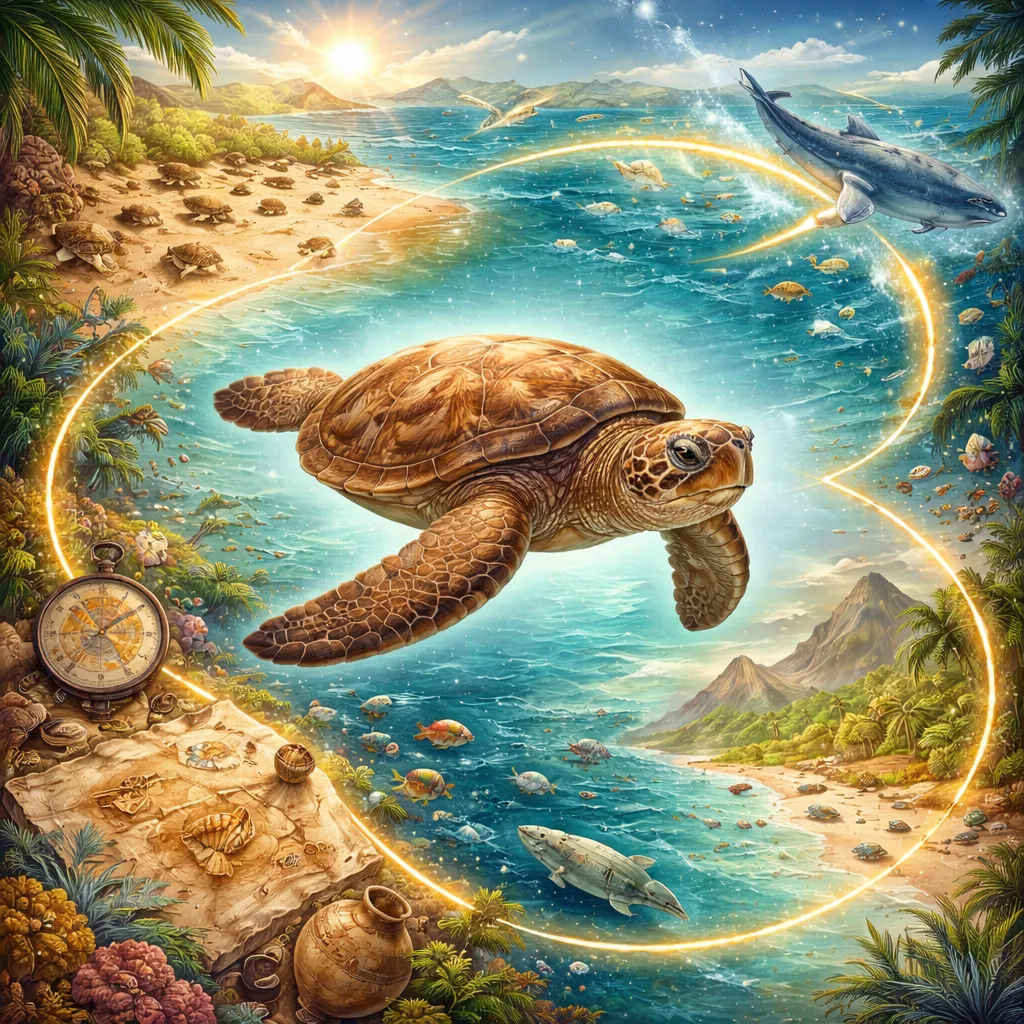

Imagine you’re snorkeling in a clear, blue ocean and you see a large, graceful animal with flippers slowly gliding through the water. It looks wise and peaceful, like a visitor from another time. That’s a sea turtle! These amazing reptiles have been swimming in our oceans since the time of the dinosaurs. Learning about sea turtles is a journey through time and across vast oceans. Let’s begin our adventure of learning about sea turtle travels and trials.
English Language Learning
Vocabulary and Spelling Our ancient, swimming friend is called a sea turtle. The words "sea turtle" form a noun. A noun names a person, place, or thing. So, a sea turtle is a thing—a living reptile of the sea. Spelling "sea turtle" is two words: S-E-A and T-U-R-T-L-E. S-E-A T-U-R-T-L-E spells sea turtle.
Sound and Pronunciation Let’s say the words correctly. It sounds like this: /ˈsiː ˌtɝː.t̬əl/. We can say it in two clear parts. First, say "sea". It’s just like the big ocean. Next, say "turtle". It starts with "tur" (like in turn) and ends with "tul". Now, put it together! "Sea" "turtle". Sea turtle! Great! The phrase "sea turtle" has two main beats. Clap twice: Sea turtle. It’s a calm, strong name.
Related Words Learning about sea turtles is more fun with new words! Here are some important ones. Baby: A baby sea turtle is called a hatchling. Body Part: The hard, protective covering on a sea turtle’s back is its carapace (shell). Its strong swimming limbs are flippers. Home: The sandy beach where a sea turtle lays her eggs is a nesting beach.
A Famous Saying People sometimes say: "As ancient as a sea turtle." This means something is very, very old, wise, and has seen many things. It comes from the sea turtle’s incredibly long history on our planet. It reminds us to respect and learn from ancient life. Say the saying with me: "As ancient as a sea turtle." It speaks of great age and wisdom.
Now you know the words "sea turtle"! Are you ready to follow their incredible journey? Let’s swim from words to wonderful knowledge!
Animal Knowledge
Who Are They? – Family and Group What kind of animal is a sea turtle? Sea turtles are reptiles. They are cold-blooded, have scaly skin, and breathe air. They belong to the Cheloniidae family, or the Dermochelyidae family for the giant Leatherback turtle. There are seven different species, like the Green Sea Turtle and the Loggerhead. They are some of the most ancient reptiles alive today.
What Do They Look Like? – Amazing Bodies Sea turtles are large, with shells that can be as long as a kitchen table! They have a streamlined shell, large flippers, and a beaked mouth. Their most famous features are their large, protective shell and their strong, paddle-like flippers. Their shell is a super suit of armor! It protects their body. Their flippers are perfect for flying through the water, but they are clumsy on land. They cannot pull their head or flippers into their shell like a land turtle can. Sea turtles have special adaptations. They can hold their breath for hours when resting. They have special glands near their eyes to remove excess salt from the seawater they drink. They have an amazing sense of direction, using the Earth’s magnetic field to navigate across entire oceans.
Where Do They Live and How? – Home and Habits Sea turtles live in all the warm and temperate oceans of the world. Their home is the open ocean, coral reefs, and coastal bays. They travel thousands of miles between their feeding grounds and the beaches where they were born. What a sea turtle eats depends on its species. Some are herbivores (plant-eaters) like the Green Sea Turtle, which eats sea grass. Others are carnivores (meat-eaters) like the Loggerhead, which eats crabs and jellyfish. Sea turtles are solitary but gather near good feeding areas. They are active during the day. They spend their time swimming, diving for food, and coming to the surface to breathe. Females return to land only to lay eggs. A group of sea turtles is sometimes called a bale or a turn.
A Sea Turtle’s Life Story – Growing Up A baby sea turtle is called a hatchling. Sea turtles lay eggs. A mother turtle crawls onto a beach at night, digs a hole, and lays about one hundred soft, white eggs. She then covers the nest and returns to the sea. The mother does not take care of the eggs or hatchlings. The eggs are kept warm by the sun. After about two months, the hatchlings use a special "egg tooth" to break out of their shell. They all dig out of the sand together in a big group. The hatchlings are tiny, about the size of a cookie. They must immediately scramble to the ocean, guided by the light of the moon on the water. This journey is very dangerous. Only one in a thousand hatchlings will survive to become an adult. Sea turtles grow slowly and can live for over eighty years.
How Do They "Talk"? – Communication Sea turtles are generally quiet animals. They do not have vocal cords. Some may make hisses or grunts, especially when nesting, but they are not talkative. They communicate mostly through body language and touch. During mating, they might nudge or bite. They are not social animals, so they do not need complex calls. Their best senses are their excellent eyesight (especially underwater) and their incredible sense of direction. They can see well to find food. Their ability to navigate using the Earth’s magnetic field is one of their most amazing superpowers.
Are They Okay? – Taking Care of Them Almost all species of sea turtles are endangered or threatened. This means they are in danger of disappearing forever. They need our help very much. The main threats are plastic pollution (they think plastic bags are jellyfish), getting caught in fishing nets, loss of nesting beaches, poaching of their eggs, and climate change warming the sand and affecting the sex of hatchlings. You can be a sea turtle hero! You can reduce plastic use, especially bags and straws. You can keep beaches clean and dark at night during nesting season. You can support groups that protect sea turtles and their nests. Never buy products made from sea turtle shell.
Life Connections and Inspiration
How to Be With Them – Safety and Love Sea turtles are wild, protected, and often endangered animals. We must give them space and never interfere with their natural behavior. The rule is: Watch quietly from a respectful distance. If you see a sea turtle in the ocean while swimming or snorkeling, do not touch, chase, or ride it. If you see a turtle on the beach nesting, stay far back, be quiet, and never use flashlights or camera flashes. Always follow local guidelines. We show our love by being guardians of their ocean and beach homes. We can make choices that ensure these ancient mariners continue their journeys for generations.
Super Qualities We Learn from Them Sea turtles teach us profound lessons. One super quality is ancient wisdom and incredible navigation. Sea turtles travel thousands of miles and always find their way back to the beach where they were born. They teach us about perseverance, finding our way in life, and the importance of returning to our roots. Another quality is protected resilience. A sea turtle carries its strong shell for protection, yet it moves with grace and purpose. This reminds us that it is wise to have protection and boundaries, but we must still move forward bravely on our own life’s journey. Think about it: What is a long-term goal you are navigating towards? How can you carry your own "shell" of strengths and values to protect you on your journey?
Take Action! – Your "Turtle Migration" Project Let’s do a navigational and creative activity! Your project is to map the epic migration of a sea turtle. On a large piece of paper, draw a simple world map with oceans. Choose a species, like the Loggerhead. Draw a line from its nesting beaches in Japan, across the Pacific Ocean, to feeding grounds near Mexico! Draw a small paper sea turtle and attach it with a paper clip so it can "swim" the route. Label the dangers it might face, like plastic or nets. This shows the incredible journey these animals undertake.
Closing Learning about sea turtle journeys is a humbling and awe-inspiring adventure! We learned the words "sea turtle" and how to say them. We discovered amazing facts about their shells, their magnetic navigation, and their dangerous trip from nest to ocean. We know that sea turtles are ancient, resilient reptiles that are in great danger and need our immediate help. You can use your new words to share the urgent story of these ocean voyagers. You can use your knowledge to become a protector of beaches and oceans. The animal world is full of wise and persistent teachers. Always remember to respect wildlife from a safe distance, navigate your own path with purpose, and carry your strengths with you. Keep exploring with wonder, swim through life with grace, and be a friend to the wild. Your caring actions and protective spirit make you a true friend to the amazing sea turtle.