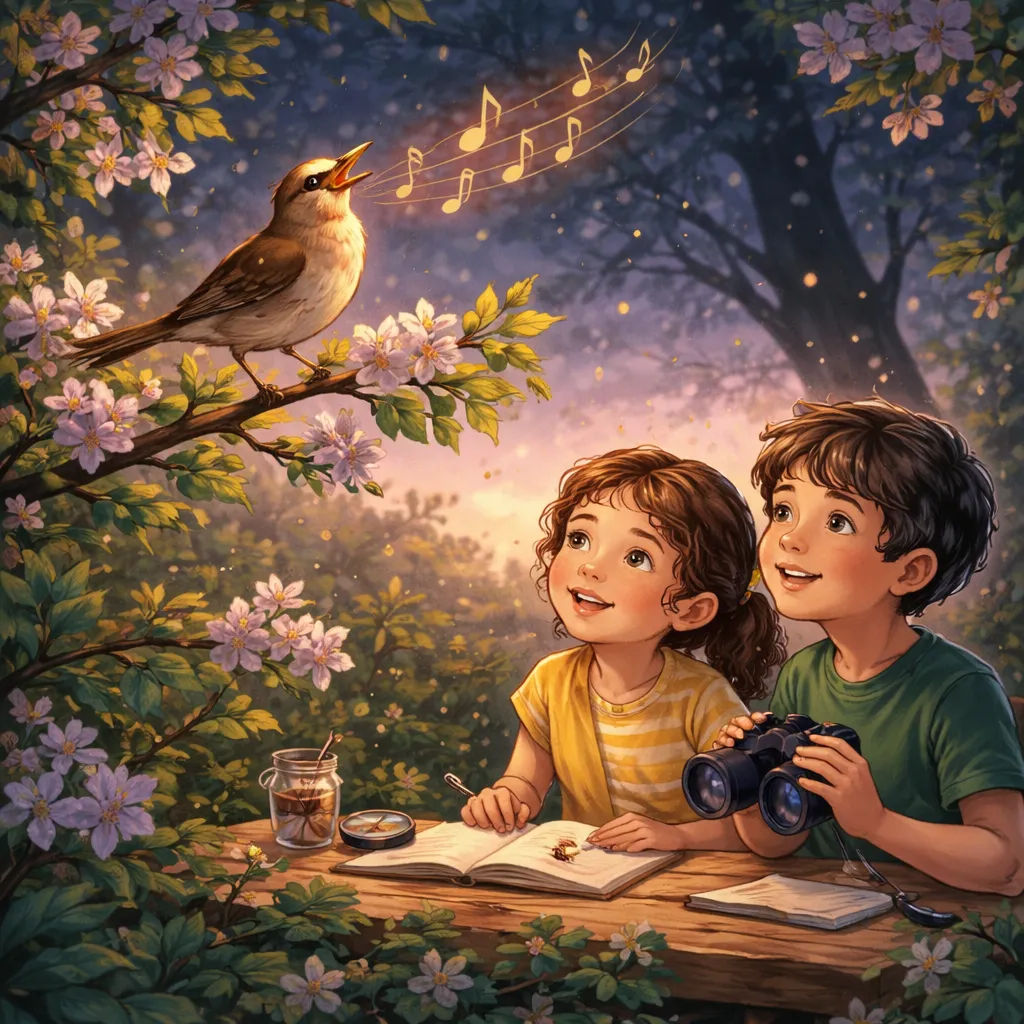

Have you ever heard a story or a poem about a bird that sings the most beautiful song, even in the dark of night? This bird is famous in books and songs from all over the world. It’s the nightingale! With their powerful and lovely voices, nightingales are known as nature’s greatest singers. Learning about nightingales is a magical adventure that takes us to moonlit forests and teaches us about music and mystery. Let’s begin our journey of learning about nightingale songs.
English Language Learning
Vocabulary and Spelling Our famous singing friend is called a nightingale. The word "nightingale" is a noun. A noun names a person, place, or thing. So, a nightingale is a thing—a small bird with a very big voice. Spelling "nightingale" is two words put together: N-I-G-H-T and I-N-G-A-L-E. N-I-G-H-T-I-N-G-A-L-E spells nightingale.
Sound and Pronunciation Let’s say the word correctly. It sounds like this: /ˈnaɪ.tən.ɡeɪl/. We can say it in three clear parts. First, say "nite". It rhymes with "light". Next, say "in". It’s a quick sound. Last, say "gale". It rhymes with "sail". Now, put it together! "Nite" "in" "gale". Nightingale! Great! The word "nightingale" has three beats, or three syllables. Clap three times: Night-in-gale. It’s a musical, flowing word.
Related Words Learning about nightingales is more fun with new words! Here are some important ones. Sound: The complex and beautiful song of a nightingale is a melody or song. A baby nightingale is a chick. Action: The act of singing, especially at night, is singing or warbling. Home: The nightingale’s home in dense bushes and forests is a thicket.
A Famous Saying The nightingale is so famous that it appears in a common phrase: "As sweet as a nightingale’s song." This means something is very pleasant, beautiful, and joyful to listen to. It comes from the bird’s incredibly rich and musical voice. It reminds us of the power of beautiful sounds to bring happiness. Say the saying with me: "As sweet as a nightingale’s song." It’s a lovely compliment.
Now you know the word "nightingale"! Are you ready to listen to some amazing facts? Let’s travel from words to wonderful knowledge!
Animal Knowledge
Who Are They? – Family and Group What kind of animal is a nightingale? Nightingales are birds. They are warm-blooded, have feathers, and lay eggs. They are part of the thrush family, called Muscicapidae. Their scientific name is Luscinia megarhynchos. They are close cousins of robins. They are famous for being one of the best songbirds in the world.
What Do They Look Like? – Amazing Bodies Nightingales are small, brown birds, about the size of your hand. They are not very colorful; their feathers are plain brown and cream. This helps them hide in the bushes. Their most famous feature is not how they look, but their incredible voice. They have a super voice box! Their song is very complex, with over 200 different phrases. They can copy other birds and make whistles, trills, and gurgles. They sing to attract a mate and to mark their territory. Nightingales have special adaptations. They are shy and hide in thick bushes, so their beautiful song is how they communicate. They have excellent hearing to listen to other birds. They are also strong fliers and migrate long distances.
Where Do They Live and How? – Home and Habits Nightingales live in Europe, Asia, and Africa. In summer, they live in dense forests, woodlands, and parks with lots of bushes. They like places where they can hide. In winter, they fly to warm Africa. Nightingales are insectivores. This means they eat insects. They love beetles, ants, and flies. They find their food on the ground, hopping in the leaf litter. Sometimes they also eat berries. Nightingales are often alone or in pairs. They are most active at dawn and dusk, and yes, at night! The male sings his famous song mostly at night to attract a female and to tell other males to stay away. During the day, they are quiet and secretive.
A Nightingale’s Life Story – Growing Up A baby nightingale is called a chick. Nightingales are birds, so chicks hatch from eggs. The mother usually lays four or five greenish-brown eggs in a nest well-hidden on the ground or in a low bush. The mother nightingale does most of the work. She builds the nest and keeps the eggs warm. After hatching, both parents bring insects to the hungry chicks. They are very careful to not lead predators to their hidden nest. Chicks are born naked and blind. They grow quickly and leave the nest after about 12 days, before they can even fly well! They hide in the bushes while the parents feed them for a few more weeks. They learn to sing by listening to their father.
How Do They "Talk"? – Communication The nightingale’s song is its most famous talk! The male’s song is loud, long, and very complicated. It is a series of beautiful whistles, trills, and gurgles. Each male has his own style. They also use short call notes to warn of danger. But their main way to talk is through their music. The night song is a way to say, "I am here, I am strong, and this is my home," without being seen. Their best senses are their amazing hearing and voice. They have excellent hearing to learn songs and to hear predators. Their voice is their most important tool for life.
Are They Okay? – Taking Care of Them In many places, nightingale numbers are going down. They are becoming scarce and are a cause for concern. This is because their special homes are disappearing. The main threats are the loss of the dense, messy bushes and woodlands they need to live and hide in. People sometimes clear these areas. Also, droughts in their African winter homes make it hard to find food. You can be a nightingale friend! You can learn about them and tell others. You can support groups that protect wild forests and woodlands. If you have a garden, you can leave a wild, bushy corner for birds and insects. Never use pesticides, as they kill the insects nightingales eat.
Life Connections and Inspiration
How to Be With Them – Safety and Love Nightingales are very shy, wild birds. They are hard to see and easy to scare. We must be very respectful and quiet if we are lucky enough to be near one. The rule is: Listen, but do not look for them. If you are in a place where nightingales live, the best way to enjoy them is to sit quietly at dusk or night and just listen. Never try to find their nest or chase them. Use your ears, not your eyes. Keep noise and lights low. We show our love by protecting the quiet, wild, and bushy places they call home. We can be voices for peace and natural spaces.
Super Qualities We Learn from Them Nightingales teach us beautiful lessons. One super quality is finding your unique voice and sharing it bravely. The nightingale is a plain brown bird, but it shares the most beautiful music. It teaches us that true beauty and talent can be hidden, and that we should have the courage to share our own unique "song" with the world. Another quality is the power of music and persistence. The nightingale sings its heart out every night, creating beauty in the darkness. This reminds us that music and art can bring light and joy. It also shows persistence in practicing its song until it is perfect. Think about it: What is your own special "song" or talent that you can share? How can you use music, art, or kind words to bring light to others, like the nightingale’s song in the night?
Take Action! – Your "Nightingale Song" Project Let’s do a musical and creative activity! Your project is to create a drawing inspired by a nightingale’s song. Find a recording of a nightingale’s song online (with an adult’s help). Listen to it with your eyes closed. Now, take paper and crayons. Don’t draw a bird. Instead, draw the shapes, colors, and lines that the music makes you think of. Is it curly? Is it blue? Is it sparkly? This shows how music can create pictures in our minds and connects us to the nightingale’s art.
Closing Learning about nightingale music is a enchanting and thoughtful adventure! We learned the word "nightingale" and how to say its three-part name. We discovered amazing facts about their powerful songs, their hidden life in bushes, and their journey between continents. We know that nightingales are shy, musical birds whose beautiful songs are becoming rarer. You can use your new words to share the poetic story of these legendary singers. You can use your knowledge to appreciate the importance of wild spaces and the courage of sharing your own voice. The animal world is full of brave and artistic teachers. Always remember to respect wildlife by listening quietly, have the courage to share your unique talents, and use art and kindness to brighten the world. Keep exploring with quiet ears, find your own song, and be a friend to the wild. Your thoughtful actions and artistic spirit make you a true friend to the amazing nightingale.