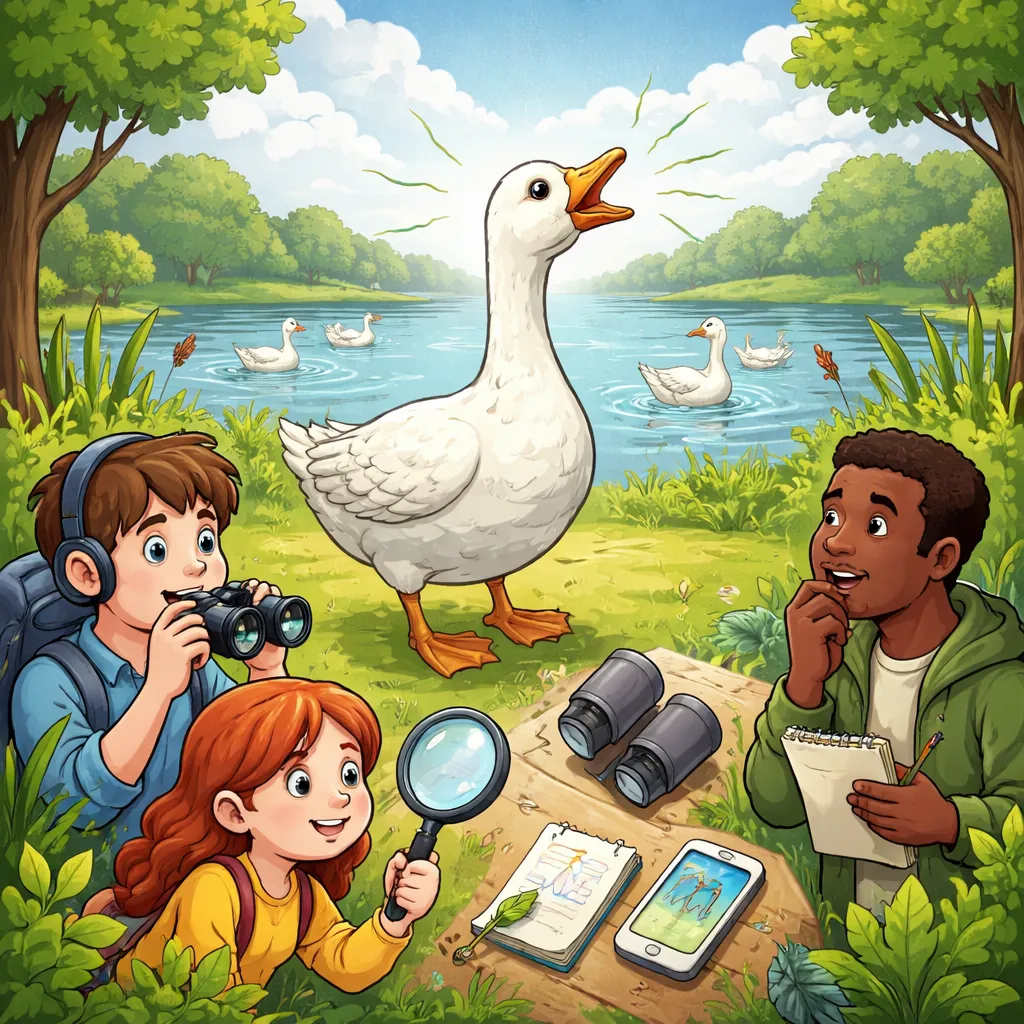

Have you ever been to a park or a farm and heard a loud "honk!"? You might have seen a goose! With their long necks, webbed feet, and noisy calls, geese are interesting birds that live near water. They are known for flying in a V shape and for being very protective. Learning about geese is a fun adventure that takes us to ponds, fields, and the sky. Let’s start our journey of learning about goose habits and sounds.
English Language Learning
Vocabulary and Spelling
Our loud, feathered friend is called a goose.
The word "goose" is a noun. A noun names a person, place, or thing. So, a goose is a thing—a living bird. When there is more than one, we say geese.
Spelling "goose" is simple: G-O-O-S-E. The 'G' starts the word, it has two 'O's in the middle, and it ends with 'S-E'. G-O-O-S-E spells goose.
Sound and Pronunciation
Let’s say the word correctly. It sounds like this: /ɡuːs/.
We can say it in one clear part. First, say "goo". It rhymes with "too" or "blue". Then, add a soft "s" sound at the end. "Goo" + "s".
Now, blend it together! Goose! Great!
The word "goose" has just one beat, or one syllable. Clap your hands once: Goose! It’s a strong, clear word.
Related Words
Learning about geese is more fun with new words! Here are some important ones.
Baby: A baby goose is called a gosling.
Sound: The loud call a goose makes is a honk.
Group: A group of geese on the ground is called a gaggle. A group flying together is a skein or a wedge.
A Famous Saying
There is a common phrase: "A wild goose chase."
This means a hopeless search for something you cannot find, or a useless errand. It comes from the idea that chasing a wild goose is very hard. It reminds us to think before we start a difficult task that might not have an end.
Say the saying with me: "A wild goose chase." It’s a fun piece of language.
Now you know the word "goose"! Are you ready to learn about their amazing lives? Let’s fly from words to wonderful knowledge!
Animal Knowledge
Who Are They? – Family and Group
What kind of animal is a goose? Geese are birds. They are warm-blooded, have feathers, and lay eggs.
They are part of the waterfowl family, called Anatidae. Their close cousins are ducks and swans. There are many types, like the Canada Goose and the Greylag Goose.
What Do They Look Like? – Amazing Bodies
Geese are medium to large birds, bigger than most ducks. They have a long neck, a wide body, and webbed feet. Their most famous features are their strong wings and their loud honk.
Their wings are powerful for long flights. Geese are known for their V-shaped flight formation, which helps them save energy on long trips. Their webbed feet are perfect for swimming.
Geese have special adaptations. They have strong bills for grazing on grass. Their feathers are waterproof, and they have a layer of soft down to keep warm. They are very good at walking, swimming, and flying.
Where Do They Live and How? – Home and Habits
Geese live in many parts of the world. Their homes are near lakes, ponds, rivers, fields, and parks. They like places with water for safety and grass for eating.
Geese are herbivores. This means they mostly eat plants. They graze on grass, leaves, and seeds. They also eat grains and sometimes berries. They are often seen eating grass in parks and fields.
Geese are very social and live in flocks. They are active during the day. They spend their time grazing, swimming, and flying. In the fall, many geese fly south for the winter in a V formation. This trip is called migration.
A Goose’s Life Story – Growing Up
A baby goose is called a gosling. Geese are birds, so goslings hatch from eggs. A mother goose, called a goose, usually lays four to eight eggs in a nest on the ground near water.
Both parents often take care of the goslings. The mother keeps the eggs warm. The father, called a gander, guards the nest. After hatching, the goslings can walk and swim very soon.
Goslings are born with soft, yellow or gray down feathers. They follow their parents everywhere to learn and stay safe. They grow quickly and learn to fly in about two to three months. Geese often mate for life.
How Do They "Talk"? – Communication
Geese are very loud and talk a lot! Their most famous sound is the honk. They honk to talk to each other, to warn of danger, and to keep the flock together in flight.
They use body language. A goose might lower its head and stretch its neck forward to show it is upset. They are very protective and will hiss and spread their wings to scare away danger.
Their best senses are their excellent eyesight and hearing. They have good vision to spot predators from far away. Their ears are hidden under feathers but are very sensitive to sounds.
Are They Okay? – Taking Care of Them
Many goose species are common and doing well. Some, like the Nene Goose, are endangered and need protection.
The main threats are loss of wetland homes, pollution, and sometimes being hunted. In some places, too many geese can cause problems in parks, but we must always be kind.
You can be a goose friend! You can enjoy watching them from a distance. You can help keep ponds and parks clean by not littering. Never chase or try to scare geese. Support groups that protect wetlands and wildlife.
Life Connections and Inspiration
How to Be With Them – Safety and Love
Geese are wild animals. They can be friendly but also very protective, especially near their nests. We must always respect them and keep a safe distance.
The rule is: Watch quietly and do not approach. If you see geese, watch from far away. Never try to touch, feed, or chase geese. If a goose hisses or spreads its wings, it is telling you to back away. Always give them space, especially in the spring when they have goslings.
We show our love by protecting the clean water and open spaces they need. We can be voices for kind and safe sharing of parks.
Super Qualities We Learn from Them
Geese teach us wonderful things. One super quality is loyalty and teamwork. Geese mate for life and work together in flocks. They fly in a V to help each other on long trips. They teach us the importance of sticking together, helping each other, and being loyal to our family and friends.
Another quality is brave protection. Geese are not afraid to honk loudly and stand their ground to protect their family. This reminds us to be brave in standing up for what is right and protecting those we care about.
Think about it: How can you be a good team player, like a goose in a V formation? How can you bravely protect or stand up for a friend or sibling?
Take Action! – Your "Goose V Formation" Project
Let’s do a fun and teamwork activity! Your project is to create a flying V formation with your family or friends.
Line up in a V shape, just like geese flying. The person at the front is the leader. Take turns being the leader and flapping your "wings" (your arms). Practice moving together. Talk about how it feels to work as a team. You can even draw paper goose badges to wear. This shows how geese work together to make flying easier for everyone.
Closing
Learning about goose adventures is a loud and wonderful journey! We learned the word "goose" and how to say its one-syllable name. We discovered amazing facts about their honking, their V formations, and their loyal family life. We know that geese are social, brave birds who teach us about teamwork and protection. You can use your new words to share stories about these noisy birds. You can use your knowledge to be a respectful wildlife watcher and a good team player. The animal world is full of loyal and brave teachers. Always remember to respect wildlife from a safe distance, work well with your team, and bravely protect what you love. Keep exploring with curiosity, honk your ideas with confidence, and be a friend to the wild. Your caring actions and team spirit make you a true friend to the amazing goose.