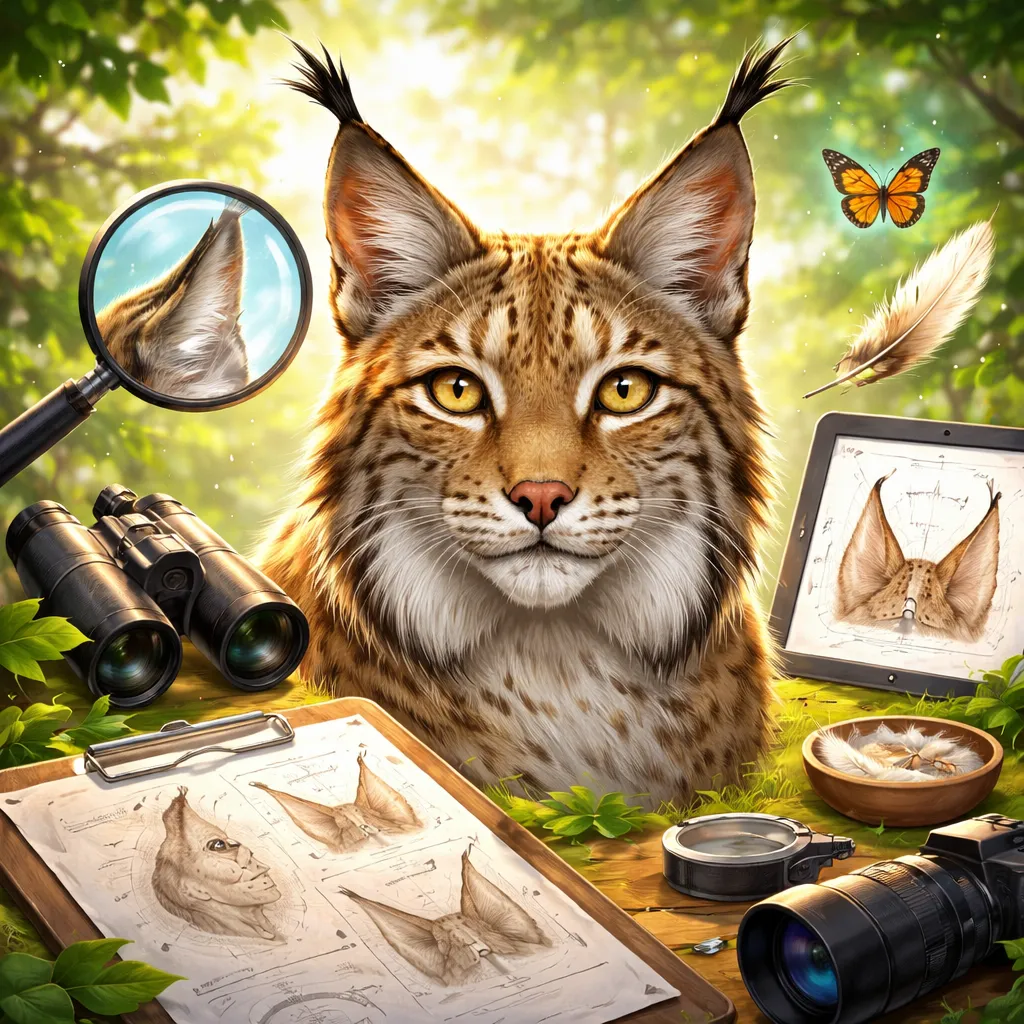

Have you ever seen a picture of a lynx, the wild cat that looks like it has cute little brushes on the tips of its ears? With their tufted ears, big paws, and short tail, lynx are mysterious cats of the northern forests. They are masters of living in cold, snowy places. Learning about lynx takes us on a quiet adventure to the deep, snowy woods. Let’s step softly and start our journey of learning about lynx secrets.
English Language Learning
Vocabulary and Spelling Our tuft-eared friend is called a lynx. The word "lynx" is a noun. A noun names a person, place, or thing. So, a lynx is a thing—a wild, living cat. Spelling "lynx" is short and special: L-Y-N-X. The 'L' starts the word, the 'Y' is in the middle, and it ends with 'N-X'. L-Y-N-X spells lynx. The plural can be lynx or lynxes.
Sound and Pronunciation Let’s say the word correctly. It sounds like this: /lɪŋks/. We can say it in one clear part. First, say "link". It rhymes with "pink" or "think". Now, just add a soft "s" sound at the end. "Link" + "s". Blend it together! Lynx! Great! The word "lynx" has just one beat, or one syllable. Clap your hands once: Lynx! It’s a sharp, quick word.
Related Words Learning about lynx is more fun with new words! Here are some important ones. Body Parts: The long black hairs on the tips of a lynx’s ears are called ear tufts or tassels. Its huge front feet are like snowshoes for walking on deep snow. Baby: A baby lynx is called a kitten. Action: Lynx are great at pouncing on their prey from a hiding spot.
A Famous Saying People sometimes call the lynx: "The ghost of the forest." This is because lynx are so quiet, secretive, and hard to see in their woodland home. They move like silent shadows. It’s a name that shows how mysterious and well-hidden they are. Say the name with me: "The ghost of the forest." It sounds mysterious, doesn’t it?
Now you know the word "lynx"! Are you ready to learn about these elusive forest cats? Let’s walk from words to wonderful woodland knowledge!
Animal Knowledge
Who Are They? – Family and Group What kind of animal is a lynx? Lynx are mammals. They have fur, are warm-blooded, and mother lynx feed their babies milk. They are part of the cat family. There are four species: the Canada lynx, the Eurasian lynx, the Iberian lynx, and the bobcat. They are medium-sized wild cats, bigger than a house cat but smaller than a cougar.
What Do They Look Like? – Amazing Bodies Lynx are about the size of a large dog. They have thick fur that is usually yellowish-brown or gray with faint spots. Their most famous features are their black ear tufts and their short, black-tipped tail. Their ear tufts are not just for show! Scientists think they help direct sound to their ears, making their hearing even better. Their huge, furry paws act like natural snowshoes, spreading their weight so they can walk on top of deep, soft snow without sinking. Lynx have special adaptations for the cold. They have long legs for leaping through snow. Their thick fur coat keeps them warm in freezing winters. They are built for power and stealth in a snowy world.
Where Do They Live and How? – Home and Habits Lynx live in the northern forests of North America, Europe, and Asia. Their home is the boreal forest, also called the taiga. It is a cold forest with lots of snow in winter. Lynx are carnivores. This means they are meat-eaters. They are specialists, which means they eat mostly one thing: the snowshoe hare. The number of lynx goes up and down with the number of hares! Lynx are solitary and secretive. They are most active at night and at dusk and dawn. They spend their time hunting, patrolling their large territory, and resting. They are excellent climbers and swimmers.
A Lynx’s Life Story – Growing Up A baby lynx is called a kitten. Lynx are mammals, so kittens are born live from their mother. A mother lynx usually has one to four tiny, blind kittens at a time. The mother lynx is a careful parent. She finds a safe den, like a hollow log or a cave. She feeds the kittens milk and protects them fiercely. She later teaches them how to hunt. Kittens are born with their eyes closed and a full coat of fur. Their eyes open after about two weeks. They have spots that may fade as they grow. They stay with their mother for about ten months, learning to survive before going off on their own.
How Do They "Talk"? – Communication Lynx are usually quiet, but they can make sounds. They mew, hiss, growl, and purr. They do not roar. A mother lynx calls her kittens with a soft meow. They use scent marking a lot. They have scent glands and will scratch trees or spray urine to mark their territory. This tells other lynx to stay away. Their best senses are their incredible hearing and eyesight. Their ear tufts may help funnel sound. They can hear a mouse under the snow! Their eyes are very sharp, especially in the dark.
Are They Okay? – Taking Care of Them The conservation status depends on the species. The Iberian lynx is endangered, with very few left. The Canada lynx is threatened in some areas. The Eurasian lynx is more common but still needs protection. The main threats are losing their forest homes, being hit by cars, and a lack of prey (snowshoe hares). Sometimes they are hunted for their fur. You can be a lynx friend! You can learn and tell others about these special cats. You can support groups that protect large forests and work to save endangered species like the Iberian lynx. Choosing recycled paper products helps save trees in their forest home.
Life Connections and Inspiration
How to Be With Them – Safety and Love Lynx are wild predators. We must always admire them from a very safe and respectful distance. The rule is: Observe from an extreme distance. We watch them in nature documentaries or at zoos that are part of conservation programs. In the wild, we would be very lucky to see one, but we must never try to approach or follow a lynx. If you see one, consider yourself very lucky and watch quietly from far away. We show our love by protecting the vast, snowy forests they call home. We can be voices for keeping wild places connected and healthy.
Super Qualities We Learn from Them Lynx teach us wonderful things. One super quality is silent patience and focus. A lynx can wait for hours, perfectly still, for the right moment to catch its food. It teaches us the value of being patient, staying focused on our goal, and waiting for the right time to act. Another quality is specialized adaptation. Lynx are perfectly designed for one specific environment: the snowy northern forest. Their big paws and ear tufts are perfect for that home. This reminds us that it’s great to be really good at something and to find the place where your own special skills shine. Think about it: When is a time you needed to be patient and wait for something? What is something you are specially good at, and how does it help you?
Take Action! – Your "Lynx Tracker" Project Let’s do a fun and patient activity! Your project is to become a wildlife detective and look for animal tracks. On a snowy day (or in mud), go outside with an adult. Look carefully at the ground. Can you see any animal tracks? A lynx track would be big and round, about the size of your hand, with no claw marks (cats keep claws hidden). Draw the shapes of the tracks you see in a notebook. Can you guess what animal made them? Remember, you are being a patient observer, just like a lynx. If you don’t have snow, you can research and draw pictures of lynx tracks and other animal tracks.
Closing Learning about lynx mysteries is a wonderful winter adventure! We learned the word "lynx" and how to say its one-syllable name. We discovered amazing facts about their ear tufts, their snowshoe paws, and their patient hunting life. We know that lynx are specialized, secretive cats who need our help to protect their forest homes. You can use your new words to share the hidden story of these tuft-eared hunters. You can use your knowledge to understand the importance of every creature in the wild. The animal world is full of patient and specialized teachers. Always remember to respect all wildlife from a safe distance, practice patience in your own life, and celebrate your own special skills. Keep exploring with quiet curiosity, be focused on your goals, and be a friend to the wild. Your observant eyes and caring heart make you a true friend to the elusive lynx.