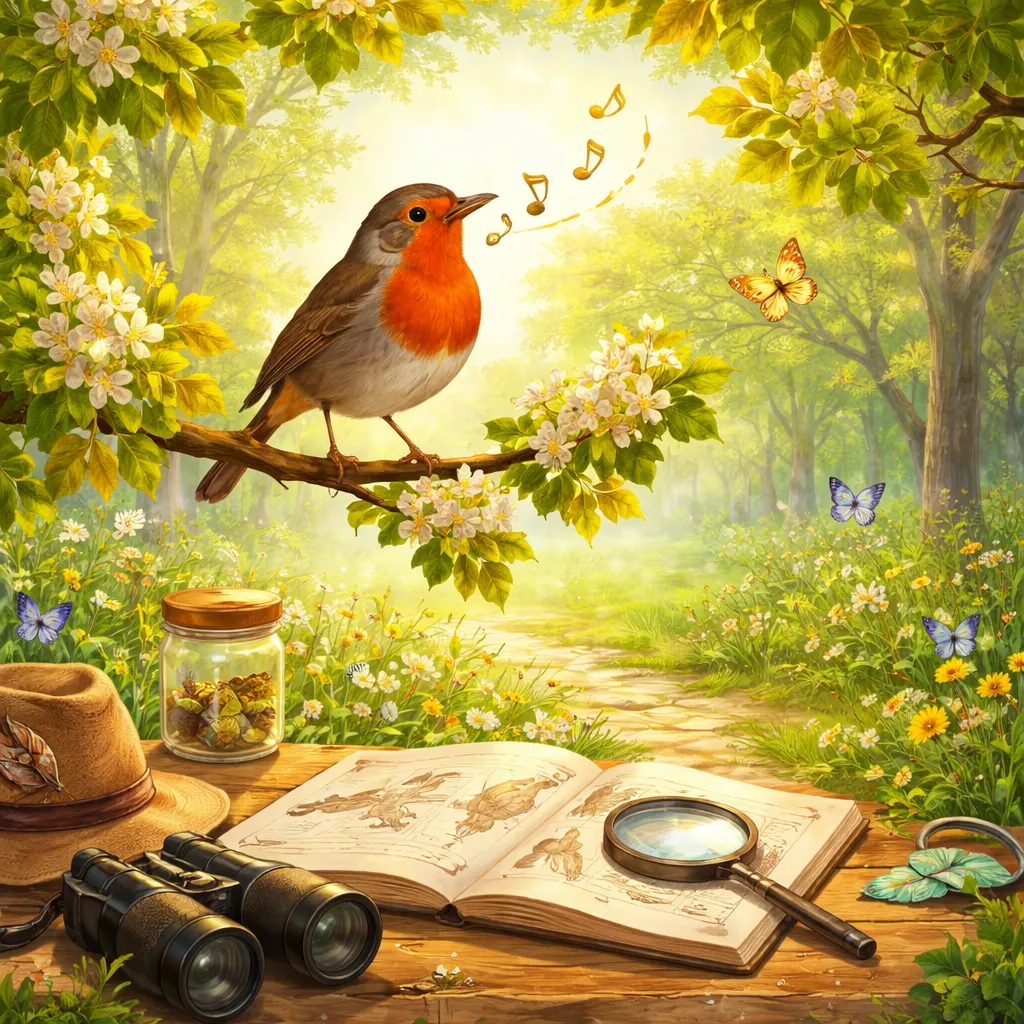

Imagine you’re in your backyard or a park on a cool morning, and you hear a sweet, clear song. You look and see a small bird with a bright red chest hopping on the grass. That’s a robin! With their friendly appearance and beautiful singing, robins are beloved birds that many people think of as a sign of spring. Learning about robins is a joyful adventure that takes us to gardens and woodlands. Let’s begin our journey of learning about robin life and music.
English Language Learning
Vocabulary and Spelling Our cheerful, red-breasted friend is called a robin. The word "robin" is a noun. A noun names a person, place, or thing. So, a robin is a thing—a small, singing bird. Spelling "robin" is simple: R-O-B-I-N. The 'R' starts the word, the 'O' and 'B' are in the middle, and it ends with 'I-N'. R-O-B-I-N spells robin.
Sound and Pronunciation Let’s say the word correctly. It sounds like this: /ˈrɑː.bɪn/. We can say it in two clear parts. First, say "rah". It sounds like the beginning of "rock". Next, say "bin". It’s just like the container, a bin. Now, put it together! "Rah" "bin". Robin! Great! The word "robin" has two beats, or two syllables. Clap your hands twice: Rob-in. It’s a friendly, short word.
Related Words Learning about robins is more fun with new words! Here are some important ones. Body Part: The red feathers on a robin’s chest are its breast. A baby robin is called a chick. Sound: The musical sounds a robin makes are its song or call. Home: A robin’s nest, often in a tree or bush, is a cup nest because of its shape.
A Famous Saying People often say: "The early bird catches the worm." This means that if you start your day early and are prepared, you will be successful. Robins are often seen early in the morning looking for worms. It reminds us to be proactive and start our tasks with energy. Say the saying with me: "The early bird catches the worm." It’s a great piece of advice!
Now you know the word "robin"! Are you ready to learn about these musical birds? Let’s hop from words to wonderful knowledge!
Animal Knowledge
Who Are They? – Family and Group What kind of animal is a robin? Robins are birds. They are warm-blooded, have feathers, and lay eggs. They are part of the thrush family. Their scientific name is Turdus migratorius for the American Robin. The European Robin is a different but similar bird. They are known for their beautiful songs.
What Do They Look Like? – Amazing Bodies Robins are plump, small birds. The American Robin has a gray-brown back, a bright orange-red breast, and a yellow beak. Their most famous feature is their vibrant red or orange breast and their large, dark eyes. Their red breast is a super signal! It helps robins recognize each other. The color is bright and easy to see. They have strong legs for hopping on the ground and a sharp beak for catching food. Robins have special adaptations. They are excellent at finding worms by sight and hearing. They can tilt their head to listen for worms moving underground. They are also very good at building strong, cup-shaped nests.
Where Do They Live and How? – Home and Habits Robins live across North America and Europe. Their homes are gardens, parks, woodlands, and fields. They like open spaces with short grass where they can find worms and insects. Robins are omnivores. This means they eat both plants and animals. They love earthworms, insects, and berries. In spring and summer, they eat more worms. In fall and winter, they eat more berries and fruits. Robins are often seen alone or in pairs. They are active during the day. They spend their time hopping on the ground looking for food, singing from high perches, and building nests. A group of robins is called a round.
A Robin’s Life Story – Growing Up A baby robin is called a chick. Robins are birds, so chicks hatch from eggs. A mother robin usually lays three to five beautiful blue eggs in a nest. Both parents take care of the chicks. The mother keeps the eggs warm. The father helps bring food. After hatching, both parents work very hard to feed the hungry chicks worms and insects. Chicks are born naked and blind, with pink skin. They grow quickly and are covered in fluffy feathers in about a week. They leave the nest about two weeks after hatching. The parents continue to feed them for a few more days while they learn to fly and find food.
How Do They "Talk"? – Communication Robins are famous for their beautiful song. They sing to mark their territory and to attract a mate. Their song is a series of clear, whistled notes. They also have different calls for warning of danger. They use body language too. A robin might puff up its feathers or tilt its head to show how it feels. They are very aware of other robins in their area. Their best senses are their excellent eyesight and hearing. They have very good vision to spot worms and predators. Their hearing is so good they can hear worms moving underground!
Are They Okay? – Taking Care of Them Robins are common and widespread birds. However, they face dangers from people and the environment. The main threats are pesticides that poison the insects and worms they eat, cats, and windows they might fly into. Loss of trees and bushes for nesting can also be a problem. You can be a robin friend! You can plant native trees and bushes that provide berries for them to eat. Avoid using pesticides in your garden. Keep cats indoors. You can put stickers on your windows to help robins see the glass and avoid collisions.
Life Connections and Inspiration
How to Be With Them – Safety and Love Robins are wild birds. They are used to people but are not pets. We must always respect them and their space. The rule is: Watch quietly and enjoy from a distance. You can watch robins from a window or a bench. Never try to touch a robin, its eggs, or its nest. If you find a baby robin on the ground, it might be learning to fly. Watch from a distance; its parents are likely nearby. Only intervene if it is in immediate danger, like from a cat. We show our love by making our yards safe and welcoming for them. We can provide fresh water in a birdbath and plant berry bushes.
Super Qualities We Learn from Them Robins teach us wonderful things. One super quality is cheerful persistence and hope. Robins are one of the first birds to sing in the morning and a sign that spring is coming. They teach us to greet each day with a positive song and to have hope, even after a long, cold winter. Another quality is dedicated care and hard work. Robin parents work tirelessly from dawn to dusk to feed their hungry chicks. This reminds us of the importance of hard work, dedication, and taking good care of our own family and responsibilities. Think about it: How can you start your day in a cheerful way, like a robin’s song? How can you show dedication and hard work in a task you are doing, like a parent robin feeding its chicks?
Take Action! – Your "Robin’s Nest" Project Let’s do a careful and creative activity! Your project is to build a model of a robin’s cup nest. You will need: a small bowl, mud or brown playdough, dry grass, twigs, and string. Line the bowl with the grass and twigs to make the shape. Use the mud or playdough to cement it together, leaving a cup shape in the middle. You can add little blue beads or painted stones for eggs. This shows how carefully and strongly robins build their homes.
Closing Learning about robin songs is a heartwarming and lovely adventure! We learned the word "robin" and how to say its two-part name. We discovered amazing facts about their red breasts, their worm-finding skills, and their life as dedicated parents. We know that robins are cheerful, hardworking birds that bring joy to our gardens. You can use your new words to share the story of these beloved songbirds. You can use your knowledge to create a safer, kinder environment for birds right where you live. The animal world is full of hopeful and diligent teachers. Always remember to respect wildlife from a safe distance, greet each day with cheerfulness, and work hard at the things you care about. Keep exploring with a song in your heart, listen for the music in nature, and be a friend to the wild. Your caring actions and cheerful spirit make you a true friend to the amazing robin.