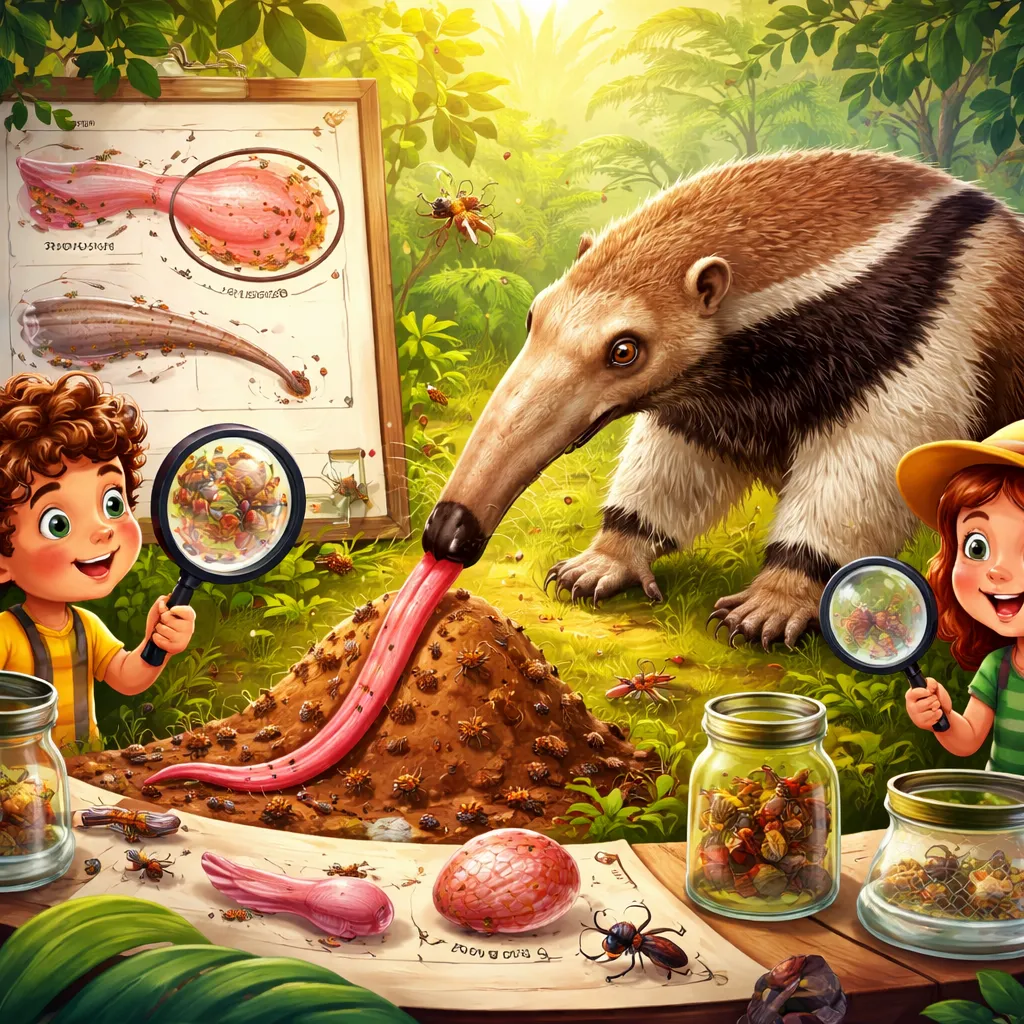

Have you ever seen a picture of an animal with a very long, tube-shaped snout and a bushy tail? That might be an anteater! These gentle, curious animals are famous for their love of eating ants and termites. Learning about anteaters takes us on a sticky adventure to the rainforests and grasslands of Central and South America. Let’s start our journey of learning about anteater skills and secrets.
English Language Learning
Vocabulary and Spelling Our long-snouted friend is called an anteater. The word "anteater" is a noun. A noun names a person, place, or thing. So, an anteater is a thing—a unique, living animal. Spelling "anteater" is two words put together: A-N-T and E-A-T-E-R. The first part is "ant", the tiny insect. The second part is "eater", which means an animal that eats. A-N-T-E-A-T-E-R spells anteater.
Sound and Pronunciation Let’s say the word correctly. It sounds like this: /ˈænt.iː.tɚ/. We can say it in three clear parts. First, say "ant". It’s the same as the insect. Next, say "ee". It’s a long 'e' sound. Last, say "ter". It rhymes with "her". Now, put it together! "Ant" "ee" "ter". Anteater! Great job! The word "anteater" has three beats, or three syllables. Clap three times: Ant-ea-ter. It’s a descriptive, fun word.
Related Words Learning about anteaters is more fun with new words! Here are some important ones. Body Parts: The long, tube-shaped nose and mouth of an anteater is called a snout. Its incredibly long, sticky muscle for catching food is its tongue. Action: Anteaters are experts at foraging for food, which means searching for it. Home: The home of an anteater is a range in the forest or grassland.
A Famous Saying While there isn't a famous old saying, there is a fun and true fact: "The anteater is a walking vacuum cleaner for insects!" This is because it uses its long, sticky tongue to suck up thousands of ants and termites very quickly. It’s a playful way to remember its special eating style. Say the phrase with me: "The anteater is a walking vacuum cleaner for insects!" It’s a cool picture, isn’t it?
Now you know the word "anteater"! Are you ready to explore some amazing facts about this insect expert? Let’s march from words to wonderful knowledge!
Animal Knowledge
Who Are They? – Family and Group What kind of animal is an anteater? Anteaters are mammals. They have fur, are warm-blooded, and mother anteaters feed their babies milk. They are part of the order Pilosa. Their closest relatives are sloths and armadillos. There are four species: the Giant Anteater, the Silky Anteater, the Northern Tamandua, and the Southern Tamandua.
What Do They Look Like? – Amazing Bodies Anteaters can be as small as a squirrel or as large as a big dog. The Giant Anteater is the biggest. They have a long, narrow head, a bushy tail, and sharp, curved claws. Their fur is usually gray, brown, or golden. Their most famous feature is their long, sticky tongue. A Giant Anteater’s tongue can be two feet long! It is covered in tiny, backward-pointing spines and sticky saliva to catch insects. They have no teeth. Anteaters have special adaptations. Their sharp front claws are for digging into hard ant and termite mounds. They walk on their knuckles to protect these claws. They have a great sense of smell to find food.
Where Do They Live and How? – Home and Habits Anteaters live in Central and South America. Their homes are tropical forests, grasslands, and savannas. They need places where ants and termites are plentiful. Anteaters are insectivores. This means they only eat insects. They are specialists, eating mostly ants and termites. They use their claws to open a nest, then quickly lick up the insects with their long tongue. They can eat tens of thousands of insects in one day! Anteaters are mostly solitary, meaning they like to live alone. They are active during the day and night, depending on the species and the weather. They spend their time slowly walking and searching for food. They are also good swimmers.
An Anteater’s Life Story – Growing Up A baby anteater is called a pup. Anteaters are mammals, so pups are born live from their mother. A mother anteater usually has one tiny pup at a time. The mother anteater is a very caring parent. The pup rides on the mother’s back for several months. The mother feeds it milk and later teaches it how to find and eat insects. Pups are born with a full coat of fur. They cling to their mother’s back for safety and travel. They drink milk for about six months but start trying insects much earlier. They stay with their mother for up to two years.
How Do They "Talk"? – Communication Anteaters are usually quiet animals. They can hiss, snort, or make a soft bleat if they are upset or scared. A mother may make a humming sound to her pup. They use scent marking a lot. They have scent glands and will mark trees with their smell to tell other anteaters about their territory. They also use their strong sense of smell to find each other. Their best sense is their incredible sense of smell. It is about 40 times better than a human’s! They use it to find insect nests. Their eyesight and hearing are not as strong.
Are They Okay? – Taking Care of Them The Giant Anteater is listed as vulnerable. This means it is at risk. Other species face threats too, but are in less danger. The main threats are losing their forest and grassland homes to farms and cities, being hit by cars on roads, and sometimes being hunted or caught in fires. They also can get hurt by dogs. You can be an anteater ally! You can learn and tell others about these amazing animals. You can support groups that protect rainforests and grasslands in South America. You can choose products that are friendly to rainforests, like recycled paper. Protecting their home helps all the animals that live there.
Life Connections and Inspiration
How to Be With Them – Safety and Love Anteaters are wild animals. They are generally gentle, but they have very strong, sharp claws for defense. We must always respect them and keep a safe distance. The rule is: Admire from far away. We watch them in nature documentaries or at zoos that care for them. In the wild, we never try to approach or touch an anteater. If you see one crossing a road, you can tell an adult so they can drive carefully and give it space. We show our love by protecting the wild spaces and insect populations they need to survive. We can be voices for conservation.
Super Qualities We Learn from Them Anteaters teach us wonderful things. One super quality is peaceful specialization. Anteaters are experts at one thing: eating ants and termites. They do it very well and peacefully. They teach us that it’s great to become really good at something you enjoy, and to do it in a calm, focused way. Another quality is gentle strength and protection. Anteaters are strong (they can break open concrete-hard termite mounds!) but they are not aggressive. They use their strength mostly for finding food and protecting their young. This reminds us that true strength can be gentle and used for good purposes. Think about it: What is something you are working to become really good at? How can you use your own strength (like being strong, smart, or kind) in a gentle and helpful way?
Take Action! – Your "Anteater Snout" Project Let’s do a fun and focused activity! Your project is to create a model of an anteater’s head and tongue. Find a paper towel tube. This will be the snout. Decorate it with paint or paper. Now, take a long piece of yarn or a thin strip of felt. This is the tongue. Make it sticky by putting a bit of tape on the end, sticky side out. Can you use your model to pick up small, light paper "ants"? Scatter a few small paper circles on a table and try to pick them up with the sticky end of your "tongue." This shows how the anteater uses its long, sticky tongue to eat. Remember, a real anteater’s tongue is much more amazing!
Closing Learning about anteater wonders is a fascinating adventure! We learned the word "anteater" and how to say its three-part name. We discovered amazing facts about their two-foot-long tongues, their sharp digging claws, and their life as insect specialists. We know that anteaters are peaceful, strong animals who need our help to protect their homes. You can use your new words to share the story of these unique creatures. You can use your knowledge to appreciate the importance of every animal’s role in nature. The animal world is full of peaceful specialists and gentle giants. Always remember to respect wildlife from a safe distance, become an expert in what you love, and use your strengths in kind and helpful ways. Keep exploring with curiosity, focus on your passions, and be a friend to the wild. Your caring actions and focused mind make you a true friend to the amazing anteater.