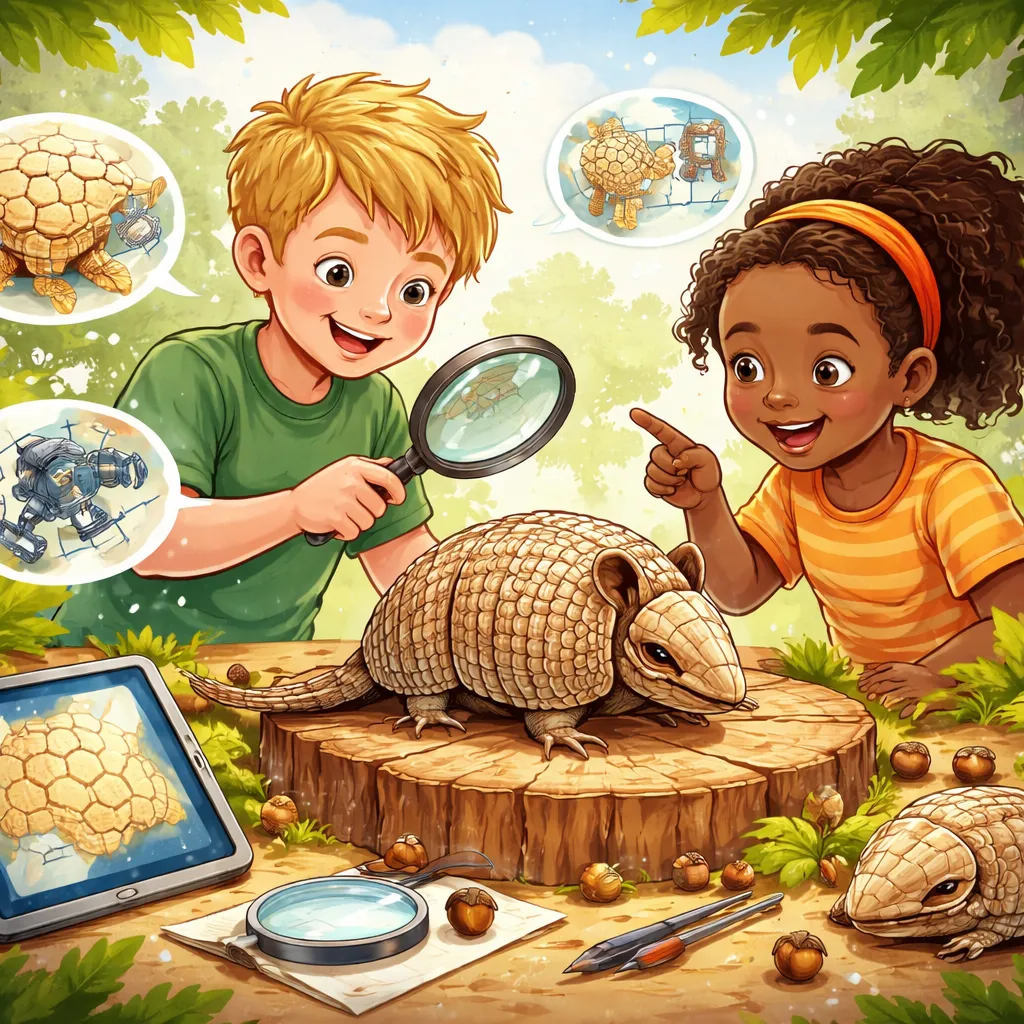

Have you ever seen a picture of an animal that looks like a small knight in a suit of armor? That’s an armadillo! With their bony plates and pointy snouts, armadillos are unique animals that look like they’re from another time. Learning about armadillos is a digging adventure that takes us to the grasslands and forests of the Americas. Let’s get ready to start our journey of learning about armadillo armor and habits.
English Language Learning
Vocabulary and Spelling Our armored friend is called an armadillo. The word "armadillo" is a noun. A noun names a person, place, or thing. So, an armadillo is a thing—a unique, living animal. Spelling "armadillo" is fun: A-R-M-A-D-I-L-L-O. The 'A' starts the word, the 'R' and 'M' are in the middle, and it ends with two 'L's and an 'O'. A-R-M-A-D-I-L-L-O spells armadillo.
Sound and Pronunciation Let’s say the word correctly. It sounds like this: /ˌɑːr.məˈdɪl.oʊ/. We can say it in four clear parts. First, say "ar". It sounds like the letter 'R'. Next, say "muh". It’s a soft, quick sound. Then, say "dill". It rhymes with "hill". Last, say "oh". It’s the sound you make when you understand something. Now, put it together! "Ar" "muh" "dill" "oh". Armadillo! Great job! The word "armadillo" has four beats, or four syllables. Clap four times: Ar-ma-dil-lo. It’s a bouncy, rolling word.
Related Words Learning about armadillos is more fun with new words! Here are some important ones. Body Part: The hard, bony plates covering an armadillo’s body are called a shell or armor. Its strong front feet have long claws for digging. Action: Armadillos are experts at digging for food and making homes. Home: The underground tunnel an armadillo lives in is called a burrow.
A Famous Saying People sometimes say: "As armored as an armadillo." This means someone or something is very well protected. It comes from the armadillo’s tough, bony shell. It’s a way to talk about being safe and secure. Say the saying with me: "As armored as an armadillo." It’s a compliment for being well-protected!
Now you know the word "armadillo"! Are you ready to dig into some amazing facts? Let’s tunnel from words to wonderful knowledge!
Animal Knowledge
Who Are They? – Family and Group What kind of animal is an armadillo? Armadillos are mammals. They have hair (between their armor plates!), are warm-blooded, and mother armadillos feed their babies milk. They are part of the order Cingulata. Their closest living relatives are sloths and anteaters. There are about 20 different species, and the nine-banded armadillo is the most common.
What Do They Look Like? – Amazing Bodies Armadillos are about the size of a small dog or a cat. They have a bony shell made of plates called scutes. Their shell can be brown, gray, or yellowish. Their most famous feature is their bony, armored shell. Their shell is their super suit! It protects them from thorns and predators. The nine-banded armadillo can even curl into a ball for extra protection! They have a long, sticky tongue and poor eyesight. Armadillos have special adaptations. They are excellent diggers with strong legs and sharp claws. They can hold their breath for up to six minutes, which helps when they are digging. Some can even swim by swallowing air to float!
Where Do They Live and How? – Home and Habits Armadillos live in the Americas, from the southern United States to South America. Their homes are grasslands, forests, and semi-deserts. They like areas with loose soil for digging. Armadillos are insectivores, but they are actually omnivores. This means they eat both plants and animals. They love to eat insects, especially ants and termites. They also eat worms, snails, berries, and small reptiles. Armadillos are mostly nocturnal, meaning they are most active at night. They are solitary animals, meaning they like to be alone. They spend their nights digging for food, swimming, and exploring. A group of armadillos is called a roll.
An Armadillo’s Life Story – Growing Up A baby armadillo is called a pup. Armadillos are mammals, so pups are born live from their mother. The nine-banded armadillo always has four identical pups at a time! The mother armadillo takes care of her pups in the burrow. She feeds them milk. The pups’ armor is soft at birth but hardens quickly. They stay in the burrow for a few months. Pups are born with their eyes open. They start to follow their mother on foraging trips when they are a few weeks old. They drink milk for about two months and then start eating insects. They leave their mother after about six months.
How Do They "Talk"? – Communication Armadillos are usually quiet, but they can make sounds. They grunt, squeal, or make a clicking sound when they are exploring. A mother may cluck to her pups. They use their sense of smell to talk. They have scent glands and will mark their territory with their smell. They also use their excellent sense of smell to find food. Their best sense is their amazing sense of smell. They have a very good nose to sniff out insects underground. Their hearing is also good, but their eyesight is poor.
Are They Okay? – Taking Care of Them Many armadillo species are doing well, but some are endangered. The giant armadillo, for example, is vulnerable because it needs large wild areas. The main threats are habitat loss, cars (they often get hit when crossing roads), and hunting. Some people think they are pests because they dig in gardens. You can be an armadillo friend! You can learn about them and teach others that they are helpful because they eat insects. If you see one crossing the road, you can tell an adult to drive carefully. Never try to touch or keep an armadillo as a pet.
Life Connections and Inspiration
How to Be With Them – Safety and Love Armadillos are wild animals. They are generally gentle but can carry diseases. We must always admire them from a safe distance. The rule is: Look, don’t touch, and give them space. If you see an armadillo in your yard or on a walk, watch it from far away. Never try to touch, chase, or feed an armadillo. If you see one digging, let it be. It is just looking for food. We show our love by protecting the natural areas where they live. We can be kind even if they dig in our gardens, because they are just being armadillos.
Super Qualities We Learn from Them Armadillos teach us wonderful things. One super quality is protective adaptation. Armadillos have their own built-in armor. They teach us to use our own strengths and talents to protect ourselves and face challenges in a smart way. Another quality is determined digging and perseverance. Armadillos don’t give up when they want to find food or build a home. They keep digging. This reminds us to be determined, to keep trying, and to work hard to reach our goals, even if it takes time. Think about it: What is your own special "armor" or strength that makes you feel protected? How can you show determination when you are working on a difficult task, like learning a new skill or finishing a project?
Take Action! – Your "Armadillo Burrow" Project Let’s do a fun and determined activity! Your project is to create a cross-section model of an armadillo burrow. Get a shoebox and turn it on its side. This is the ground. Use brown paper or paint to make the dirt walls. Now, use paper towel tubes or molded clay to create tunnels underground. These are the burrow’s pathways. Make a little nest chamber with shredded paper. Draw and cut out a small armadillo and place it in the burrow. Label the different rooms: sleeping chamber, food storage, entrance. This shows how armadillos design their underground homes.
Closing Learning about armadillo armor is a fascinating adventure! We learned the word "armadillo" and how to say its four-part, rolling name. We discovered amazing facts about their bony shells, their excellent digging, and their life as nocturnal foragers. We know that armadillos are determined, well-protected animals who are helpful members of their ecosystem. You can use your new words to share the story of these armored diggers. You can use your knowledge to appreciate the importance of every creature’s role in nature. The animal world is full of determined and well-adapted teachers. Always remember to respect wildlife from a safe distance, use your own strengths for protection, and persevere in your goals. Keep exploring with curiosity, dig deep for knowledge, and be a friend to the wild. Your caring actions and determined spirit make you a true friend to the amazing armadillo.