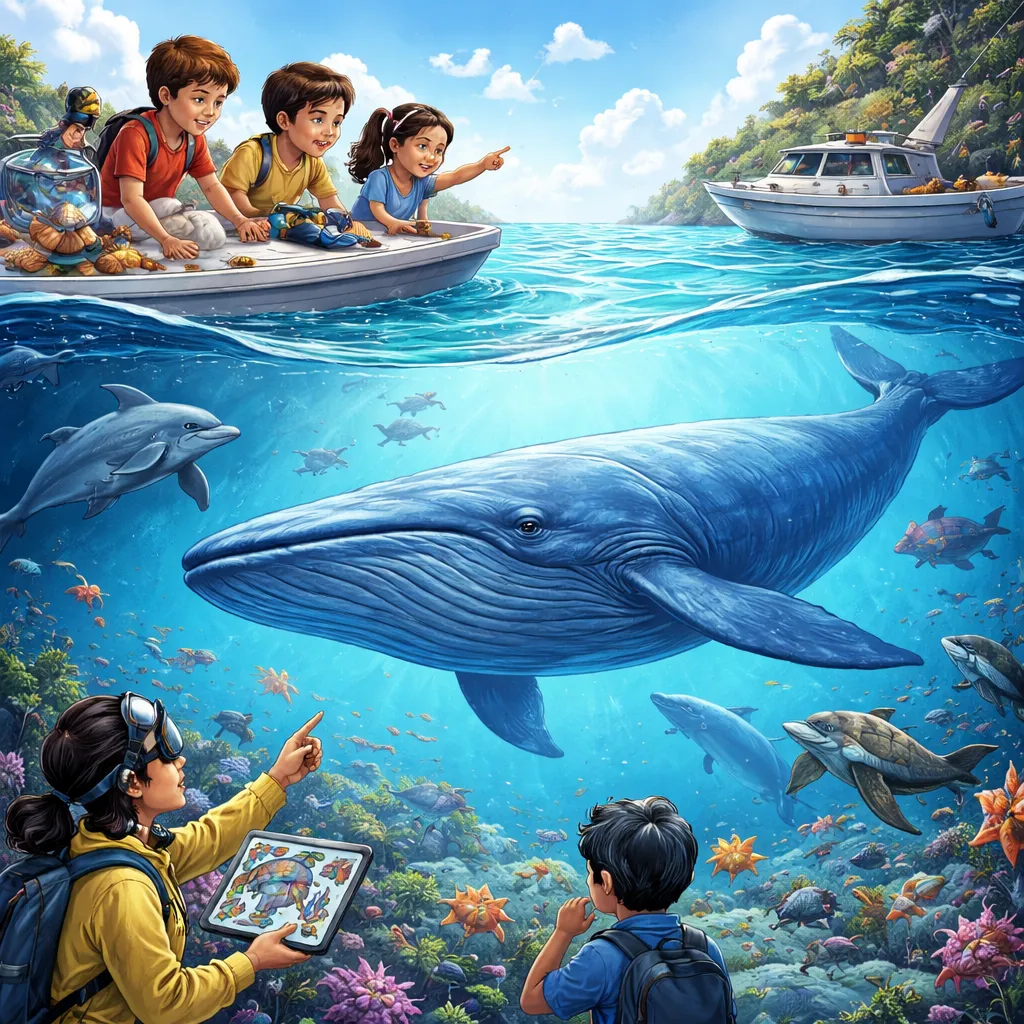

Have you ever seen a picture of a creature so large that it is bigger than a bus, swimming gracefully in the deep blue sea? That incredible animal is a whale! As the largest creatures to ever live on Earth, whales capture our imagination with their size, intelligence, and mysterious ocean lives. Learning about whales is a journey into the heart of the ocean. Let’s dive into our adventure of learning about whale wonders.
English Language Learning
Vocabulary and Spelling The majestic giant of the sea is called a whale. The word "whale" is a noun. A noun names a person, place, or thing. So, a whale is a thing—a massive, living mammal of the ocean. Spelling "whale" is simple: W-H-A-L-E. The 'W' starts the word, the 'H' and 'A' are in the middle, and it ends with 'L-E'. W-H-A-L-E spells whale.
Sound and Pronunciation Let’s say the word correctly. It sounds like this: /weɪl/. We can say it in one clear sound. It starts with a "w" and rhymes with "sail" or "pail". Now, say it out loud! Whale! Wonderful! The word "whale" has just one beat, or one syllable. Clap your hands once: Whale! It’s a short, powerful word.
Related Words Learning about whales is more fun with new words! Here are some important ones. Group: A family of whales is called a pod. A baby whale is a calf. Body Part: The powerful tail of a whale is called a fluke. Action: The stream of water and air a whale blows out is a spout.
A Famous Saying People often say: "A whale of a time!" This means having an absolutely fantastic and fun time. It’s a happy way to say you are enjoying yourself immensely, just as a whale enjoys the vast ocean. It reminds us to find joy in big adventures. Say the saying with me: "A whale of a time!" Let’s have one!
Now you know the word "whale"! Are you ready to explore the life of this ocean giant? Let’s swim from words to wonderful knowledge!
Animal Knowledge
Who Are They? – Family and Group What kind of animal is a whale? Whales are mammals. They are warm-blooded, breathe air, have a little hair, and mother whales feed their babies milk. They belong to the cetacean family. There are two main groups: baleen whales, like the Blue Whale, which have no teeth, and toothed whales, like the Sperm Whale, which do. They are more closely related to cows and hippos than to fish!
What Do They Look Like? – Amazing Bodies Whales are the largest animals ever. The Blue Whale is longer than three school buses! They have smooth, streamlined bodies, flippers, and a horizontal tail fluke. Their most famous features are their sheer size and their blowhole on top of their head. The blowhole is their nose! They must come to the surface to breathe through it, creating a iconic spout. Their fluke moves up and down to power their swimming. Baleen whales have bristly plates in their mouth to filter food from the water. Whales have special adaptations. A thick layer of fat called blubber keeps them warm in icy waters. They can hold their breath for over an hour. Their bodies are perfectly shaped for moving through the water with minimal effort.
Where Do They Live and How? – Home and Habits Whales live in every ocean on Earth. Their home is the vast open sea. Some species, like the Gray Whale, make the longest migration of any mammal, traveling thousands of miles each year between feeding and breeding grounds. What a whale eats depends on its type. Baleen whales are filter feeders, eating tiny krill and small fish. Toothed whales are hunters, eating fish, squid, and other marine animals. Whales are very social and live in close-knit family groups called pods. They are active day and night. They spend their time swimming, diving deep for food, coming up to breathe, and caring for their young. Their breaches and tail slaps are spectacular to see.
A Whale’s Life Story – Growing Up A baby whale is called a calf. Whales are mammals, so calves are born live from their mother. A mother usually has one calf at a time, which is already as long as a small car! Mother whales are incredibly nurturing. They feed their calf rich, fatty milk to help it grow quickly. The calf swims close to its mother for protection and learning. The whole pod often helps look after the young. Calves are born ready to swim. They grow at an amazing rate, gaining hundreds of pounds a day. They stay with their mother for one to two years or more, learning migration routes, hunting skills, and pod songs. A whale can live for a very long time, some for over 100 years.
How Do They "Talk"? – Communication Whales are famous for their complex underwater language. They use clicks, whistles, and pulsed calls. Humpback whales sing long, beautiful songs that can last for hours and travel across entire oceans. They also communicate through touch and body language. Rubbing against each other, breaching, or slapping their flukes on the water are all ways to send messages. Their most important sense is their extraordinary hearing. Sound travels far and fast in water, and whales use it to navigate, find food, and stay connected with their pod over huge distances. Their songs are one of nature’s most haunting and beautiful sounds.
Are They Okay? – Taking Care of Them Many great whale species are still endangered or vulnerable after centuries of hunting. They are protected now, but still face serious threats. The main dangers today are collisions with large ships, entanglement in fishing gear, ocean pollution (especially plastic and noise), and climate change affecting their food supply. Their recovery is slow and needs our help. You can be a whale guardian! Learn about them and share their story. Reduce plastic use to keep oceans clean. Support organizations that work to protect whales and their habitats. If you go whale watching, choose a responsible company that respects the whales’ space.
Life Connections and Inspiration
How to Be With Them – Safety and Love Whales are wild, deep-ocean animals. We must always admire them with the utmost respect and from a safe, legal distance. The rule is: Observe with awe, from afar. On a boat, always follow guidelines and stay hundreds of meters away. Never attempt to touch, feed, or swim with a whale. Boat traffic and noise can disrupt their communication, navigation, and feeding. Responsible observation lets them live their lives in peace. We show our love by being voices for clean, healthy, and quiet oceans. We can make choices that protect the blue planet we share with them.
Super Qualities We Learn from Them Whales teach us profound lessons. One super quality is gentle strength and profound connection. The largest animal on the planet shows us that great size can be paired with grace, and that life in the vast, connected ocean depends on deep bonds and long-distance communication. They teach us the power of gentle strength and staying connected with our own "pod." Another quality is resilience and epic journey. Whales survive immense ocean pressures, undertake the longest migrations, and are recovering from past threats. This reminds us to be resilient, to undertake our own important journeys in life, and to always move forward, no matter the distance. Think about it: How can you show gentle strength in your actions? What is a long "journey" or goal you are working towards, and how can you be resilient in reaching it?
Take Action! – Your "Whale Migration Map" Project Let’s do a grand and creative activity! Your project is to map the incredible migration journey of a whale. On a large piece of paper, draw a simple world map. Research a whale species, like the Gray Whale. Draw its migration route from its cold feeding grounds in the Arctic to its warm breeding lagoons in Mexico. Draw a small paper whale and attach it with a paper clip so it can "travel" along the route. Label the oceans. This shows the amazing endurance of these ocean travelers.
Closing Learning about whale majesty is a humbling and awe-inspiring adventure! We learned the word "whale" and how to say its strong, one-syllable name. We discovered amazing facts about their blowholes, their blubber, their family pods, and their epic ocean journeys. We know that whales are intelligent, social giants who are symbols of the ocean’s health and need our continued protection. You can use your new words to share the epic story of these gentle giants. You can use your knowledge to make choices that help our oceans and all the creatures within them. The animal world is full of gentle and resilient teachers. Always remember to respect all wildlife from a safe distance, use your strength with kindness, value your own family journeys, and be a voice for our planet’s incredible oceans. Keep exploring with wonder, dive deep into your curiosity, and be a friend to the wild. Your thoughtful actions and caring spirit make you a true friend to the amazing whale.