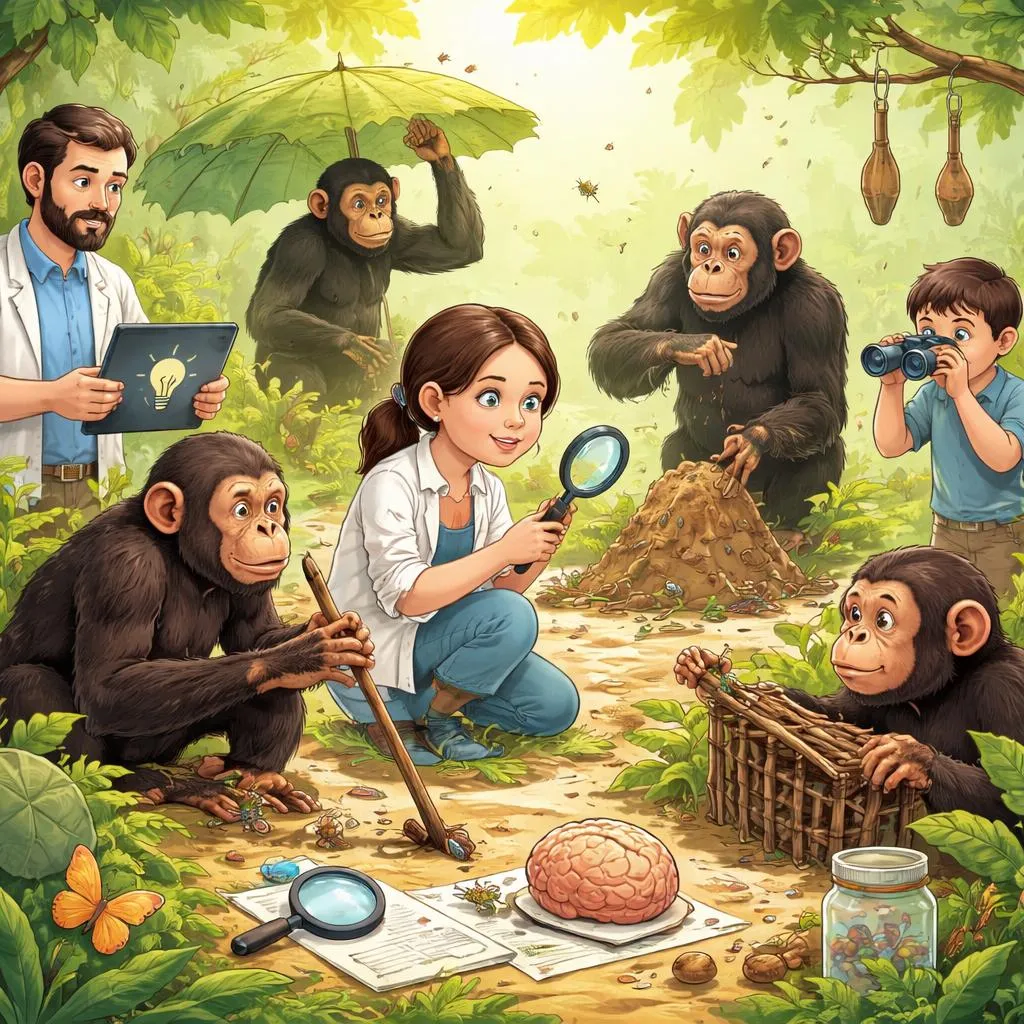

Imagine you’re at the zoo, watching an animal that looks a little bit like a person, with long arms, a hairy body, and very smart eyes. It’s a chimpanzee! Chimps are incredibly clever and social animals. They are our closest living relatives in the animal kingdom. Learning about chimpanzees is a fascinating adventure that takes us to the African rainforest. Let’s get ready to start our journey of learning about chimp smarts and society.
English Language Learning
Vocabulary and Spelling Our clever cousin is called a chimpanzee. The word "chimpanzee" is a noun. A noun names a person, place, or thing. So, a chimpanzee is a thing—a very intelligent, living animal. Spelling "chimpanzee" is a bit long: C-H-I-M-P-A-N-Z-E-E. The 'C' and 'H' start the word. The 'I', 'M', 'P' are in the middle, and it ends with 'A-N-Z-E-E'. C-H-I-M-P-A-N-Z-E-E spells chimpanzee. We often call them chimps for short.
Sound and Pronunciation Let’s say the word correctly. It sounds like this: /tʃɪmˈpæn.zi/. We can say it in three clear parts. First, say "chim". It rhymes with "him" or "dim". Next, say "pan". It’s just like the cooking pan. Last, say "zee". It sounds like the letter 'Z'. Now, put it together! "Chim" "pan" "zee". Chimpanzee! Great job! The word "chimpanzee" has three beats, or three syllables. Clap three times: Chim-pan-zee. It’s a fun, bouncy word.
Related Words Learning about chimpanzees is more fun with new words! Here are some important ones. Group: A chimpanzee family group is called a troop or a community. A baby chimp is called an infant. Action: Chimpanzees spend a lot of time grooming each other, which means cleaning fur. It is a way to be friendly. Skill: Chimps are famous for using tools, like sticks to get termites out of a mound.
A Famous Saying Scientists and writers often say: "Chimpanzees are our closest living relatives." This is a true fact! We share about 98% of our DNA with chimpanzees. This means we are very, very similar in many ways. It reminds us that we are all connected to the animal world. Say the fact with me: "Chimpanzees are our closest living relatives." Isn’t that amazing?
Now you know the word "chimpanzee"! Are you ready to learn about their amazing lives? Let’s swing from words to wonderful knowledge!
Animal Knowledge
Who Are They? – Family and Group What kind of animal is a chimpanzee? Chimpanzees are mammals. They have hair, are warm-blooded, and mother chimps feed their babies milk. They are part of the great ape family. This family also includes gorillas, orangutans, bonobos, and humans. Chimpanzees and bonobos are our closest animal cousins.
What Do They Look Like? – Amazing Bodies Chimpanzees are about as tall as a 7-year-old child when standing, but much stronger. They have long black or brown hair over most of their body, with bare faces, hands, and feet. Their most famous feature is their intelligent, expressive face. They have long, strong arms for swinging in trees. Their hands are like ours, with thumbs that can touch their fingers, which lets them grip and use tools. Their feet are also good for grasping. Chimpanzees have special adaptations. Their large brains help them solve problems. They are excellent climbers and can also walk on two legs for short distances. They are very good at using their hands.
Where Do They Live and How? – Home and Habits Chimpanzees live in the forests of Central and West Africa. Their homes are tropical rainforests and woodlands. They need large forests with lots of fruit trees. Chimpanzees are omnivores. This means they eat both plants and animals. They eat a lot of fruit, leaves, nuts, and seeds. They also hunt and eat small animals like monkeys or bushbabies. Chimpanzees are very social and live in large troops. Troops can have 20 to 150 members. They are active during the day. They spend their time foraging for food, playing, grooming, and using tools. A troop has a complex social structure with friends and leaders.
A Chimpanzee’s Life Story – Growing Up A baby chimpanzee is called an infant. Chimpanzees are mammals, so infants are born live from their mother. A mother chimp usually has one infant at a time. The mother chimpanzee is a dedicated parent. The infant clings to her belly for months and later rides on her back. She feeds it milk and teaches it everything. Other females in the troop may also help. Infants are born with a pink face and ears that darken as they grow. They are very playful. They drink their mother’s milk for about four to five years. They stay with their mother for up to ten years, learning all the skills they need to survive. A chimp becomes an adult at about 13 to 16 years old.
How Do They "Talk"? – Communication Chimpanzees talk in many ways. They have a huge number of calls, like hoots, screams, and grunts. Each call can mean something different, like a warning, a greeting, or a food call. They use a lot of body language and facial expressions. A big, toothy grin might mean they are scared. A relaxed, open-mouthed "play face" means they are happy. Grooming is a peaceful way to communicate friendship. Their best senses are their eyesight and hearing. They have excellent vision, like humans. They are also very good at understanding the feelings and intentions of others in their troop.
Are They Okay? – Taking Care of Them Chimpanzees are endangered. This means there are not many left, and they are in danger of disappearing from the wild. The main threats are people cutting down the forests for wood and farms, hunting them for meat, and diseases. Baby chimps are sometimes taken from the wild to be sold as pets, which is very cruel. You can be a chimp champion! You can learn and tell everyone about their trouble. You can support groups that protect rainforests and rescue chimpanzees. You can choose to recycle and buy products that are rainforest-friendly. Never buy a chimp as a pet—they belong in the wild with their families.
Life Connections and Inspiration
How to Be With Them – Safety and Love Chimpanzees are strong, intelligent, and wild animals. We must always respect them and keep a very safe distance. The rule is: Protect and observe from a very far distance. We watch them in nature documentaries or at accredited zoos and sanctuaries that care for rescued chimps. In the wild, we must never try to touch, feed, or get close to a chimpanzee. They can be unpredictable and are much stronger than people. We show our love by protecting the forests they need and by letting them live free. We can be a voice for their conservation and well-being.
Super Qualities We Learn from Them Chimpanzees teach us incredible lessons. One super quality is intelligent problem-solving and learning. Chimpanzees can figure out how to use tools and solve puzzles. They learn from watching each other. They teach us to be curious, to think about problems, and to learn from those around us. Another quality is the power of social bonds and teamwork. Chimpanzees live in complex communities. They work together, play together, and comfort each other. This reminds us of the importance of our own friends, family, and working together as a team. Think about it: How can you use your intelligence to solve a problem at home or school? How can you be a good friend and teammate, like chimps in a troop?
Take Action! – Your "Chimp Tool" Project Let’s do a clever and creative activity! Your project is to invent a simple tool to solve a problem, like a chimp might. Find a small problem. Maybe you need to get a toy from under the couch without crawling all the way. What can you use? A ruler? A wrapping paper tube? Think like a chimp! Find a safe household item and use it as a tool. Draw a picture of your tool and how it works. Write a sentence about the problem it solves. This shows how chimps use their brains to make their lives easier.
Closing Learning about chimpanzee smarts is a thrilling adventure! We learned the word "chimpanzee" and how to say its three-part name. We discovered amazing facts about their tool use, their close family bonds, and their life in the troop. We know that chimpanzees are intelligent, social animals who are our close cousins and need our help to survive. You can use your new words to teach others about these amazing apes. You can use your knowledge to appreciate the importance of intelligence, family, and protecting wild places. The animal world is full of clever and social teachers. Always remember to respect all wildlife from a safe distance, use your brain to solve problems, and value your friends and family. Keep exploring with curiosity, work together with your team, and be a friend to the wild. Your caring actions and clever mind make you a true friend to the amazing chimpanzee.