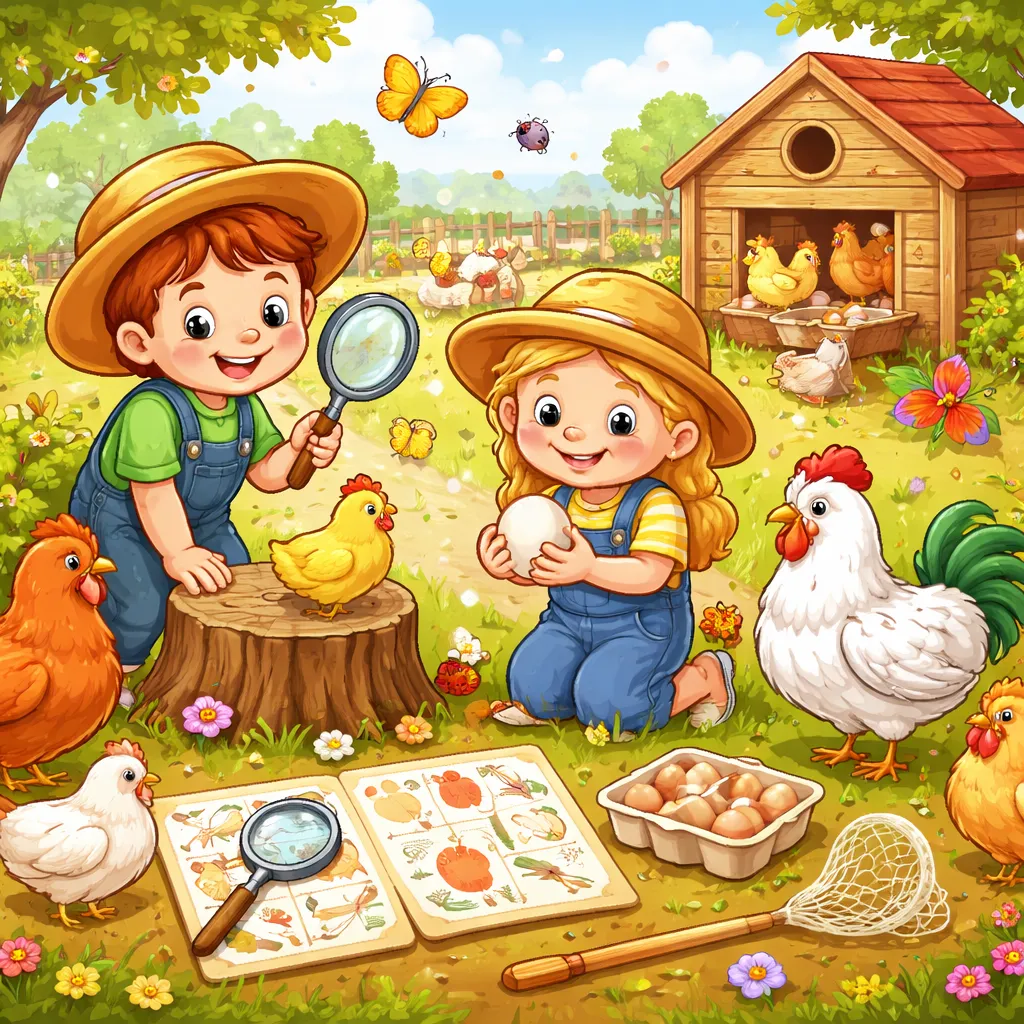

Have you ever visited a farm or a petting zoo and heard a cheerful "cluck-cluck" sound? Or maybe you’ve seen a picture of a bright red rooster crowing at the sunrise? Chickens are familiar birds that live on farms and in backyards all over the world. They give us eggs and teach us about life on the farm. Learning about chickens is a pecking good adventure that takes us to coops and yards. Let’s begin our journey of learning about chicken life and habits.
English Language Learning
Vocabulary and Spelling Our feathered farm friend is called a chicken. The word "chicken" is a noun. A noun names a person, place, or thing. So, a chicken is a thing—a living bird. A grown-up female chicken is called a hen, and a grown-up male is a rooster or cock. Spelling "chicken" is fun: C-H-I-C-K-E-N. The 'C' and 'H' start the word together, the 'I' and 'C' are in the middle, and it ends with 'K-E-N'. C-H-I-C-K-E-N spells chicken.
Sound and Pronunciation Let’s say the word correctly. It sounds like this: /ˈtʃɪk.ɪn/. We can say it in two clear parts. First, say "chick". It rhymes with "pick" or "stick". Next, say "in". It’s the same as the word "in". Now, put it together! "Chick" "in". Chicken! Great! The word "chicken" has two beats, or two syllables. Clap your hands twice: Chick-en. It’s a bouncy, fun word.
Related Words Learning about chickens is more fun with new words! Here are some important ones. Baby: A baby chicken is called a chick. Home: A chicken’s house is called a coop. The yard where they play is a run. Sound: The sound a hen makes is a cluck. A rooster’s morning call is a crow.
A Famous Saying There is a common phrase: "Don’t count your chickens before they hatch." This means you should not make plans based on something good happening until it actually happens. It comes from the idea that a chick must safely hatch from its egg first. It teaches us to be patient and wait for results. Say the saying with me: "Don’t count your chickens before they hatch." It’s a wise piece of advice.
Now you know the word "chicken"! Are you ready to peck into some amazing facts? Let’s scratch from words to wonderful knowledge!
Animal Knowledge
Who Are They? – Family and Group What kind of animal is a chicken? Chickens are birds. They are warm-blooded, have feathers, and lay eggs. They are part of the pheasant family, called Phasianidae. Their closest wild relative is the Red Junglefowl. People have kept chickens as farm animals for thousands of years.
What Do They Look Like? – Amazing Bodies Chickens come in many sizes and colors. They have a round body, a small head with a comb on top, and two strong legs. Their most famous features are their feathers, their comb and wattles, and their hard beak. Their comb (on the head) and wattles (under the beak) help them stay cool. Their beak is perfect for pecking at food. They have sharp claws on their feet for scratching the ground. Chickens have special adaptations. They have very good eyesight and can see colors. They have a special way of sleeping, by perching on a branch or a roost. They take dust baths to keep their feathers clean and free of bugs.
Where Do They Live and How? – Home and Habits Chickens live all over the world on farms and in backyards. Their homes are coops and yards where they are kept safe. Some chickens, called free-range, get to roam in open areas. Chickens are omnivores. This means they eat both plants and animals. They eat seeds, grains, insects, worms, and even small mice. They scratch the ground with their feet to find food. Chickens are very social and live in groups called a flock. A flock has a order, called a pecking order. They are active during the day. They spend their time pecking for food, dust bathing, and resting. At night, they sleep on a perch.
A Chicken’s Life Story – Growing Up A baby chicken is called a chick. Chickens are birds, so chicks hatch from eggs. A hen lays about one egg every day or two. She sits on the eggs to keep them warm for 21 days until they hatch. The mother hen is a very caring parent. She keeps the chicks warm and teaches them what to eat. She protects them from danger. The chicks follow her everywhere. Chicks are born with soft, fluffy down feathers. They can walk and eat soon after hatching. They grow quickly and get their adult feathers in a few weeks. A chick becomes a hen or rooster in about five to six months.
How Do They "Talk"? – Communication Chickens talk with many sounds. Hens cluck and purr. Roosters crow, especially in the morning. They have different calls for danger, for finding food, and for laying an egg. They use body language. A chicken might fluff its feathers to look bigger or lower its head to show it is not a threat. The way they stand and move tells other chickens how they feel. Their best senses are their excellent eyesight and hearing. They can see a wide area to watch for danger. Their ears are hidden under feathers but are very good at hearing the smallest sounds.
Are They Okay? – Taking Care of Them Many chickens are well cared for on farms, but some are not treated kindly. It is important for chickens to have space, fresh air, and clean water. The main threats to chickens are diseases, predators, and sometimes living in very crowded conditions. As responsible people, we should make sure chickens have a good life. You can be a chicken friend! If you have chickens, make sure they have a clean coop, fresh food and water, and space to scratch. You can collect their eggs gently. Always be kind and gentle with chickens. Support farmers who treat their animals well.
Life Connections and Inspiration
How to Be With Them – Safety, Responsibility, and Care Chickens are often kept as farm animals or backyard pets. They are living creatures that need our care and respect. Owning chickens is a big responsibility. They need a safe coop to protect them from rain, wind, and predators. They need fresh water and special chicken food every day. Their home must be cleaned regularly. When you are with chickens, move slowly and talk softly. Let them get used to you. You can offer food from your hand, but let them come to you. Never chase or grab a chicken. We show our love by being responsible owners. A happy chicken is one that is healthy, safe, and can do chicken things like pecking and dust bathing.
Super Qualities We Learn from Them Chickens teach us wonderful things. One super quality is diligence and daily routine. Hens lay eggs regularly, and chickens have a daily rhythm of waking, eating, and resting. They teach us the value of having a routine and doing our daily tasks diligently. Another quality is community and order. Chickens live in a flock with a clear pecking order. This helps them live together peacefully. It reminds us of the importance of understanding our place in a group, whether in family, school, or teams, and working together harmoniously. Think about it: How can having a daily routine help you, like a hen laying an egg? How can you be a good member of your own "flock" at home or school?
Take Action! – Your "Chicken Coop" Project Let’s do a fun and responsible activity! Your project is to design a dream chicken coop. On a large piece of paper, draw and label a cozy chicken coop. Include a roosting bar for sleeping, nesting boxes for laying eggs, a feeder and waterer, and a door to a safe outdoor run. Add details like windows for light and ventilation. Draw a few happy chickens in your coop. Present your design and explain why each part is important for the chickens’ health and happiness.
Closing Learning about chicken life is a delightful and educational adventure! We learned the word "chicken" and how to say its two-part name. We discovered amazing facts about their combs, their clucking, and their life in a flock. We know that chickens are diligent, social birds that need our responsible care. You can use your new words to share stories about these feathered friends. You can use your knowledge to be a kind and responsible animal caretaker. The animal world is full of diligent and communal teachers. Always remember to be responsible for the animals in your care, value daily routines, and live harmoniously in your community. Keep exploring with curiosity, tend to your tasks with diligence, and be a friend to all creatures. Your caring actions and responsible spirit make you a true friend to the amazing chicken.