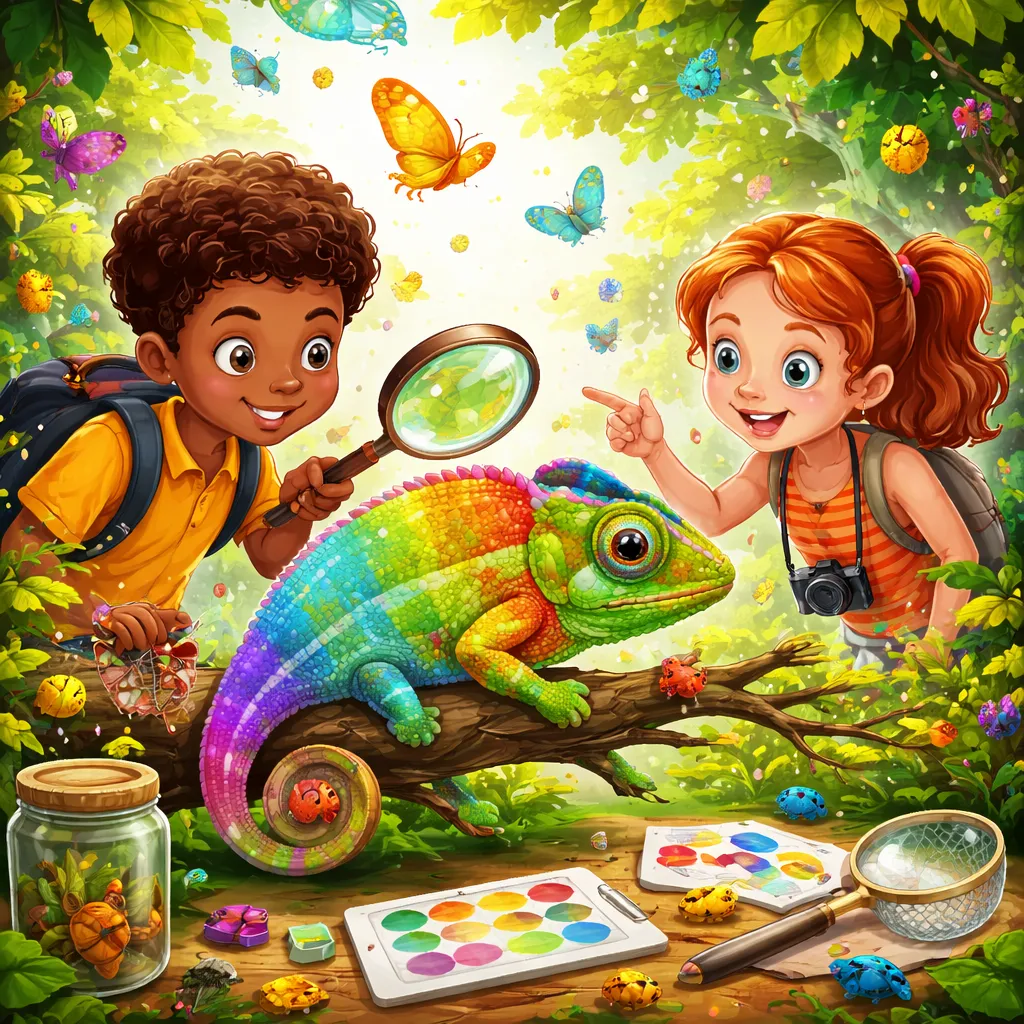

Have you ever seen a picture of a lizard that looks like it’s wearing a rainbow? It can be green, brown, blue, or even have stripes! This amazing animal is a chameleon. Famous for their color-changing skin and funny, swiveling eyes, chameleons seem like magical creatures. Learning about chameleons is a vibrant adventure into the world of adaptation and surprise. Let’s begin our journey of learning about chameleon colors and cool skills.
English Language Learning
Vocabulary and Spelling Our colorful, changing friend is called a chameleon. The word "chameleon" is a noun. A noun names a person, place, or thing. So, a chameleon is a thing—a very special, living lizard. Spelling "chameleon" is interesting: C-H-A-M-E-L-E-O-N. C-H-A-M-E-L-E-O-N spells chameleon.
Sound and Pronunciation Let’s say the word correctly. It sounds like this: /kəˈmiː.li.ən/. We can say it in three clear parts. First, say "kuh". It’s a soft sound. Next, say "mee". It rhymes with "see". Last, say "lee-uhn". It’s like "leon" in "Napoleon". Now, put it together! "Kuh" "mee" "lee-uhn". Chameleon! Great! The word "chameleon" has three beats, or three syllables. Clap three times: Cha-me-leon. It’s a musical, flowing word.
Related Words Learning about chameleons is more fun with new words! Here are some important ones. Action: The way a chameleon changes its color is camouflage or color change. A baby chameleon is a hatchling. Body Part: The long, sticky tongue a chameleon shoots out is its projectile tongue. Home: A chameleon’s home in the trees is the canopy.
A Famous Saying People often say: "As adaptable as a chameleon." This means someone can adjust easily to new situations, just like a chameleon changes its colors to match its environment. It reminds us of the importance of being flexible and adaptable in life. Say the saying with me: "As adaptable as a chameleon." It’s a great skill to have.
Now you know the word "chameleon"! Are you ready to explore their world of change? Let’s shift from words to wonderful knowledge!
Animal Knowledge
Who Are They? – Family and Group What kind of animal is a chameleon? Chameleons are reptiles. They are cold-blooded, have scaly skin, and lay eggs. They belong to the Chamaeleonidae family. There are over 200 species, from the tiny Brookesia to the large Parson’s chameleon. They are a very special type of lizard.
What Do They Look Like? – Amazing Bodies Chameleons come in many sizes, but most are about the length of your hand. They have a curled tail, feet that grip like hands, and eyes that move separately. Their most famous features are their color-changing skin and their swiveling, bulging eyes. Their body is full of super tools! Their eyes can look in two different directions at the same time, giving them a full view to spot insects or danger. Their feet are perfect for holding onto branches. Their long, sticky tongue can shoot out faster than you can blink to catch a bug. Chameleons have special adaptations. They change color using special cells in their skin. This is mostly for talking to other chameleons, showing their feelings, or controlling their temperature, not just for hiding. They are masters of slow, swaying movement.
Where Do They Live and How? – Home and Habits Chameleons live in warm places. Their homes are rainforests, deserts, and savannas in Africa, Madagascar, southern Europe, and Asia. They almost always live in trees and bushes. Chameleons are insectivores. This means they are insect-eaters. They love to eat crickets, grasshoppers, and flies. They are patient hunters, staying very still and then shooting out their incredible tongue to grab a bug from a distance. Chameleons are solitary and territorial. They are active during the day. They spend their time slowly climbing in trees, looking for food with their amazing eyes, and basking in the sun. A group of chameleons is called a camp.
A Chameleon’s Life Story – Growing Up A baby chameleon is called a hatchling. Chameleons are reptiles, so hatchlings hatch from eggs. The mother lays her eggs in a hole in the ground or in a tree. Most chameleon mothers do not take care of their eggs or babies. They leave the eggs buried. The hatchlings must dig their way out and are completely on their own from the start. Hatchlings are tiny and look like adults. They can change color from the day they hatch. They grow quickly and must hunt for their own food immediately. They face many dangers from birds and other predators. Chameleons can live for several years.
How Do They "Talk"? – Communication Chameleons are usually quiet. They might hiss or make soft sounds when scared. But their main way of talking is through color and body language. They change their skin color to send messages. Bright colors might mean "I am angry" or "I want to find a mate." Dark colors can mean "I am scared" or "I am cold." They also puff up their bodies to look bigger. Their best sense is their incredible eyesight. Their swiveling eyes give them almost a full circle of vision. They can see tiny insects from far away. Their eyesight is their most important tool for life in the trees.
Are They Okay? – Taking Care of Them Many chameleon species are in danger. They are threatened or endangered. Their special tree homes are disappearing fast. The main threats are the loss of their forest homes and people taking them from the wild to sell as pets. Chameleons are very sensitive and do not do well when moved. The pet trade hurts their wild families. You can be a chameleon champion! You can learn and tell others about their trouble. You can support groups that protect rainforests. If you dream of a pet chameleon, remember they are very difficult pets and need expert care. Always choose a pet that was bred in captivity by a responsible breeder, never taken from the wild.
Life Connections and Inspiration
How to Be With Them – Safety and Love Chameleons are wild, sensitive, and delicate animals. They are not toys or simple pets. We must admire them with great care and without causing them stress. The rule is: Observe with wonder, never with hands. If you see a chameleon in the wild, look from a distance. Never try to touch, catch, or take one. Never buy a chameleon (or any animal) from a street seller or a store that doesn’t know how to care for them. In a zoo or aquarium, be a quiet observer. We show our love by protecting the forests and trees they call home. We can be voices for these quiet, colorful tree-dwellers.
Super Qualities We Learn from Them Chameleons teach us beautiful lessons. One super quality is amazing adaptability and observation. A chameleon changes to suit its situation and uses its incredible eyes to see the whole world. It teaches us to be observant, to see things from different perspectives, and to adapt to new situations in a calm way. Another quality is the power of peaceful patience. Chameleons move very slowly and wait patiently for the right moment. This reminds us that sometimes, moving slowly, being patient, and waiting for the right opportunity is the best way to succeed. Think about it: How can you be more observant of the world around you, like a chameleon? When is a time you can use patience to achieve a goal?
Take Action! – Your "Chameleon Vision" Project Let’s do an observant and creative activity! Your project is to create a picture that shows a chameleon’s 360-degree view. Draw a large chameleon in the middle of your paper. Now, draw what its two separate eyes might see. On one side, draw a bug on a leaf. On the other side, draw a bird in the sky. This shows how a chameleon can look for food and watch for danger at the same time!
Closing Learning about chameleon changes is a colorful and thoughtful adventure! We learned the word "chameleon" and how to say its three-part name. We discovered amazing facts about their swiveling eyes, their projectile tongues, and their life as patient tree climbers. We know that chameleons are adaptable, observant animals that are in danger and need us to protect their forest homes. You can use your new words to share the fascinating story of these masters of change. You can use your knowledge to be a protector of wildlife and to understand the importance of seeing the world from different points of view. The animal world is full of adaptable and patient teachers. Always remember to respect wildlife from a safe distance, be observant and adaptable in your own life, and use patience to reach your goals. Keep exploring with curious eyes, see the world from all angles, and be a friend to the wild. Your thoughtful actions and adaptable spirit make you a true friend to the amazing chameleon.