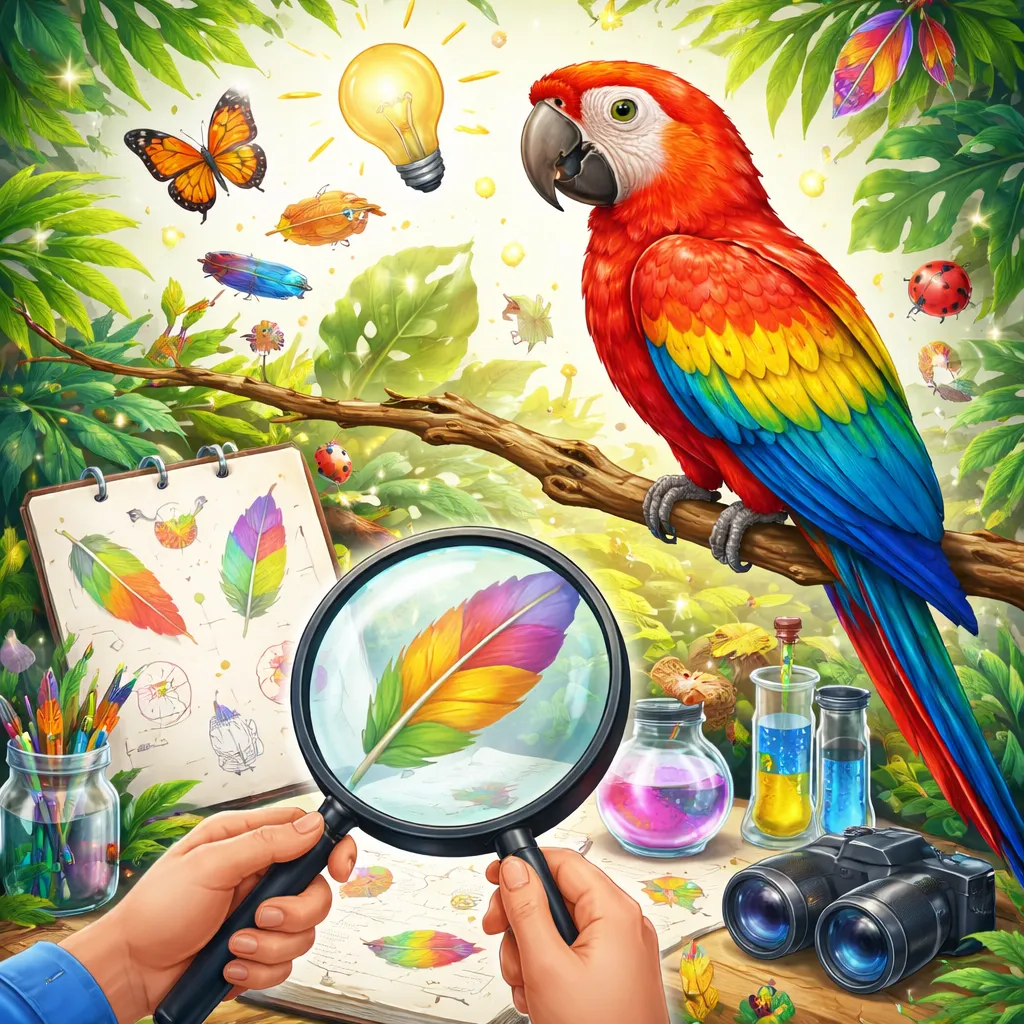

Have you ever seen a parrot at a zoo, in a pet store, or in a cartoon? With their bright rainbow feathers, curved beaks, and amazing ability to copy sounds, parrots are some of the most exciting birds in the world. Learning about parrots is a colorful adventure that takes us to tropical forests and teaches us about smart, social birds. Let’s get ready to start our journey of learning about parrot talk and talent!
English Language Learning
Vocabulary and Spelling Our colorful, talking friend is called a parrot. The word "parrot" is a noun. A noun names a person, place, or thing. So, a parrot is a thing—a very smart, living bird. Spelling "parrot" is simple: P-A-R-R-O-T. The 'P' starts the word, there are two 'R's in the middle, and it ends with 'O-T'. P-A-R-R-O-T spells parrot.
Sound and Pronunciation Let’s say the word correctly. It sounds like this: /ˈper.ət/. We can say it in two clear parts. First, say "pair". It rhymes with "air" or "care". Next, say "ut". It’s a soft, quick sound, like the end of "carrot". Now, put it together! "Pair" "ut". Parrot! Great! The word "parrot" has two beats, or two syllables. Clap your hands twice: Par-rot. It’s a fun, chatty word.
Related Words Learning about parrots is more fun with new words! Here are some important ones. Body Part: A parrot’s strong, curved mouth is called a beak. The two toes pointing forward and two pointing backward on each foot are called zygodactyl feet. Skill: A parrot’s ability to copy sounds and words is called mimicry. Group: A group of parrots is called a flock or a pandemonium.
A Famous Saying There is a common phrase: "Sick as a parrot." This is a saying that means feeling very disappointed or unhappy. It’s a playful way to show big disappointment, like when your team loses a game. Remember, it’s just an expression—a real sick parrot needs a vet! Say the saying with me: "Sick as a parrot." It’s a fun piece of language.
Now you know the word "parrot"! Are you ready to chat about some amazing facts? Let’s fly from words to wonderful knowledge!
Animal Knowledge
Who Are They? – Family and Group What kind of animal is a parrot? Parrots are birds. They are warm-blooded, have feathers, and lay eggs. They are part of the order Psittaciformes. This includes cockatoos, macaws, lorikeets, and budgies. There are over 350 different species of parrots in the world.
What Do They Look Like? – Amazing Bodies Parrots come in many sizes, from a small sparrow to a large cat! They are famous for their brightly colored feathers in red, blue, green, and yellow. Their most famous features are their strong, curved beak and their special feet. Their beak is a super tool! It is strong enough to crack the hardest nuts. They also use it to climb, like a third foot. Their special feet with two toes forward and two back are perfect for holding food and climbing branches. Parrots have special adaptations. They have a thick, muscular tongue to help them manipulate food. Some, like the lory, have brush-tipped tongues for eating nectar. They are very intelligent and can live for a very long time—some for over 50 years!
Where Do They Live and How? – Home and Habits Most parrots live in warm, tropical areas. Their homes are rainforests, woodlands, and savannas in places like South America, Australia, and Africa. Some also live in mountains. Parrots are herbivores. This means they mostly eat plants. They eat seeds, nuts, fruits, berries, and flowers. Some also eat nectar. They use their strong beaks like tools to get their food. Parrots are very social and live in loud, noisy flocks. They are active during the day. They spend their time flying, foraging for food, preening their feathers, and chatting with each other. They are very playful and curious.
A Parrot’s Life Story – Growing Up A baby parrot is called a chick. Parrots are birds, so chicks hatch from eggs. The mother parrot usually lays two to eight white eggs in a nest inside a tree hole. Both parents often take care of the chicks. They keep the eggs warm and then feed the chicks by regurgitating food. The parents are very protective of their nest. Chicks are born blind and without feathers. They grow quickly and are very hungry. They stay in the nest for several weeks until they grow their flight feathers. Then, they learn to fly and find food with their parents' help. A parrot chick is called a fledgling when it first leaves the nest.
How Do They "Talk"? – Communication Parrots are famous for their voices! They squawk, screech, chirp, and whistle. In the wild, they have different calls for danger, food, and flock contact. Their most amazing skill is mimicry. Some pet parrots can copy human words, phone rings, and other sounds. They do this to fit into their "flock" (which might be a human family). They don’t always know what the words mean, but they are very smart. Their best senses are their excellent eyesight and hearing. They can see colors very well. Their good hearing helps them learn and copy sounds perfectly.
Are They Okay? – Taking Care of Them Many parrot species are in great danger. Over 100 species are endangered or critically endangered. This means they could disappear from the wild. The main threats are people cutting down the rainforests, trapping them for the illegal pet trade, and hunting. Some parrots get sick from diseases. You can be a parrot protector! You can learn and tell everyone about their trouble. You can support groups that protect rainforests and rescue parrots. If you want a pet parrot, only get one from a responsible rescue center, never from the wild. Remember, parrots are a big, long-term responsibility.
Life Connections and Inspiration
How to Be With Them – Safety and Love Parrots are wild animals that can be pets, but they are a huge responsibility. They are not toys. They need a lot of care, time, and love. Owning a parrot is a very long-term promise. Some parrots live longer than people! They need a very large cage, fresh food and water daily, toys, and time outside the cage to fly and play. They need a vet who knows about birds. Always be gentle and let the parrot come to you. Move slowly and talk softly. Never grab a parrot. We show our love by giving them the best life possible, with lots of mental stimulation and social time. A happy parrot is a healthy, busy, and loved parrot.
Super Qualities We Learn from Them Parrots teach us wonderful things. One super quality is social intelligence and communication. Parrots are very social and need their flock. They communicate in many ways. They teach us the importance of talking, listening, and being part of a community. Another quality is bright curiosity and playfulness. Parrots are naturally curious and love to play with toys and solve puzzles. They remind us to stay curious, to keep learning new things, and to find joy and color in every day. Think about it: How can you be a good communicator in your family or with friends? How can you stay curious and playful as you learn about the world?
Take Action! – Your "Parrot Chatter" Project Let’s do a fun and communicative activity! Your project is to create a "parrot chatter" tape or drawing. If you can record sound: with an adult’s help, use a phone or recorder. Practice saying a few fun, clear phrases, like "Hello!" or "Good morning!" Then, try to whistle a tune. See if you can teach a family member to repeat it back, just like training a parrot! If you prefer to draw, create a colorful picture of a parrot. Write a speech bubble next to it with a fun word or sound you think it might say. Share your recording or drawing.
Closing Learning about parrot chatter is a vibrant and joyful adventure! We learned the word "parrot" and how to say its two-part name. We discovered amazing facts about their strong beaks, their mimicry skills, and their life in noisy, social flocks. We know that parrots are intelligent, colorful birds who are in danger and need our protection. You can use your new words to share stories about these brilliant birds. You can use your knowledge to be a responsible pet owner or a voice for parrots in the wild. The animal world is full of smart and social teachers. Always remember to be a good communicator, stay curious and playful, and make promises to pets that you can keep for their whole life. Keep exploring with colorful curiosity, share your voice with kindness, and be a friend to all creatures. Your caring actions and bright spirit make you a true friend to the amazing parrot.