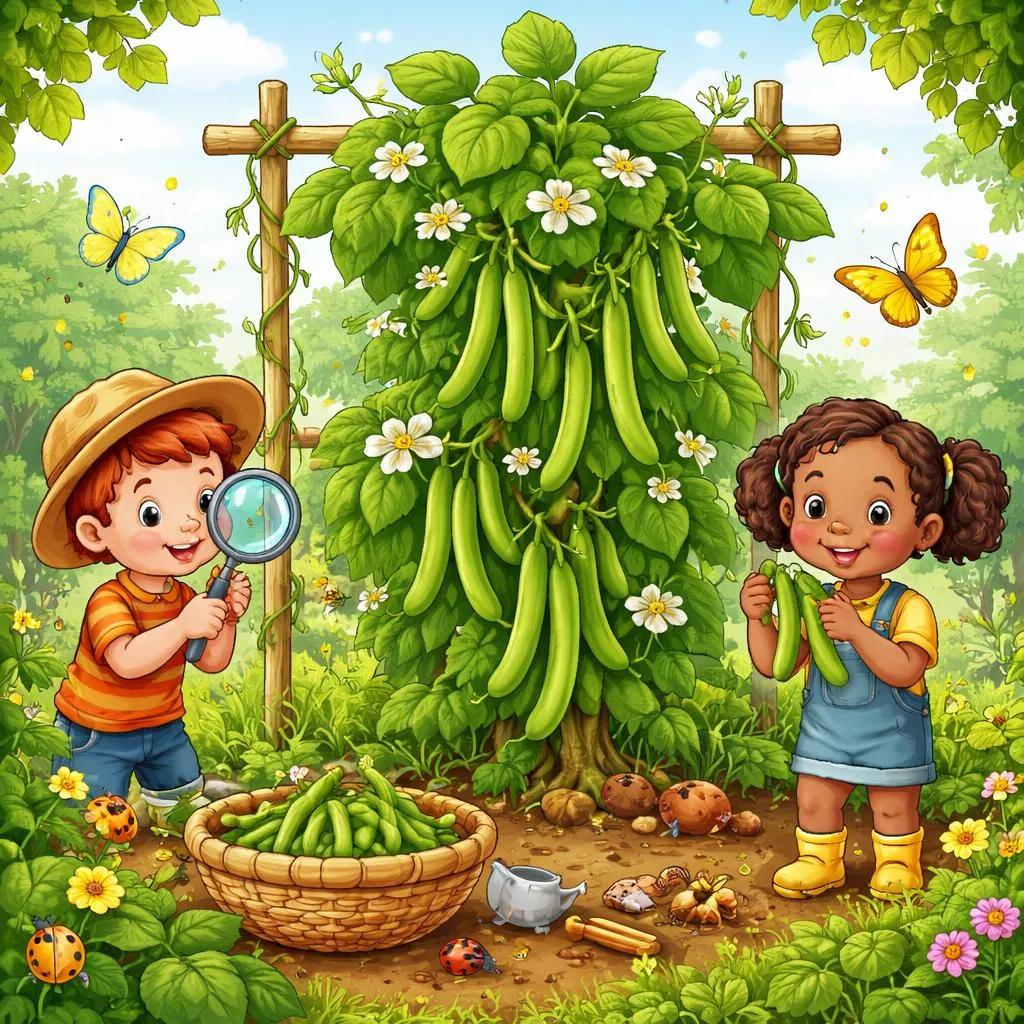

Have you ever helped snap the ends off long, crunchy green beans for dinner? You might have noticed they break with a satisfying snap! These tasty pods grow on friendly plants in the garden. Some plants are short and bushy, while others are tall climbers that need a fence or trellis. The best part is, the more you pick, the more the plant grows! Let’s get ready to learn about the productive and delicious Green Bean plant.
Let’s Learn the Word! – Open the Treasure Box of Language
Formal Name and Pronunciation
This crunchy pod is called a Green Bean. Its scientific name is Phaseolus vulgaris. You can say it like this: /ɡriːn biːn/ (green been). “Green” is the color, and “Bean” is the seed. Green Bean. Say it: Green Bean. It’s a simple, friendly name.
The Etymology Tale
The word “Bean” is very, very old! It comes from an ancient Germanic word. The word has been used for thousands of years to talk about the seeds of pod-bearing plants. “Green” tells us we eat the pod when it’s young, tender, and green. Its name is ancient and descriptive.
Nicknames and Friendly Aliases
Green beans are known by how they grow. The tall, climbing kind is a Pole Bean. The short, bushy kind is a Bush Bean. If you let the pod dry on the plant, the seeds inside are Dry Beans. Young, skinny ones are sometimes called French Beans or Haricots Verts.
Building Your Word Web: Core Parts
Let’s learn the words for a Green Bean plant’s productive body. The Pod is the long, green container we eat, with the seeds inside. The Seed is the bean itself, inside the pod. The Leaf is made of three heart-shaped leaflets. The Flower is small, pretty, and can be white, pink, or purple. The Tendril is the thin, curly string on pole beans that grabs onto supports. A Trellis covered in vines is a bean trellis.
Action and State Words
Green bean plants are generous producers. You plant the seed. The plant grows quickly. The flowers are pollinated. The pods form and lengthen. They are harvested by picking. You can snap or slice them for cooking. A green bean plant is productive, tender, sun-loving, and annual.
Ecosystem Friends Vocabulary
A green bean patch is a helpful garden friend. Like all beans, it hosts special bacteria on its roots that take nitrogen from the air and put it in the soil. This fertilizes the garden! The flowers might attract bees. Sometimes, bean beetles (yellow with spots) might visit; pick them off. It is a quiet helper in the garden community.
Cultural Imprint in Language
Beans are symbols of simplicity, sustenance, and potential. Think of the fairy tale “Jack and the Beanstalk,” where a single bean held magical potential! The phrase “spill the beans” means to tell a secret. Another saying is, “Don’t know beans about it,” meaning you don’t understand something. Beans represent humble, honest food and hidden possibilities.
Ready for Discovery
We know its ancient, simple name. Are you ready to be a garden scientist and discover the secret nitrogen power in the roots of this plant? Let’s explore the helpful world of the Green Bean plant.
Discover the Plant’s Secrets! – A Nature Detective’s Notebook
The Plant Passport
Green Beans belong to the Fabaceae family, the legume or pea family. Its scientific name is Phaseolus vulgaris. It is an annual plant that comes in two main types: bush (short) and pole (climbing). The leaves are compound with three leaflets. The flowers are small and pea-like. The fruit is a pod, and we eat the whole pod before the seeds inside fully mature. It grows best in warm, frost-free weather and full sun.
Survival Smarts
The green bean plant is a soil superhero! Its roots form a partnership with special rhizobia bacteria. These bacteria live in little lumps on the roots called nodules. They take nitrogen gas from the air and “fix” it into a form the plant can use. This is like the plant having its own built-in fertilizer factory! This is why beans are so good for the soil. The plant grows quickly to produce lots of pods and seeds.
Its Role and Gifts
In the garden, beans are fantastic “cover crops” that enrich the soil with nitrogen for other plants. Their greatest gift is the pod. Green beans are a crunchy, healthy vegetable, steamed, stir-fried, or eaten raw. If left to mature, the seeds inside become dry beans (like kidney or pinto beans) for soups and stews. The plant gives two different foods.
Human History and Cultural Symbol
Green beans were first domesticated in Central and South America over 7,000 years ago. They were a staple for Native American tribes. Spanish and Portuguese explorers brought them to Europe and Africa in the 1500s. They quickly became a global garden favorite because they are so easy to grow and preserve (by drying). They represent ancient agriculture, global exchange, and reliable food.
Fun “Wow!” Facts
Get ready for a space fact! In 1984, green bean seeds were taken on the space shuttle Challenger to see how microgravity affected their growth. And here’s a family fact: Green beans, peas, peanuts, and clover are all cousins in the legume family. They all have those special nitrogen-fixing root nodules!
From Seed to Soil Helper
The story of the Green Bean plant is one of speed and generosity. Would you like to grow your own crunchy, soil-helping crop? You can grow bush beans in a pot, or pole beans on a balcony trellis! Let’s see how.
Let’s Grow It Together! – A Little Guardian’s Action Guide
Good for Home Growing?
Perfect! Bush beans are one of the easiest and most rewarding plants for a child. They grow quickly in a medium-sized pot on a sunny patio or step. Pole beans need a tall support but produce for a longer time. You’ll be harvesting in just 7-8 weeks. It’s instant garden success.
Little Gardener’s Toolkit
You will need a packet of green bean seeds (choose ‘bush’ for pots, ‘pole’ for a trellis). Get a medium-deep pot with drainage holes. Use regular potting soil. Have a watering can, a sunny spot, and a small trellis or teepee (for pole beans) ready.
Step-by-Step Growing Guide
Planting Your Productive Friend
Plant seeds directly in the pot after all danger of frost. Beans hate having their roots disturbed. For bush beans, plant seeds 1 inch deep and 3 inches apart. For pole beans, plant 3-4 seeds at the base of each support. Water well. Place the pot in full sun. Beans love warmth.
Care Calendar
Keep the soil moist until the seeds sprout. Once growing, water when the top inch of soil is dry. They love full sun. You don’t need much fertilizer because they make their own nitrogen! The most important job is to pick the pods often. This tells the plant to make more. For pole beans, help the young vines find the trellis.
Watch and Be Friends
Watch for the first two leaves pushing through the soil. The plant will grow quickly. Look for the pretty little flowers. Soon, tiny green pods will appear where the flowers were. Watch the pods get longer and fatter. Pick them when they are firm, crisp, and before you can see the big shape of the seeds inside. Snap one and listen to the sound!
Problem Diagnosis
If leaves turn yellow, it might be overwatered. Let the soil dry a bit. If pods are small and tough, you harvested too late. Pick them younger next time. Mexican bean beetles (yellow with spots) might eat leaves; pick them off. The most common problem is not enough sun, which makes fewer pods.
Your Rewards and Gifts
Your gift is a continuous, crunchy harvest. You are learning about plant life cycles, beneficial bacteria, and the joy of quick results. Caring for green beans teaches daily observation, gentle harvesting, and the satisfaction of eating something you grew in just weeks. You become a grower of abundance.
Creative Fun
Start a Bean Counter Journal. Draw your plant. Count how many pods you harvest each day. Do the “seed dissection”: soak a dry bean in water overnight, then carefully open it to see the tiny baby plant inside. With an adult, make a simple three-bean salad. Build a mini “bean teepee” from sticks for pole beans. Research the story of Jack and the Beanstalk and draw your own magical beanstalk. Have a “snap test” to see which bean is the crunchiest.
Growing a Snapping Good Harvest
By planting green beans, you are not just growing a vegetable. You are growing a lesson in garden science, a connection to ancient stories, and the simplest, tastiest snack. You are a cultivator of simple, generous joy.
Conclusion and Forever Curiosity
What a quick, crunchy, and helpful journey from a seed to a snapping pod! You started to learn about the Green Bean plant, you discovered its secrets as the nitrogen-fixing, soil-enriching champion of the garden, and you learned how to grow your own bountiful crop. You now know the Green Bean plant is not just a side dish; it is a lesson in plant partnerships, a giver of two different foods, a piece of agricultural history, and a symbol of productive simplicity. Remember, its power is in its speed and its quiet work with the soil. Your curiosity helps you see the incredible cooperation happening under the ground in every garden. Keep planting seeds that grow fast, exploring the magic of plant partnerships, and tasting the fresh, crunchy rewards of your care. Your adventure to learn about the Green Bean plant shows us that the most generous plants are often the simplest and quickest to grow.