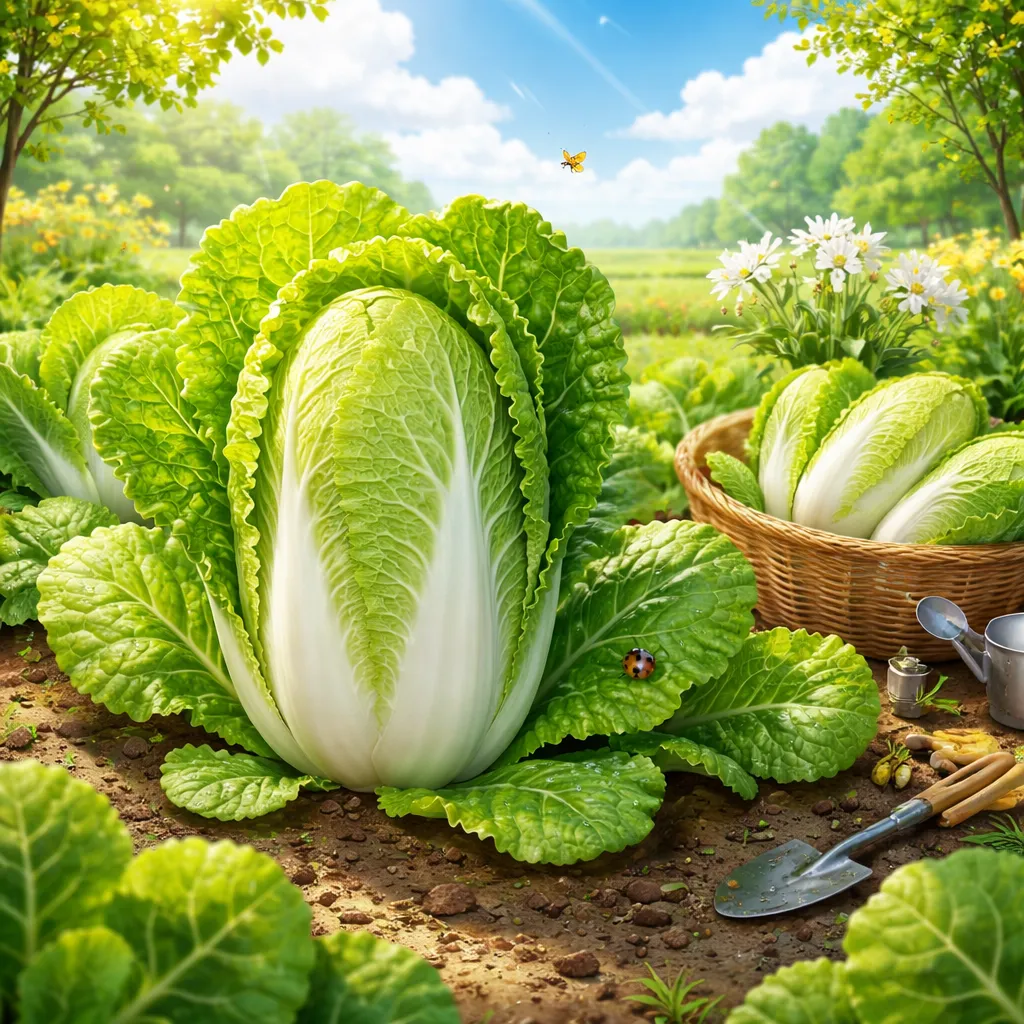

Have you ever eaten a crunchy, fresh egg roll or a warm, savory stir-fry with tender, pale green and white vegetables? That delicious ingredient is often Chinese cabbage! In the garden, it doesn’t look like a round, red tomato or a long, orange carrot. It grows into a beautiful, tall head of leaves that wrap around each other tightly, like a living, leafy football. It’s a staple in many Asian dishes and is super healthy. Let’s unwrap the story of the amazing Chinese Cabbage plant.
Let’s Learn the Word! – Open the Treasure Box of Language
Formal Name and Pronunciation
This leafy head is called Chinese Cabbage. Its scientific name is Brassica rapa (Pe-tsai group). You can say it like this: /ˌtʃaɪˈniːz ˈkæb.ɪdʒ/ (chy-NEEZ KAB-ij). The “Chinese” is for its origin, and “cabbage” is the vegetable. Chi-nese Cab-bage. Say it: Chinese Cabbage. It is also called Napa Cabbage or Wombok.
The Etymology Tale
The name tells us where it’s from! “Chinese” means it was first cultivated in China over 1,500 years ago. “Cabbage” comes from an old French word “caboche,” meaning “head.” The name “Napa” comes from the Japanese word “nappa” for leafy greens. “Wombok” comes from the Cantonese language. Its names are a map of its Asian journey.
Nicknames and Friendly Aliases
This plant has many names from across Asia. Most commonly, it is Napa Cabbage in the US and Japan. It is Wombok in Southeast Asia. The long, barrel-shaped type is Michihili. Because it forms a head, it is a Headed Cabbage. In recipes, it is often just called Chinese Leaves.
Building Your Word Web: Core Parts
Let’s learn the words for a Chinese Cabbage plant’s wrapped body. The Head is the whole tight bundle of leaves. Each Leaf is thick, crinkly, with wide white ribs and pale green tips. The Rib is the thick, juicy white center of the leaf. The Core is the solid base of the head. The Root system is shallow. A mature plant is a Chinese cabbage head.
Action and State Words
Chinese Cabbage plants are patient formers. You sow seeds. The plant first grows a rosette of open leaves. Then the leaves begin to wrap and head-up into a tight bundle. The head matures and firms up. It is harvested by cutting. A Chinese cabbage plant is crunchy, mild, cool-season, and biennial (harvested in first year).
Ecosystem Friends Vocabulary
A Chinese cabbage patch is part of the garden community. Like other cabbages, it can attract cabbage white butterflies that lay eggs. The caterpillars might eat the leaves. Ladybugs are helpful friends that eat aphids, which sometimes bother the plant. The large leaves provide shade and shelter for soil creatures at their base.
Cultural Imprint in Language
Chinese cabbage is a symbol of longevity, prosperity, and good health in many Asian cultures. Its long, white stems represent a long life. It is essential for making kimchi in Korea, a fermented dish that is central to Korean food culture. The phrase “wrapped up like a Napa cabbage” means something is bundled tightly. It represents tradition, preservation, and wholesome eating.
Ready for Discovery
We know its Asian, headed name. Are you ready to be a garden detective and discover how this plant forms its perfect, crunchy bundle? Let’s explore the world of the Chinese Cabbage plant.
Discover the Plant’s Secrets! – A Nature Detective’s Notebook
The Plant Passport
Chinese Cabbage belongs to the Brassicaceae family, the mustard and broccoli family. Its scientific group is Brassica rapa (Pe-tsai). It is a cool-season annual vegetable. The plant forms an upright, cylindrical or barrel-shaped head of closely packed, oblong leaves. The leaves are heavily veined and have a crisp texture. It grows best in the cool temperatures of spring and fall and needs consistent moisture.
Survival Smarts
Chinese cabbage’s clever trick is heading up. The inner leaves curl inward to protect the tender, young growth in the center from cold, pests, and harsh sunlight. This creates a microclimate inside the head. The thick, white ribs of the leaves store water, helping the plant in dry spells. Its mild flavor, compared to other cabbages, comes from different levels of natural chemicals.
Its Role and Gifts
In the garden, it is a productive space-user. Its greatest gift is its versatility. The leaves are eaten raw in salads for a mild, juicy crunch. They are the key ingredient in kimchi, stir-fries, soups, and dumplings. The white ribs stay crunchy when cooked. It is a nutritional powerhouse, full of vitamins C and K, and fiber. It is a cornerstone of East Asian cuisine.
Human History and Cultural Symbol
Chinese cabbage was domesticated in the Yangtze River region of China. It has been a crucial vegetable in China, Korea, and Japan for centuries. Korean kimchi, made by fermenting Chinese cabbage with spices, is a UNESCO-recognized cultural heritage. It was introduced to the West in the 19th century. It represents ancient agricultural wisdom, cultural identity, and the art of food preservation.
Fun “Wow!” Facts
Get ready for a kimchi fact! One head of Chinese cabbage can make jars and jars of kimchi! The fermentation process makes it tangy, spicy, and full of good probiotics for your gut. And here’s a water fact: Chinese cabbage is about 95% water, which is why it’s so juicy and crunchy when you take a bite!
From Loose Leaves to Firm Head
The story of the Chinese Cabbage plant is one of cool-weather patience. Would you like to grow your own crunchy head for stir-fries? You can grow Chinese cabbage in a large container or garden bed! Let’s see how.
Let’s Grow It Together! – A Little Guardian’s Action Guide
Good for Home Growing?
Yes, but it needs space and cool weather. Chinese cabbage needs a deep, wide pot or a garden spot. It doesn’t like extreme heat, so plant it in spring or fall. Watching the leaves slowly curl inward to form a head is a magical process. It’s a rewarding project for a patient gardener.
Little Gardener’s Toolkit
You will need a packet of Chinese cabbage (Napa) seeds. Get a very large, deep pot (at least 12 inches wide and deep) or a garden space. Use rich, moisture-retaining potting soil. Have a watering can, liquid fertilizer, and a cool, sunny spot ready.
Step-by-Step Growing Guide
Planting Your Headed Friend
Sow seeds directly in late summer for a fall harvest or very early spring. Plant seeds ½ inch deep and 2 inches apart. Water well. Once seedlings are a few inches tall, thin them to stand 12-18 inches apart. This space is crucial for the head to form properly. Place in a spot with full sun to light shade.
Care Calendar
Keep the soil consistently moist. Chinese cabbage needs a lot of water to grow those juicy leaves, especially as the head forms. It likes cool temperatures. Feed it with a balanced liquid fertilizer every 2-3 weeks. The most important thing is steady, even growth—no big dry spells or hot waves.
Watch and Be Friends
Watch the plant first make a open bunch of leaves. Then, see the center leaves start to curve inward. Day by day, the head will get taller and firmer. Gently squeeze the head to feel it get tight. When the head feels solid and is a good size, it’s ready. Use a knife to cut it at the base. Unwrap a leaf and taste its mild, sweet crunch.
Problem Diagnosis
If the plant bolts (sends up a flower stalk) without forming a head, the weather got too hot too fast. If leaves have many holes, look for green cabbage worms; pick them off. If the head is loose, the plant didn’t get enough sun, water, or space. Slugs might chew young leaves; use crushed eggshells around the base.
Your Rewards and Gifts
Your gift is growing your own giant, crunchy leaf bundle. You are learning about cool-season crops, plant formation, and global foods. Caring for Chinese cabbage teaches observation, consistent care, and the satisfaction of harvesting a perfect, self-wrapped package. You become a grower of international flavors.
Creative Fun
Start a Global Chef Gardener’s Journal. Draw the stages of head formation. Measure the head’s width each week. Try a leaf raw and cooked—compare the texture. With an adult, make a simple stir-fry with your homegrown cabbage. Research Korea and find it on a map; learn to write “김치” (kimchi). Make leaf prints with paint. Create a “passport” for your cabbage, stamping it with China, Korea, and Japan. Write a recipe for “Magical Crunchy Wraps.”
Growing a Bundle of Goodness
By planting Chinese cabbage, you are not just growing a vegetable. You are growing a connection to ancient cultures, a lesson in plant patience, and a key ingredient for healthy, delicious meals. You are a cultivator of crunchy, cross-cultural joy.
Conclusion and Forever Curiosity
What a crunchy, mild, and culturally rich journey! You started to learn about the Chinese Cabbage plant, you discovered its secrets as the cool-loving, self-wrapping staple of Asian kitchens, and you learned how to nurture your own head of leafy goodness. You now know the Chinese Cabbage plant is not just for salads; it is a marvel of plant packaging, a cornerstone of fermentation, a lesson in steady growth, and a living link to food traditions across Asia. Remember, its perfect form is created by its own patient, curling leaves. Your curiosity helps you unwrap the stories and science in the foods of the world. Keep exploring global gardens, tasting with an adventurous spirit, and planting seeds that grow into understanding and connection. Your adventure to learn about the Chinese Cabbage plant shows us that the most wholesome foods often come neatly wrapped in their own natural package.