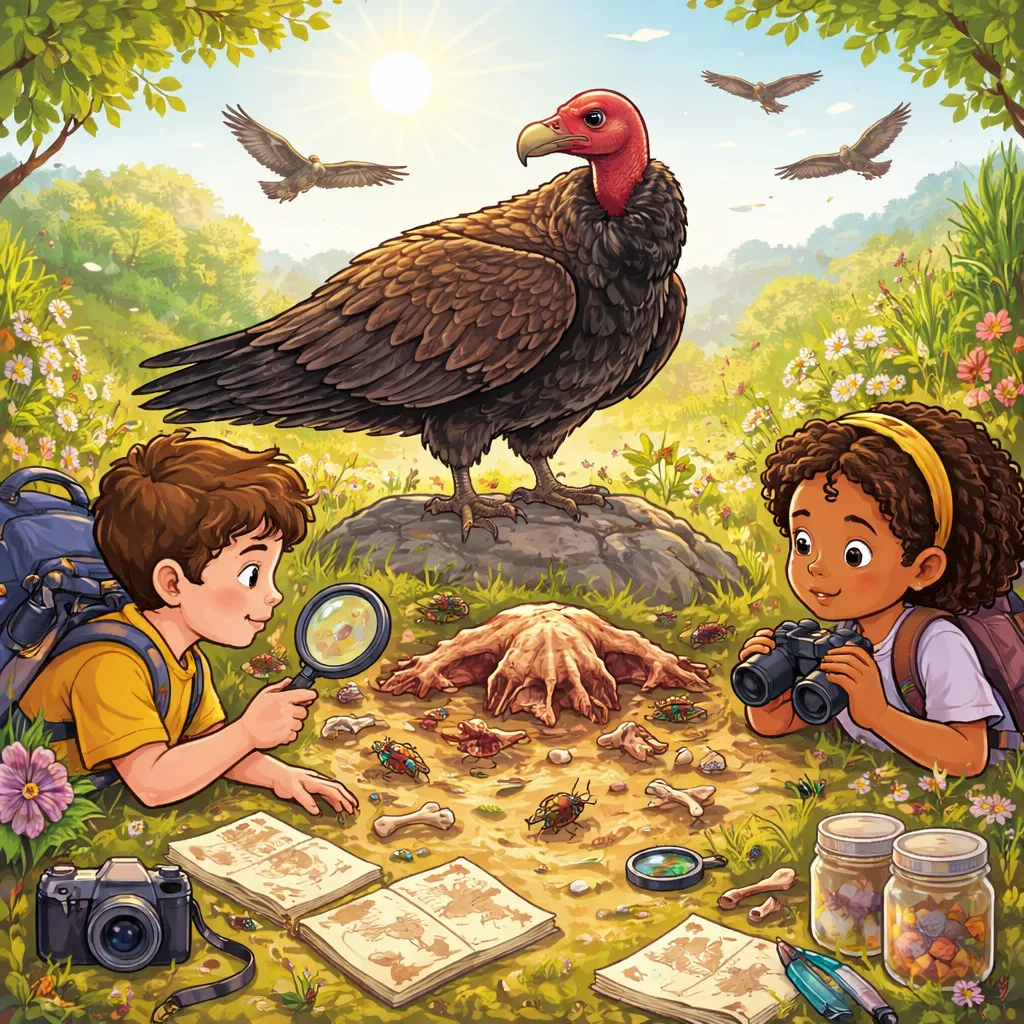

Have you ever seen a large bird soaring in slow circles, high in the sky? It might be looking for something on the ground with its amazing eyes. That’s a vulture! These birds might seem a bit scary, but they have a very important job in nature. Learning about vultures is a fascinating adventure that shows us how every animal has a special role. Let’s begin our journey of learning about vulture work and why they matter.
English Language Learning
Vocabulary and Spelling Our high-flying cleaner is called a vulture. The word "vulture" is a noun. A noun names a person, place, or thing. So, a vulture is a thing—a large, living bird. Spelling "vulture" is straightforward: V-U-L-T-U-R-E. The 'V' starts the word, the 'U' and 'L' are in the middle, and it ends with 'T-U-R-E'. V-U-L-T-U-R-E spells vulture.
Sound and Pronunciation Let’s say the word correctly. It sounds like this: /ˈvʌl.tʃɚ/. We can say it in two clear parts. First, say "vul". It rhymes with "hull". Next, say "chur". It’s a soft sound, like the beginning of "church". Now, put it together! "Vul" "chur". Vulture! Great! The word "vulture" has two beats, or two syllables. Clap your hands twice: Vul-ture. It’s a strong, important word.
Related Words Learning about vultures is more fun with new words! Here are some important ones. Group: A group of vultures circling in the air is called a kettle. A group feeding on the ground is a wake. Body Part: A vulture’s featherless head is bald. Its sharp, hooked beak is for tearing. Action: The way vultures float on warm air currents is soaring.
A Famous Saying People sometimes use the phrase: "As patient as a vulture." This doesn’t mean they are mean. It means they are very good at waiting and watching for the right moment. It comes from how vultures can soar for hours, watching the ground for their important work. It reminds us that being observant and patient can be a strength. Say the phrase with me: "As patient as a vulture." It’s about being a good watcher.
Now you know the word "vulture"! Are you ready to learn about their vital role? Let’s soar from words to wonderful knowledge!
Animal Knowledge
Who Are They? – Family and Group What kind of animal is a vulture? Vultures are birds. They are warm-blooded, have feathers, and lay eggs. There are two main families: New World Vultures (like the Turkey Vulture in the Americas) and Old World Vultures (like the Griffon Vulture in Europe, Africa, and Asia). They are not closely related but look similar because they do the same job!
What Do They Look Like? – Amazing Bodies Vultures are large birds with broad wings. They are usually dark brown or black. Their most famous features are their featherless heads and necks and their excellent eyesight. Their bald head is a super tool for cleanliness! Since they often put their heads inside animal bodies to eat, having no feathers keeps them cleaner and helps prevent disease. Their excellent eyesight helps them spot food from very high in the sky. Vultures have special adaptations. They have very strong stomach acid that can kill dangerous bacteria, making them nature’s cleanup crew. They are masters of soaring and can fly for hours without flapping their wings much, saving energy.
Where Do They Live and How? – Home and Habits Vultures live on every continent except Australia and Antarctica. Their homes are open areas like savannas, deserts, and mountains. They need open spaces to soar and see the ground. Vultures are scavengers. This means they eat animals that are already dead. They do not hunt live animals. This is their super important job! By eating dead things, they clean the environment and stop the spread of diseases. Vultures are social and often feed and roost in groups. They are active during the day. They spend their time soaring high on thermals (warm air currents), looking for food with their sharp eyes. A group in flight is a kettle.
A Vulture’s Life Story – Growing Up A baby vulture is called a chick. Vultures are birds, so chicks hatch from eggs. Vultures usually lay one or two eggs in a simple nest on a cliff ledge, in a cave, or in a hollow tree. Both parents take care of the chick. They take turns keeping the egg warm and then bringing back food (regurgitated, or brought up from their stomach) for the chick. They are very protective of their nest. Chicks are born with soft down and grow slowly. They stay in the nest for a long time, sometimes over three months. The parents feed them until they learn to fly and find food on their own. It takes years for a vulture to get its full adult feathers.
How Do They "Talk"? – Communication Vultures are usually quiet. They can hiss or grunt, but they don’t have loud calls. New World Vultures, like the Turkey Vulture, can barely make a sound at all! They use their amazing eyesight to talk. If one vulture sees food and starts to circle down, other vultures see it and join. This is how they tell each other where to find a meal without making a sound. Their best sense is their incredible eyesight. Some vultures can see a small animal on the ground from over a mile away! Turkey Vultures also have a good sense of smell, which is unusual for birds.
Are They Okay? – Taking Care of Them Many vulture species are in very serious danger. In some parts of the world, they are critically endangered. This means they could disappear forever. The main threats are poison (from eating animals that were poisoned by people), getting hit by wind turbines, losing their habitat, and sometimes being hunted. In some places, medicine given to cattle is deadly to vultures. You can be a vulture protector! You can learn and tell others that vultures are helpful, not scary. You can support groups that work to ban poisonous chemicals and create safe feeding areas for vultures. You can also support clean energy that is safe for birds.
Life Connections and Inspiration
How to Be With Them – Safety and Love Vultures are wild birds of prey. They are not aggressive toward people, but we must always give them space and never disturb them. The rule is: Always watch from a very far distance. If you see vultures circling or feeding, do not approach them. Never try to touch or scare them. They are doing an important job. If you see a vulture on the ground that cannot fly, it might be sick or hurt. Tell an adult, who can call a wildlife rehabilitator. We show our love by understanding their crucial role and protecting them from the dangers people create. We can be voices for these misunderstood cleaners of the wild.
Super Qualities We Learn from Them Vultures teach us powerful lessons. One super quality is turning something negative into a positive service. Vultures take what is dead and unwanted and turn it into a clean environment. They teach us that even jobs that seem unpleasant can be vital and important. It reminds us to look for ways to help and improve our community, even in tasks others might not notice. Another quality is incredible patience and teamwork. Vultures soar for hours, waiting and watching. They work together to find and clean up a meal quickly. This teaches us the value of patience, observation, and how working as a team can get a big job done efficiently. Think about it: How can you help "clean up" or improve something in your home or community? How can you practice patience and work with others to achieve a goal?
Take Action! – Your "Vulture's Eye View" Project Let’s do a patient and observant activity! Your project is to practice being a vulture spotter. Go outside with an adult and find a safe place to sit. Look up at the sky. Can you see any birds soaring in circles? Use your "vulture eyes" to watch them. How long can they glide without flapping? Draw a picture of what you see. This helps you practice the vulture’s skills of patience and observation.
Closing Learning about vulture work is a surprising and important adventure! We learned the word "vulture" and how to say its two-part name. We discovered amazing facts about their bald heads, their super-strong stomachs, and their life as nature’s cleanup crew. We know that vultures are patient, helpful birds who are in great danger and desperately need our understanding and protection. You can use your new words to teach others the true story of these essential birds. You can use your knowledge to stand up for misunderstood animals and support a healthier planet. The animal world is full of patient and helpful teachers. Always remember to respect wildlife from a safe distance, see the value in every job, and work with patience and teamwork. Keep exploring with open eyes, look for ways to help your world, and be a friend to the wild. Your thoughtful actions and caring spirit make you a true friend to the amazing vulture.