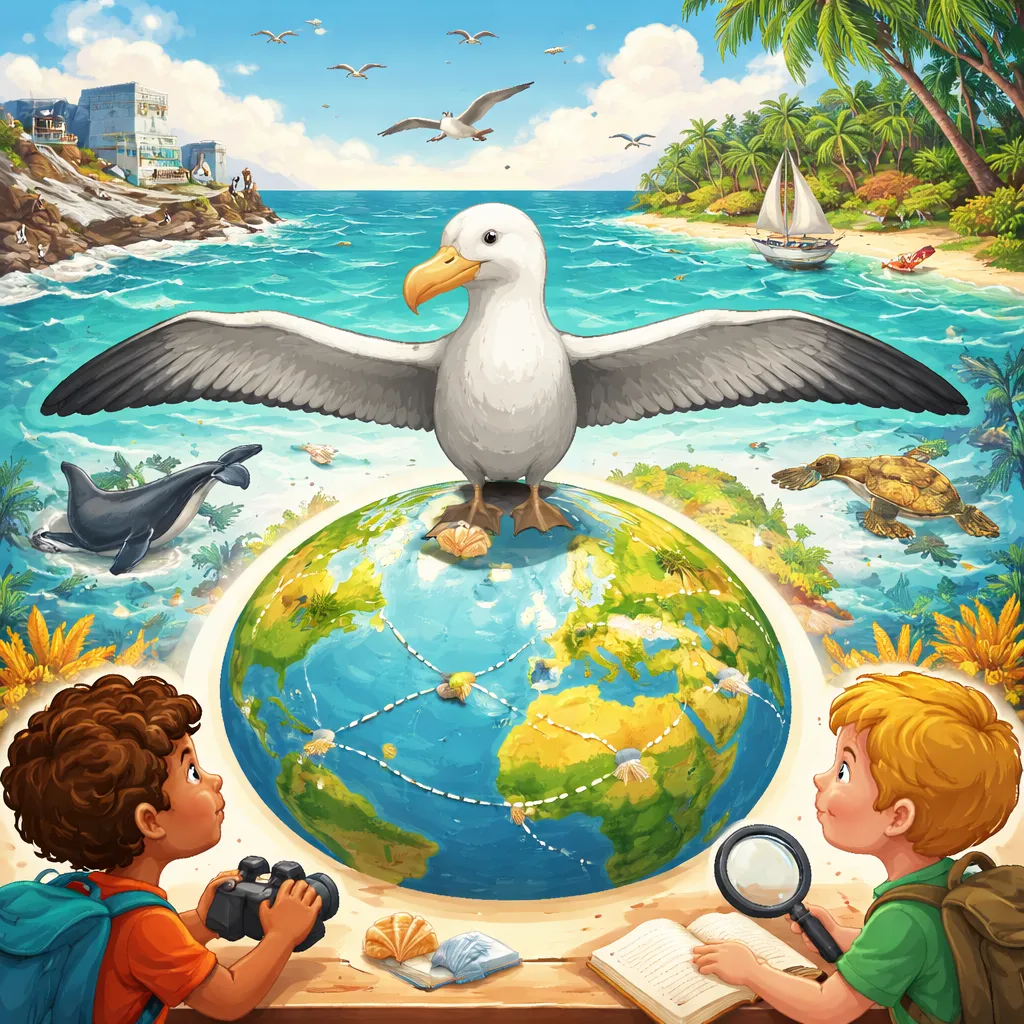

Imagine you’re on a boat in the middle of the huge, open ocean, and you see a giant bird with the longest wings you’ve ever seen, gliding for hours without a single flap. That’s an albatross! These magnificent birds are the masters of the windy southern oceans. Learning about albatrosses is a soaring adventure that takes us to the vast, open sea. Let’s begin our journey of learning about albatross endurance and flight.
English Language Learning
Vocabulary and Spelling Our majestic ocean wanderer is called an albatross. The word "albatross" is a noun. A noun names a person, place, or thing. So, an albatross is a thing—a very large, living seabird. Spelling "albatross" is interesting: A-L-B-A-T-R-O-S-S. The 'A' starts the word, the 'L' and 'B' are in the middle, and it ends with two 'S's. A-L-B-A-T-R-O-S-S spells albatross.
Sound and Pronunciation Let’s say the word correctly. It sounds like this: /ˈæl.bə.trɑːs/. We can say it in three clear parts. First, say "al". It rhymes with "pal". Next, say "buh". It’s a soft, quick sound. Last, say "tross". It rhymes with "cross". Now, put it together! "Al" "buh" "tross". Albatross! Great! The word "albatross" has three beats, or three syllables. Clap three times: Al-ba-tross. It’s a strong, sweeping word.
Related Words Learning about albatrosses is more fun with new words! Here are some important ones. Body Part: The distance from the tip of one wing to the other is the wingspan. A baby albatross is called a chick. Action: The way an albatross flies for hours without flapping is dynamic soaring. Home: The open ocean where they spend most of their life is the pelagic zone.
A Famous Idea Sailors have long believed: "The albatross is a sign of good luck at sea." This old sailor’s belief shows how much people have admired these birds for their ability to travel over the lonely ocean. It reminds us to see the beauty and hope in nature, even in the vast and empty places. Say the idea with me: "The albatross is a sign of good luck at sea." It’s a tradition of the sea.
Now you know the word "albatross"! Are you ready to soar into some amazing facts? Let’s glide from words to wonderful knowledge!
Animal Knowledge
Who Are They? – Family and Group What kind of animal is an albatross? Albatrosses are birds. They are warm-blooded, have feathers, and lay eggs. They are part of the seabird family, called Diomedeidae. They are closely related to petrels and shearwaters. The Wandering Albatross has the largest wingspan of any living bird.
What Do They Look Like? – Amazing Bodies Albatrosses are enormous birds. Their wingspan can be wider than a car is long! They have mostly white and gray feathers with dark wings. Their most famous feature is their incredibly long, narrow wings and their large, hooked beak. Their wings are super tools for flying! They are built for gliding on ocean winds, not for flapping. They can lock their wings in place to save energy. Their beak has sharp edges and tubes on the side to help get rid of salt. Albatrosses have special adaptations. They have a special gland above their eyes to remove excess salt from the seawater they drink. They can sleep while flying! They have an excellent sense of smell to find food over the open ocean.
Where Do They Live and How? – Home and Habits Albatrosses live over the open ocean in the Southern Hemisphere and the North Pacific. Their home is the vast, windy open ocean. They only come to land on remote islands to breed and raise their chicks. Albatrosses are carnivores. This means they eat meat. They eat squid, fish, and krill. They often scoop food from the water’s surface while gliding. Sometimes they follow ships. Albatrosses spend most of their lives alone, soaring over the ocean. They are active during the day. They come together in colonies on islands to find a mate and raise a chick. A group of albatrosses is called a flock, rookery, or weight.
An Albatross’s Life Story – Growing Up A baby albatross is called a chick. Albatrosses are birds, so chicks hatch from a single, large white egg. The parents build a simple nest on the ground. Albatross parents share the work. They take turns keeping the egg warm for about two months. After the chick hatches, the parents take turns going to sea to find food and coming back to feed the chick. This can go on for almost a year. The chick is born covered in soft, fluffy down. It grows very slowly. It takes almost a year for the chick to grow its flight feathers. Finally, it learns to fly and goes to sea alone. Albatrosses don’t have their own chick until they are 5 to 10 years old.
How Do They "Talk"? – Communication Albatrosses are usually quiet at sea, but at their breeding colonies, they are noisy! They make groans, whistles, and bill-clapping sounds. Pairs have special calls and dances to recognize each other. They have beautiful, complex courtship dances. They bow, point their bills to the sky, and clack their bills together. These dances can last a long time and help pairs form a strong bond. Their best senses are their amazing sense of smell and eyesight. They can smell food from many miles away. Their eyes are sharp for spotting food and navigating over the featureless ocean.
Are They Okay? – Taking Care of Them Many albatross species are in great danger. Over half of all albatross species are threatened with extinction. This is a very serious situation. The main threat is bycatch. This means they get caught accidentally on fishing hooks and drown. Other threats are plastic pollution (they eat it thinking it’s food), invasive species like rats on their nesting islands, and climate change. You can be an albatross hero! You can learn and tell everyone about their trouble. You can reduce plastic use and recycle to keep the ocean clean. You can support groups that work with fishermen to use bird-safe fishing gear and that protect remote islands where they nest.
Life Connections and Inspiration
How to Be With Them – Safety and Love Albatrosses are wild ocean birds that live most of their lives far from people. We must do everything we can to protect them and the oceans they rely on. The rule is: Protect their ocean home from afar. If you are ever on a boat near their nesting islands, follow all rules to avoid disturbance. Never try to approach an albatross or its nest. Support responsible fishing and tourism. Our actions on land affect them at sea. We show our love by being champions for clean, healthy oceans. We can be a voice for these incredible birds who spend their lives wandering the winds.
Super Qualities We Learn from Them Albatrosses teach us profound lessons. One super quality is incredible endurance and efficient travel. An albatross can fly around the world, using the wind with almost no effort. It teaches us to use our energy wisely, to be patient on long journeys, and to find the most efficient way to reach our goals. Another quality is loyal commitment and patience. Albatross pairs often mate for life and take over a year to raise just one chick, showing immense dedication. This reminds us of the value of commitment, patience, and caring deeply for the important things in our lives, even when it takes a very long time. Think about it: How can you use your own energy efficiently on a big task, like an albatross uses the wind? How can you show patience and commitment to a goal, like an albatross parent raising its chick?
Take Action! – Your "Albatross Flight" Project Let’s do an enduring and creative activity! Your project is to map an imaginary albatross journey around the world. On a large piece of paper, draw a simple world map. Now, draw a line showing a journey from a remote island in the Southern Ocean, all the way around Antarctica, and back. This is the kind of journey a Wandering Albatross might take. Draw a small paper albatross and attach it with a paper clip so it can "fly" along the route. Label the oceans. This shows the vast, enduring travels of these amazing birds.
Closing Learning about albatross endurance is a humbling and awe-inspiring adventure! We learned the word "albatross" and how to say its three-part name. We discovered amazing facts about their record-breaking wings, their ocean-spanning journeys, and their patient, loyal family life. We know that albatrosses are enduring, efficient travelers who are in grave danger and desperately need our help. You can use your new words to share the urgent story of these ocean wanderers. You can use your knowledge to make choices that protect our oceans and support safe fishing practices. The animal world is full of enduring and patient teachers. Always remember to be a voice for the voiceless, use your own energy with wisdom and patience, and commit to protecting our planet’s incredible wildlife. Keep exploring with a sense of wonder, glide towards your dreams with endurance, and be a friend to the wild. Your caring actions and committed spirit make you a true friend to the amazing albatross.