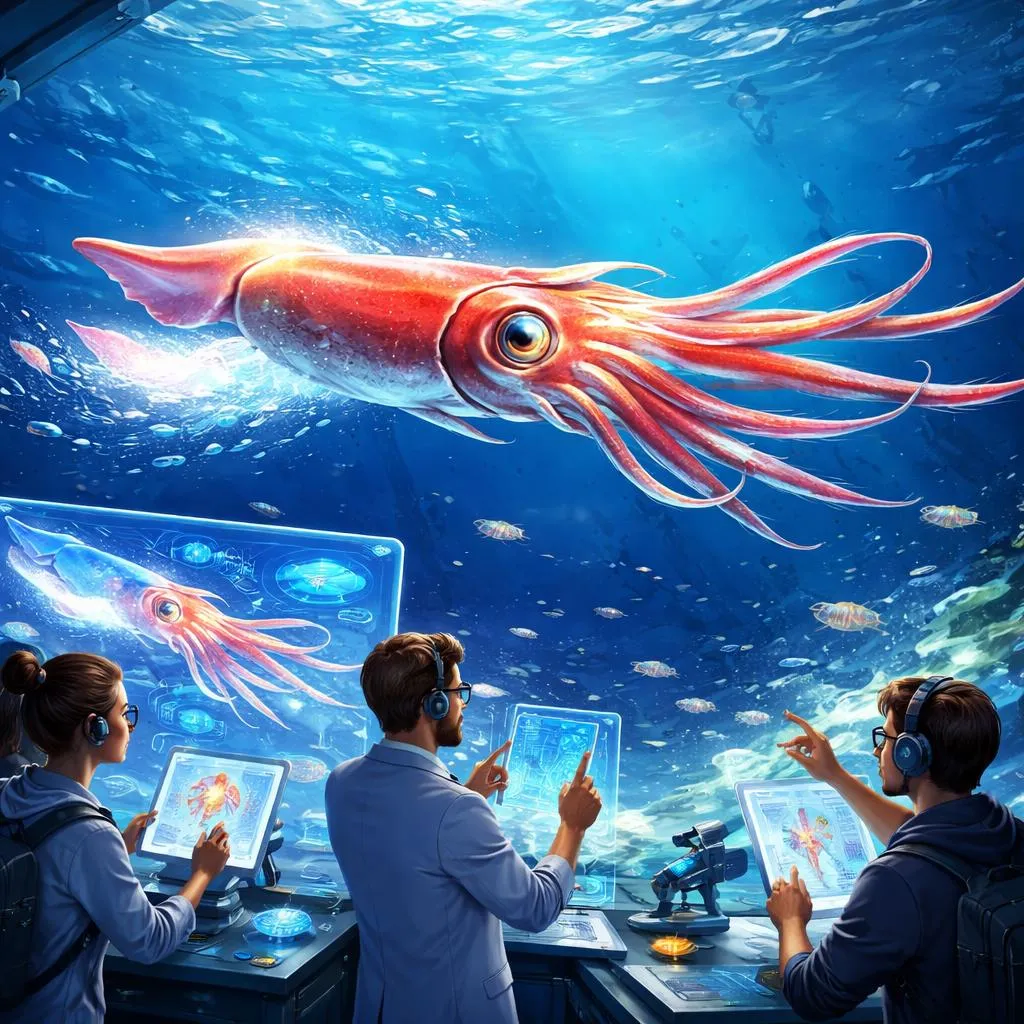

Have you ever seen a picture of a sleek, fast animal that looks like a rocket with arms, zooming through the deep blue sea? That’s a squid! These amazing creatures are the jet fighters of the ocean, known for their speed, intelligence, and mysterious deep-sea lives. Learning about squid is a high-speed adventure into the world of tentacles and ink. Let’s begin our journey of learning about squid power and secrets.
English Language Learning
Vocabulary and Spelling Our fast, jet-powered friend is called a squid. The word "squid" is a noun. A noun names a person, place, or thing. So, a squid is a thing—a very fast, living mollusk of the ocean. Spelling "squid" is short: S-Q-U-I-D. The 'S' starts the word, the 'Q' and 'U' are in the middle, and it ends with 'I-D'. S-Q-U-I-D spells squid.
Sound and Pronunciation Let’s say the word correctly. It sounds like this: /skwɪd/. We can say it in one clear part. First, say "skw". It’s a blend of the 's' and 'qu' sounds, like in "squeak". Then, say "id". It rhymes with "kid". Now, put it together! "Skwid". Squid! Great! The word "squid" has just one beat, or one syllable. Clap your hands once: Squid! It’s a short, zippy word.
Related Words Learning about squid is more fun with new words! Here are some important ones. Body Parts: The two longer tentacles a squid uses to grab food are called feeding tentacles. The other eight are arms. Defense: The dark cloud a squid releases is ink. Its body shape is a mantle. Action: The way a squid shoots through the water is jet propulsion.
A Famous Idea Because of their speed and mystery, we might say: "As elusive as a squid." This means something is hard to catch, see, or understand, often because it moves so quickly or lives in a hidden world. It reminds us that some of nature’s most amazing things are not always easy to see, but that makes them even more special. Say the idea with me: "As elusive as a squid." It’s about mystery and speed.
Now you know the word "squid"! Are you ready to jet into some amazing facts? Let’s swim from words to wonderful knowledge!
Animal Knowledge
Who Are They? – Family and Group What kind of animal is a squid? Squid are mollusks. They are invertebrates, which means they have no backbone. They are not fish! They are part of the cephalopod family, which means "head-foot". Their close cousins are octopuses, cuttlefish, and the nautilus. They are known for their speed and complex bodies.
What Do They Look Like? – Amazing Bodies Squid come in many sizes, from tiny to as long as a school bus (like the Giant Squid!). They have a long, tapered body, a large head, and ten arms. Their most famous features are their torpedo-shaped body and their two long feeding tentacles. Their body is built for speed! The mantle is like a muscular tube. They suck water into it and then force the water out through a siphon (a small tube) to jet away backwards at high speed. This is their super engine! Squid have special adaptations. They have excellent vision with large eyes. Many can change color and create shimmering light shows on their skin using special cells called chromatophores. This is for camouflage and talking. They have a hard, feather-shaped structure inside their body called a pen for support.
Where Do They Live and How? – Home and Habits Squid live in every ocean, from the sunny surface to the pitch-black deep sea. Their homes are the open ocean, deep sea, and near the coast. Some even live in the freezing waters of the Antarctic. Squid are carnivores. This means they are meat-eaters. They are fierce hunters, eating fish, shrimp, and other squid. They use their two long tentacles to snap out and grab prey, then pull it to their beak-like mouth. Squid are often social and swim in large groups called schools or shoals. They are active during the day and night. They spend their time jetting through the water, hunting, and communicating with each other with their changing colors.
A Squid’s Life Story – Growing Up A baby squid is called a paralarvae or a hatchling. Squid lay eggs. The mother often attaches egg cases to the ocean floor or releases them in a jelly-like mass. The parents usually die after reproducing. The mother does not take care of the eggs after laying them, but she finds a safe place for them. The eggs hatch into tiny, see-through paralarvae that look nothing like their parents. They drift in the ocean currents as plankton. The paralarvae are very small and many are eaten. The ones that survive grow quickly. They change shape and develop their adult features. They become adults in less than a year. A squid’s life is usually short, often just one to two years, but they grow very fast.
How Do They "Talk"? – Communication Squid are silent but have a colorful language. They do not make sounds, but they are masters of visual communication. They "talk" by rapidly changing the color, pattern, and even texture of their skin. They create stripes, spots, and ripples of light. This can mean "I am looking for a mate," "This is my territory," or "Watch out for danger!" Their best senses are their incredible eyesight and their sense of touch. Their large eyes are some of the best in the animal kingdom, even in the dark deep sea. Their arms and tentacles are covered in sensitive suckers to feel their environment.
Are They Okay? – Taking Care of Them Most squid species are common, but we are still learning about many deep-sea types. Their populations can change quickly with ocean conditions. The main threats are overfishing (they are caught for food), ocean pollution, and climate change affecting the ocean’s temperature and chemistry. They are a very important food source for many ocean animals and people. You can be a squid friend! You can learn about them and their role in the ocean. You can choose seafood that is caught in sustainable ways to help keep squid populations healthy. You can reduce plastic use to keep the ocean clean. Support scientific exploration of the deep sea.
Life Connections and Inspiration
How to Be With Them – Safety and Love Squid are wild, fast, and often deep-sea animals. We must respect them and the vast ocean, which is their home. The rule is: Admire from a distance and protect their home. If you are ever on a boat or visiting an aquarium, observe them quietly. Never try to touch or catch a wild squid. In the kitchen, if you eat squid, be thankful for the ocean’s gift and choose sources that are fished responsibly. We show our love by making choices that keep the ocean healthy, so squid and all sea life can thrive. We can be curious and responsible ocean citizens.
Super Qualities We Learn from Them Squid teach us powerful lessons. One super quality is incredible speed and efficient movement. A squid uses jet propulsion to move with purpose and power. It teaches us to move forward with energy and efficiency, to use our resources wisely, and to navigate our world with speed and direction when needed. Another quality is brilliant communication and adaptability. Squid can change their appearance in a flash to send messages or hide. This reminds us of the importance of clear communication, of being able to adapt to different situations, and of expressing ourselves in creative ways. Think about it: How can you move towards your goals with purpose and energy, like a squid jetting through water? How can you communicate clearly and adapt to new situations, like a squid changing its colors?
Take Action! – Your "Squid Jet" Project Let’s do a fast and creative activity! Your project is to make a model squid that demonstrates jet propulsion. Take a small, empty plastic bottle (like a water bottle). This is the squid’s mantle. Decorate it with paper arms and tentacles. Make a small hole in the bottle cap. Fill the bottle halfway with water. Now, squeeze the bottle hard and watch the water shoot out of the hole, pushing your "squid" forward! This shows how real squid use jet propulsion to zoom away.
Closing Learning about squid speed is a thrilling and eye-opening adventure! We learned the word "squid" and how to say its one-syllable name. We discovered amazing facts about their jet propulsion, their color-changing skin, and their life in schools in the open ocean. We know that squid are fast, communicative animals that are a vital part of the ocean’s food web. You can use your new words to share the exciting story of these ocean rockets. You can use your knowledge to make responsible choices as an ocean protector and to appreciate the wonders of deep-sea life. The animal world is full of fast and adaptable teachers. Always remember to respect the ocean and its creatures, move towards your goals with energy, and communicate and adapt with creativity. Keep exploring with curiosity, jet through your learning with speed, and be a friend to the wild. Your thoughtful actions and energetic spirit make you a true friend to the amazing squid.