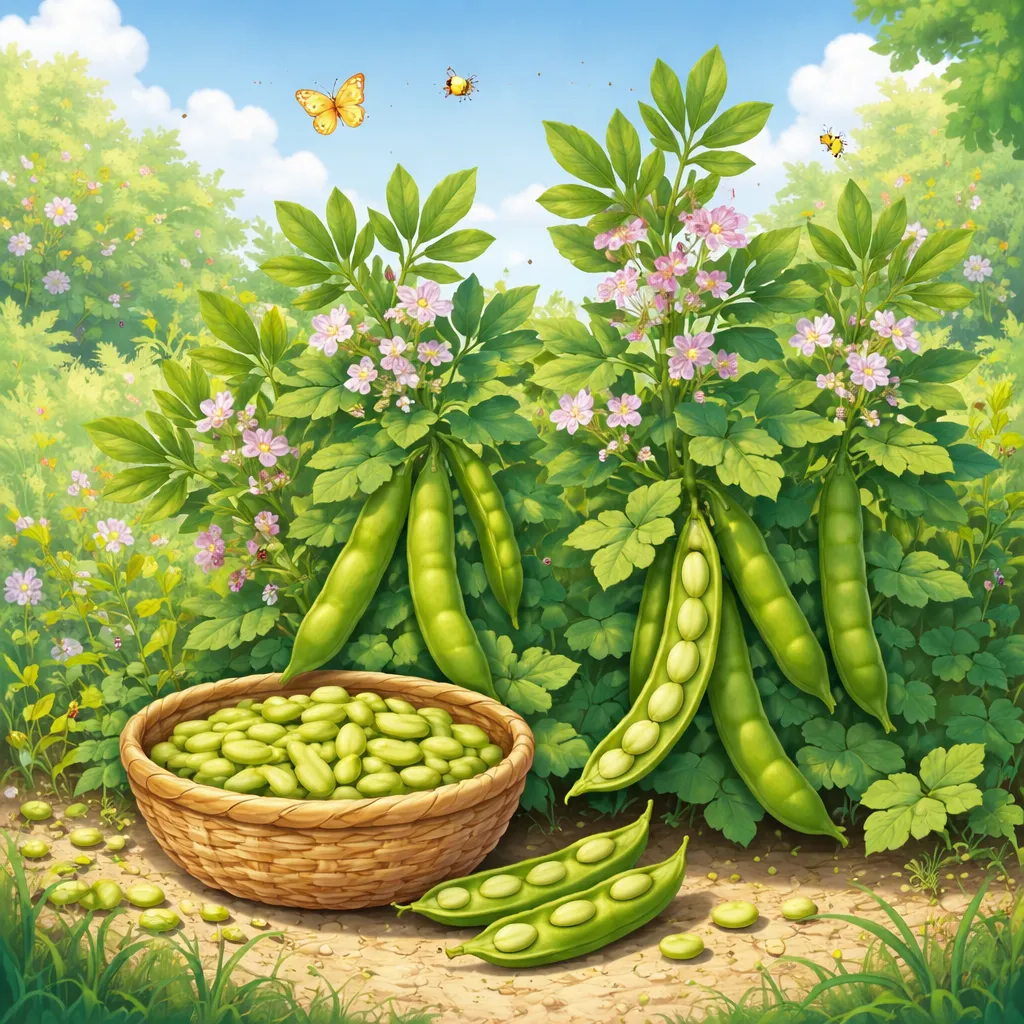

Have you ever seen a plant in a spring garden that is taller than you are? It has thick, sturdy stems, big beautiful leaves, and huge green pods pointing up to the sky. Inside those pods are large, flat beans that look like they’re tucked into a fuzzy-lined sleeping bag. This plant is not like the dainty pea vine; it’s a strong, bold bean that loves cool weather and is one of the first big harvests of the year. Let’s get ready to learn about the mighty Fava Bean plant.
Let’s Learn the Word! – Open the Treasure Box of Language
Formal Name and Pronunciation This bold bean is called the Fava bean. Its scientific name is Vicia faba. You can say it like this: /ˈfɑː.və ˌbiːn/ (FAH-vuh bean). The “Fa” rhymes with “la,” and “va” sounds like “vuh.” Fa-va. Say it: Fava. It’s a strong, open-sounding word.
The Etymology Tale The word “Fava” comes from the Latin word “faba,” which simply means “bean.” This is a very, very old word! In many parts of the world, this bean is called the Broad Bean because the beans inside the pod are broad and flat. Its name is a direct link to ancient languages, showing it has been a friend to people for thousands of years.
Nicknames and Friendly Aliases This bean is known by many descriptive names. Its most common other name is the Broad Bean. Because it’s planted in fall or very early spring, it’s called a Cool-Season Bean. In some places, it’s called the Field Bean, Horse Bean, or Windsor Bean. Its scientific name calls it the Faba Bean.
Building Your Word Web: Core Parts Let’s learn the words for a Fava Bean’s sturdy body. The Plant is tall, thick, and upright. The Stem is square and hollow. The Leaf is large, fleshy, and bluish-green. The Flower is beautiful, white with black spots, and smells sweet. The Pod is large, thick, fuzzy inside, and stands upright on the stem. A single Bean is the large, flat seed inside. The Root system is deep and has nodules for nitrogen-fixing bacteria. A cluster of flowers or pods is called a node.
Action and State Words Fava beans are tough and early. They sprout in cool soil. The plant grows tall and sturdy. It flowers with a lovely scent. The pods swell with the growing beans. Farmers harvest the green pods in spring. The plant fixes nitrogen to improve the soil. A fava bean plant is tall, cold-tolerant, stately, and biennial (often grown as an annual).
Ecosystem Friends Vocabulary The fava bean patch is a helpful part of the garden. Bumblebees are vital friends! They are strong enough to push their way into the flower to pollinate it, which honeybees sometimes can’t do. The roots host Rhizobia bacteria in their nodules, which take nitrogen from the air to feed the plant and soil. In early spring, the flowers provide important food for pollinators when little else is blooming.
Cultural Imprint in Language Fava beans have a long history. In ancient Rome, they were used in voting—a white bean for yes, a black bean for no. In some cultures, they are a traditional food for spring festivals, symbolizing the end of winter. There is an old Italian saying, “Fave e fresco” (Fava beans and fresh cheese), celebrating the classic spring meal. They represent renewal, hardiness, and ancient traditions.
Ready for Discovery We know its ancient, sturdy name. Are you ready to be a garden detective and discover the bold secrets of this early-rising giant? Let’s explore the life of the Fava Bean plant.
Discover the Plant’s Secrets! – A Nature Detective’s Notebook
The Plant Passport Fava beans belong to the legume family, Fabaceae. Their genus is Vicia. This plant is an upright, bushy annual (or biennial) that can grow 3 to 6 feet tall. The stems are thick and sturdy. The leaves are large, bluish-green, and fleshy. The flowers are striking: white with dramatic black or purple spots. The pods are large, leathery, and point upward, containing 3-8 large, flat beans. It thrives in cool, wet climates and is one of the hardiest plants, surviving frosts that would kill other beans.
Survival Smarts The fava bean is built for cool weather. It can germinate in cold soil and isn’t bothered by frost. Its thick stem helps it stand tall without needing a trellis. Its secret weapon, like other legumes, is its root nodules. The bacteria inside take nitrogen from the air, creating its own fertilizer. This lets it grow in poor, early-spring soil. The large leaves capture the weak spring sun efficiently, and the upright pods keep the seeds away from damp soil.
Its Role and Gifts In the ecosystem, fava beans are fantastic soil builders, adding nitrogen for future crops. Their early flowers feed hungry pollinators. Their greatest gift is the nutritious bean. Fava beans are packed with protein and fiber. The young, green beans are shelled and eaten fresh, often mashed with herbs. Dried, they are a storage food. In some places, the young leaves and shoots are also eaten. The plant is a true provider.
Human History and Cultural Symbol Fava beans are one of the world’s oldest cultivated plants, grown since prehistoric times in the Mediterranean and the Middle East. They were a staple food for ancient Egyptians, Greeks, and Romans. For centuries, they were a crucial protein source in Europe before the kidney bean arrived from the Americas. They symbolize survival, resilience, and the promise of spring after a long winter.
Fun “Wow!” Facts Get ready for a pollinator fact! Fava bean flowers have a special latch that only heavy insects like bumblebees can trip open to pollinate them. It’s like a private club for bumblebees! And here’s a size fact: A single fava bean pod can be as long as your hand, and the beans inside are some of the largest of all bean varieties!
From Ancient Field to Your Garden The story of the Fava Bean plant is one of hardy tradition. Would you like to grow your own towering bean fortress? You can grow fava beans in a garden bed or even a large pot! Let’s see how.
Let’s Grow It Together! – A Little Guardian’s Action Guide
Good for Home Growing? Yes, they are excellent for home gardens! They need a cool season to grow best. You can plant them in late fall for a very early summer harvest, or in very early spring as soon as the soil can be worked. They grow tall, so give them space in a garden bed or use a very large, deep pot. They are easy and satisfying to grow.
Little Gardener’s Toolkit You will need a packet of fava bean seeds (look for a shorter variety if space is limited). Get a few large, deep pots with drainage or find a sunny garden spot. Use rich, well-draining potting soil. Have a watering can and a sunny spot ready. You might need a short stake for support if it’s windy.
Step-by-Step Growing Guide
Planting Your Hardy Giant For a spring harvest, plant seeds as early as you can, even 4-6 weeks before the last frost date. Plant the seeds about 2 inches deep and 6-8 inches apart. If in pots, plant 1-2 seeds per large pot. Water the soil well. Place in full sun. They will brave the cool weather!
Care Calendar Keep the soil moist. Fava beans like consistent water but not soggy feet. They love full sun. You do not need to fertilize with nitrogen because they make their own! You can add a little compost at planting. If the plants get very tall and top-heavy, you can tie the main stem to a short stake for support.
Watch and Be Friends Watch for the thick shoots emerging. See the beautiful, bluish-green leaves unfold. Watch for the stunning black-and-white flowers—smell their sweet scent! Look for the tiny green pods that form and grow fat. Watch them point up to the sky. The most fun is opening the fuzzy pod to reveal the giant beans inside. Measure how tall your plant gets!
Problem Diagnosis If leaves get small black spots, it might be a fungus called chocolate spot; just make sure plants have good air flow. Aphids might visit the tender growing tips; spray them off with water. The most common problem is planting them too late in spring, so they flower in the heat, which they don’t like. Plant early!
Your Rewards and Gifts Your gift is growing a piece of agricultural history. You are learning about cool-season crops, pollination partnerships, and patience. Caring for fava beans teaches observation, responsibility, and the deep satisfaction of harvesting a hardy, ancient food. You become a grower of resilience.
Creative Fun Start a Spring Giant Journal. Draw your plant’s impressive growth. Press one of the beautiful black-and-white flowers. Create art with the large, flat dried beans by painting them or gluing them in a mosaic. With an adult, try making a simple mash of fresh fava beans with mint. Research ancient cultures that ate fava beans and make a fact card about one. Write a short story about a bumblebee’s important job in a fava bean flower.
Growing a Taste of History By planting fava beans, you are not just growing a bean. You are growing a connection to ancient farmers, a lesson in seasonality, and a delicious reward for braving the cool spring garden. You are a cultivator of tradition.
Conclusion and Forever Curiosity What a stately, hardy, and historic journey! You started to learn about the Fava Bean plant, you discovered its secrets as the cold-tolerant, nitrogen-fixing giant of the spring garden, and you learned how to grow your own patch of this ancient crop. You now know the Fava Bean plant is not just a big bean; it is a soil builder, a bumblebee’s banquet, a treasure of culinary history, and a symbol of spring’ bold promise. Remember, its power is in its strength and its early rise. Your curiosity helps you appreciate the plants that have fed civilizations. Keep exploring the stories behind your food, planting in different seasons, and tasting the rewards of your care. Your adventure to learn about the Fava Bean plant shows us that the mightiest plants often stand tall through the coldest nights to bring the first feast.