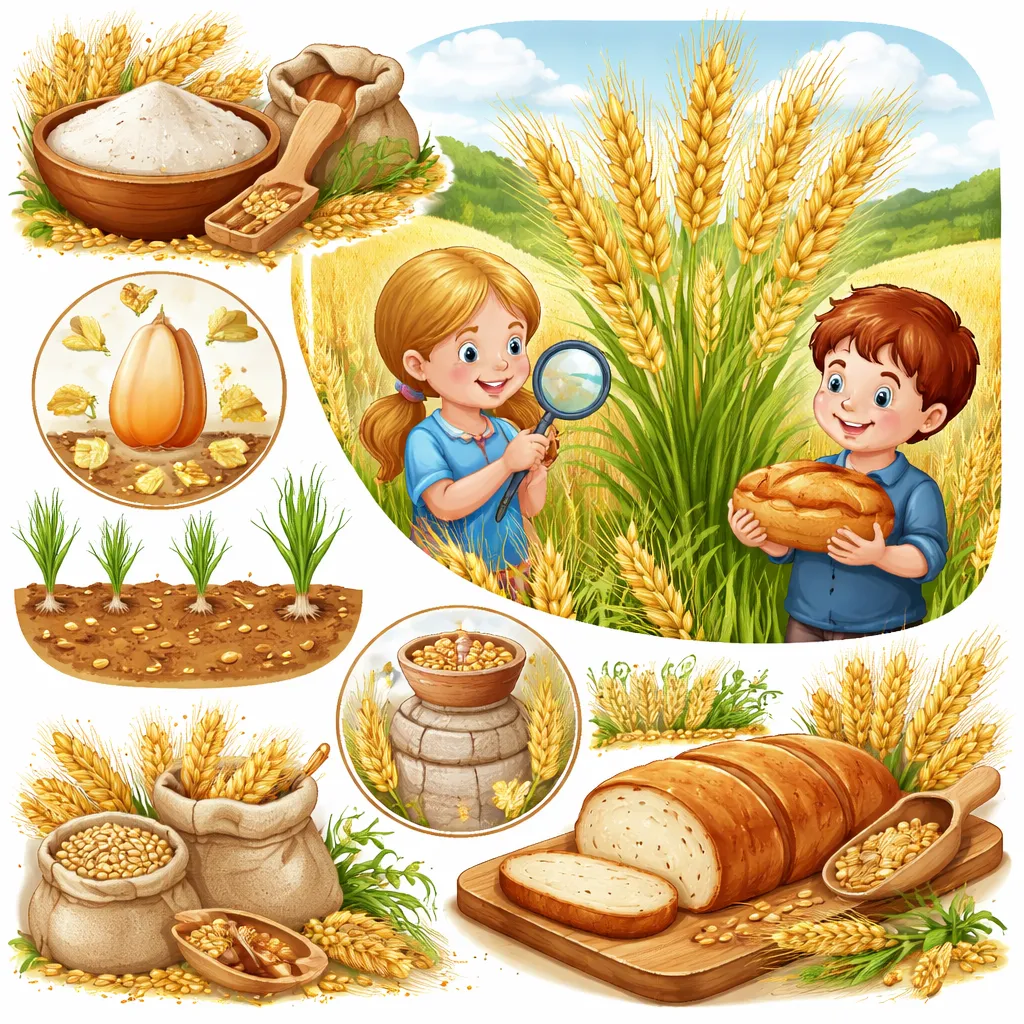

Do you know what gives your morning toast, your pasta, and your cookies their power? It all starts with a type of grass that grows in huge, sunny fields. In the summer, these fields turn a beautiful golden yellow, swaying in the wind like a giant, whispering ocean. The plant is harvested, and its tiny seeds are ground into the flour that bakers use. This humble plant is one of the most important foods in human history. Let’s walk into the sunshine and learn about the amazing Wheat plant.
Let’s Learn the Word! – Open the Treasure Box of Language
Formal Name and Pronunciation
This golden grass is called Wheat. Its scientific name is Triticum aestivum. You can say it like this: /wiːt/ (weet). It rhymes with “heat” and “treat.” Wheat. Say it: Wheat. It’s a short, sweet-sounding word.
The Etymology Tale
The word “Wheat” is very old. It comes from the Old English word “hwæte.” This word is related to “white” and means something like “the bright one” or “the white one.” Why? Because when wheat grains are ground, they make white flour! Its name has always been connected to its final, useful product—the flour that makes our daily bread.
Nicknames and Friendly Aliases
Wheat is known by names that describe its use and time. The most common type is Common Wheat or Bread Wheat. Wheat planted in autumn is Winter Wheat. Wheat planted in spring is Spring Wheat. Because of its beautiful color, it is often called the Golden Grain. In some old stories, it is called the Staff of Life.
Building Your Word Web: Core Parts
Let’s learn the words for a Wheat plant’s body. The Stem is hollow and sturdy, called a culm. The Head is the top part where the grains grow; it’s also called an ear or a spike. A single Grain is the seed we harvest. The Beard or Awn is the long, whisker-like bristle that sticks out from some wheat heads. The Leaf is long, thin, and blade-like. A Field of wheat is often called a paddock. The Straw is the dry, yellow stems left after harvesting the grain.
Action and State Words
Wheat fields are full of motion and change. The plants sway and ripple in the breeze. They grow tall and turn from green to glorious gold. Farmers harvest the ripe grain with big machines called combines. The wheat provides food for the world. A wheat plant is golden, whispering, nutritious, and annual (grows for one season).
Ecosystem Friends Vocabulary
A wheat field is a seasonal habitat. Sparrows and other seed-eating birds feast on the grains. Mice and voles make homes in the field. Bees and other insects visit if flowers are nearby. Ladybugs help by eating aphids that might bother the plant. Even after harvest, the stubble (cut stems) provides cover for small creatures and food for soil microbes.
Cultural Imprint in Language
Wheat is a global symbol of life, harvest, and abundance. A famous saying is, “Separate the wheat from the chaff,” which means to tell what’s valuable from what’s useless. The poet Walt Whitman wrote about “the spear of wheat” rising from the ground, celebrating its simple, strong life. In many cultures, a sheaf of wheat represents a good harvest and is a sign of prosperity and hard work.
Ready for Discovery
We know its life-giving, golden name. Are you ready to be a field detective and discover the journey of this grain from a tiny seed to your sandwich? Let’s explore the secrets of the Wheat plant.
Discover the Plant’s Secrets! – A Nature Detective’s Notebook
The Plant Passport
Wheat belongs to the grass family, Poaceae. Its genus is Triticum. It is an annual grass, usually growing 2 to 4 feet tall. The stem is round and hollow. The leaves are long and slender. The flower head is a dense spike where the flowers are so tiny you hardly see them bloom. Each fertilized flower produces one grain of wheat. It grows in temperate climates all over the world and is harvested in early summer or fall.
Survival Smarts
Wheat’s strategy is to grow fast and produce lots of seeds. Its roots form a dense mat in the soil, which helps it find water and also holds the soil together to prevent erosion. The awns (the whiskers) on some wheat are a clever trick. They catch the wind and help drill the seed into the soil, or they can stick to animals to hitch a ride to a new spot. Modern wheat has been bred by farmers for thousands of years to have bigger grains and stronger stems.
Its Role and Gifts
In a farm ecosystem, wheat fields provide food for wildlife and create a landscape. Its greatest gift is to humanity. Wheat grain is ground into flour, the base for bread, pasta, pastries, and so much more. The straw is used for animal bedding, mulch, and even in making paper and bricks. It is a cornerstone of the human diet and one of the world’s most important crops.
Human History and Cultural Symbol
Wheat was one of the first plants to be domesticated, over 10,000 years ago in the Middle East. This act started the Agricultural Revolution, allowing people to settle in one place and build civilizations. It is featured in ancient myths and religions as a gift from the gods. The Wheat plant represents the foundation of society, the reward of hard work, and the cycle of the seasons.
Fun “Wow!” Facts
Get ready for a numbers fact! One single wheat head can contain 40 to 60 grains, and just one grain can grow a plant that produces over 50 more grains! And here’s a flour fact: the wheat grain has three main parts. The bran is the outer layer (fiber), the endosperm is the middle (starch for energy), and the germ is the tiny core (vitamins). White flour is mostly the endosperm, while whole wheat flour uses all three parts!
From Ancient Field to Your Windowsill
The story of the Wheat plant is the story of civilization itself. Would you like to grow a little piece of this history? You can grow wheat in a pot! Let’s see how.
Let’s Grow It Together! – A Little Guardian’s Action Guide
Good for Home Growing?
Absolutely! Wheat is perfect for a container garden project. You can grow it in a wide, shallow pot or even a window box. You won’t get enough grain to bake a loaf of bread, but you will see the entire beautiful life cycle—from green grass to golden grain. It’s a wonderful lesson in where food comes from.
Little Gardener’s Toolkit
You will need a handful of whole, untreated wheat berries from a health food store or garden center. Get a wide, shallow pot with drainage holes. Use regular potting soil. Have a watering can and a sunny spot ready. That’s all!
Step-by-Step Growing Guide
Planting Your Golden Grass
The best time to plant is in early spring or fall. Fill your pot with soil. Scatter the wheat seeds evenly over the surface. Then, cover them with about half an inch to an inch of more soil. Pat it down gently. Water the soil thoroughly so it’s moist but not soggy. Place the pot in a spot that gets full sun.
Care Calendar
Keep the soil moist until the seeds sprout, which takes about a week. Once the grass is growing, water it when the top of the soil feels dry. Wheat loves sunshine. You don’t really need to fertilize it for this project. Just watch it grow! The green blades will shoot up, and eventually, a head will form in the center.
Watch and Be Friends
Watch for the first green shoots. Notice how they look like green grass. Measure how fast it grows. The most exciting part is when the head emerges from the center of the plant. Watch it swell and change from green to golden brown. Gently feel the developing grains. Listen to the dry leaves rustle. You are growing a field in a pot!
Problem Diagnosis
If the plants get very tall and flop over (called lodging), they might need more sun or less water. If the leaves get yellow spots, it might be a fungus; just make sure the plants have good air flow. The main challenge indoors might be not enough strong, direct sunlight, so a sunny windowsill is key.
Your Rewards and Gifts
Your gift is the magic of transformation. You are growing the source of flour with your own hands. Caring for wheat teaches patience, observation, and a deep connection to the food we eat every day. You learn that something as simple as a sandwich has an amazing story that starts with a seed in the soil.
Creative Fun
Start a From Seed to Sandwich Journal. Draw your plant each week. When the heads are golden, cut one and press it in a book to make a标本. Try threshing by rubbing the dry heads in your hands over a bowl to release a few grains. Grind those grains with a mortar and pestle to make your own tiny bit of whole wheat flour. Draw a comic strip showing the journey of a wheat seed to a slice of toast. Write a recipe for an “imaginary cake” made from your harvest.
Growing a Grain of Understanding
By planting wheat, you are not just growing grass. You are growing a living lesson in history, agriculture, and gratitude. You are a grower of knowledge.
Conclusion and Eternal Curiosity
What a golden journey from field to flour! You started by learning the word “Wheat,” you discovered its secrets as the whispering, golden grass of civilization, and you learned how to nurture a few stalks yourself. You now know the Wheat plant is not just a crop; it is a foundation of history, a symbol of harvest, a marvel of nature’s design, and the beginning of so many delicious meals. Remember, its power is in its humble, nourishing gift. Your curiosity helps you see the wonder in everyday things. Keep asking where your food comes from, tasting with gratitude, and planting seeds of knowledge. Your adventure to learn about the Wheat plant shows us that the greatest stories are often rooted in the smallest, most golden grains.