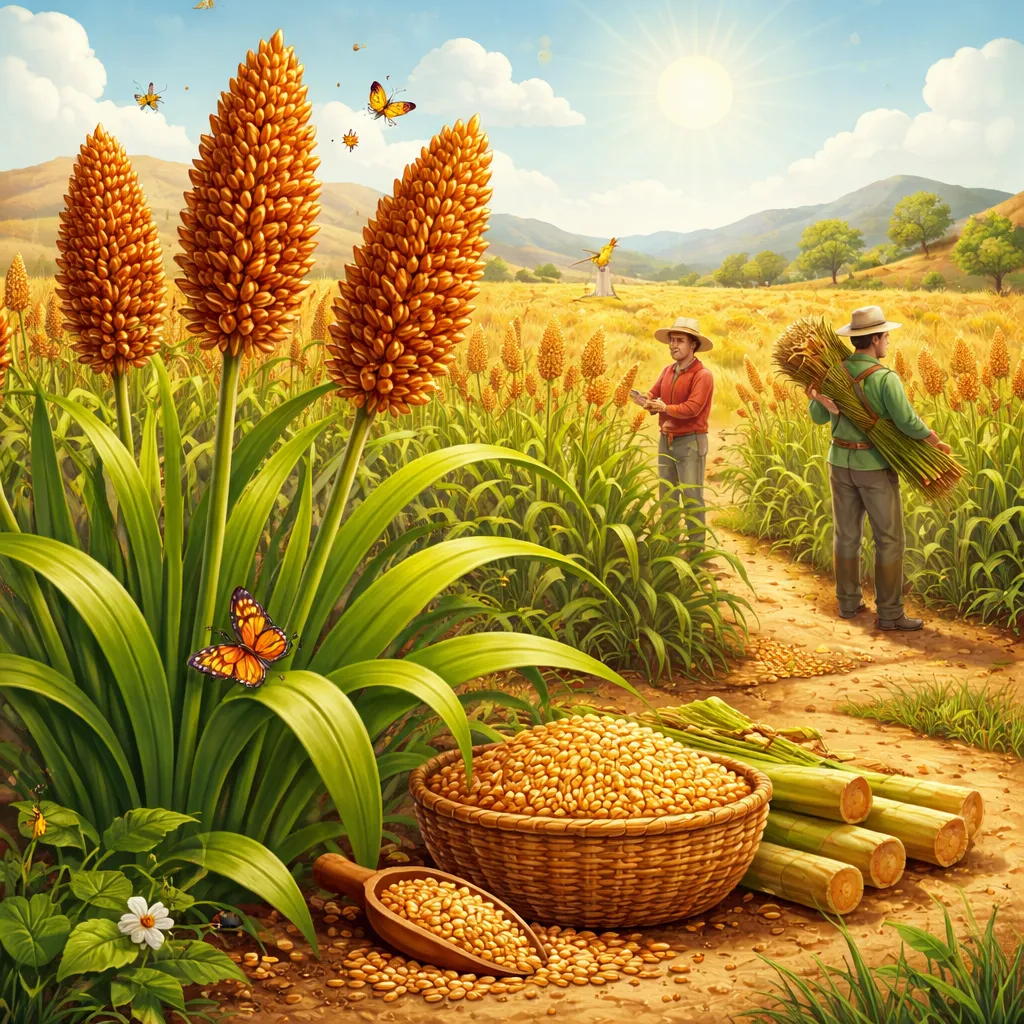

Imagine a huge, hot, sunny field. The plants growing there are tall, with wide green leaves that look a bit like corn. But at the very top, instead of a tassel or an ear, there is a beautiful, bushy seed head that can be golden, red, or even bronze. It rustles softly in the dry breeze. This amazing plant doesn’t need much rain. People use it to make sweet syrup, nutritious grain for animals and people, and even the bristles for brooms! This tough and useful plant is called Sorghum. Let’s go on an adventure to learn about the Sorghum plant.
Let’s Learn the Word! – Open the Treasure Box of Language
Formal Name and Pronunciation This tough survivor is called Sorghum. Its scientific name is Sorghum bicolor. You can say it like this: /ˈsɔːr.ɡəm/ (SOR-guhm). The “Sor” rhymes with “for,” and “ghum” sounds like “gum.” Sor-ghum. Say it: Sorghum. It’s a strong, sturdy-sounding word.
The Etymology Tale The word “Sorghum” has traveled from Africa. It comes from the Italian word “sorgo,” which might have come from a Latin word. Some experts think the name is related to the word “syrup” because the stalks of some sorghum are very sweet and juicy, perfect for making syrup! Its name hints at one of its oldest and sweetest gifts.
Nicknames and Friendly Aliases Sorghum has many names that describe its uses. It is often called Great Millet or Guinea Corn. The type grown for grain is Grain Sorghum or Milo. The tall type with stiff branches for brooms is Broomcorn. The type grown for its sweet juice is Sweet Sorghum or Sorgo. Because it’s so tough, it’s sometimes called the Camel of Crops.
Building Your Word Web: Core Parts Let’s learn the words for Sorghum’s hardy body. The Stem is tall, thick, and filled with sweet juice in some types. The Panicle is the beautiful, bushy seed head at the very top; it can look like a feathery plume. A single Grain is the small, round seed harvested from the panicle. The Node is the bump on the stem where a leaf grows. The Leaf is long, wide, and has a prominent white midrib. The Leaf Sheath wraps around the stem at the base. A Field of sorghum is often just called a sorghum field.
Action and State Words Sorghum is a champion of dry places. It grows tall under the hot sun. It sways gracefully in the wind. Farmers harvest the grain or cut the stalks for syrup. The plant tolerates drought and heat. Sorghum provides food, feed, and fuel. A sorghum plant is tall, drought-tolerant, versatile, and resilient.
Ecosystem Friends Vocabulary A sorghum field is a habitat. Birds like sparrows and doves eat the seeds from the panicles. Bees visit the flowers for pollen. Butterflies may lay eggs on the leaves. In the wild, the grains are food for many small animals. The plant also provides some cover for creatures on the ground. It is a useful part of the farm and grassland ecosystem.
Cultural Imprint in Language Sorghum is a symbol of resilience and sustenance in many dry regions of the world. An African proverb says, “Sorghum that bends in the wind does not break.” This teaches the wisdom of being flexible and strong during hard times. In folk songs and stories from places where it is a staple food, sorghum represents the ability to thrive with little, a true gift from the earth.
Ready for Discovery We know its tough and sweet name. Are you ready to be a detective and discover how this plant survives where others struggle? Let’s explore the world of the Sorghum plant.
Discover the Plant’s Secrets! – A Nature Detective’s Notebook
The Plant Passport Sorghum belongs to the grass family, Poaceae, just like corn, wheat, and rice. Its genus is Sorghum. It is a tall annual grass, often growing 5 to 8 feet high—sometimes even taller! The stem is sturdy, similar to corn. The leaves are long and broad. The flower is the panicle, which can be compact or open and feathery. The grains are small, round, and come in many colors: white, yellow, red, or brown. It thrives in warm, semi-arid climates and is a major crop in Africa, Asia, and the Americas.
Survival Smarts Sorghum’s superpower is drought tolerance. Its leaves have a special waxy coating that helps reduce water loss. It can also roll its leaves up during the hottest part of the day to save moisture. Its roots grow deep and wide to search for water far underground. Another cool trick is that some sorghum plants produce chemicals in their roots that discourage weeds from growing nearby—a natural way to reduce competition!
Its Role and Gifts Sorghum is a powerhouse of uses. The grain is a staple food for millions, ground into flour for flatbreads, porridge, and beer. The sweet juice from the stems is boiled down to make sorghum syrup, a delicious natural sweetener. The dried stems of broomcorn are used to make—you guessed it—brooms and brushes. The whole plant can be used for animal feed, and even for producing biofuels. It is a plant of zero waste.
Human History and Cultural Symbol Sorghum was first domesticated in Northeast Africa over 5,000 years ago. It spread along trade routes to India and China, and later to the Americas. In many African cultures, it is a sacred and essential food, featured in rituals and festivals. During the American Civil War, sorghum syrup was crucial as a sweetener when sugar was scarce. It represents adaptability, tradition, and food security for people living in challenging climates.
Fun “Wow!” Facts Get ready for a height fact! Some varieties of sorghum can grow over 15 feet tall—that’s as tall as a giraffe’s head! And here’s a sweet fact: it takes about 10 gallons of sweet sorghum juice to make just 1 gallon of thick, dark sorghum syrup. That’s a lot of juice for a little sweetness!
From Ancient Grain to Your Garden The story of the Sorghum plant is one of toughness and generosity. Would you like to try growing this resilient giant? You can grow sorghum in your garden or even a large pot! Let’s see how.
Let’s Grow It Together! – A Little Guardian’s Action Guide
Good for Home Growing? Yes, you can! Sorghum needs a warm, sunny growing season. It’s perfect for a sunny garden bed. Because it gets so tall, it makes a great natural “screen” or “playhouse” for kids. You can also grow a dwarf variety in a very large, deep pot on a sunny patio. It’s a fun and fast-growing project.
Little Gardiner’s Toolkit You will need a packet of sorghum seeds (look for “broomcorn” or “ornamental sorghum” for pretty seed heads). Get a few large, deep pots or find a sunny garden spot. Use regular garden soil or potting mix. Have a watering can, some compost, and lots of sunshine ready.
Step-by-Step Growing Guide
Planting Your Tough Friend Plant sorghum in late spring or early summer, after all danger of frost has passed and the soil is warm. Plant the seeds about 1 inch deep and 6-10 inches apart. If planting in a pot, plant 2-3 seeds in the center. Water the soil well. The seeds will sprout in about a week if the soil is warm.
Care Calendar Water the seedlings regularly to help them get started. Once established, sorghum is quite drought-tolerant, but it will grow better with occasional deep watering. It loves full, hot sunshine. You can side-dress the plants with a little compost or balanced fertilizer when they are about knee-high to give them a boost.
Watch and Be Friends Watch how fast it grows! The stems will get thick and tall. The leaves are wide and rustle nicely. The most exciting part is when the panicle emerges from the top and starts to flower. Watch it change color as the seeds develop. You can measure your plant every week—it grows quickly! Gently feel the seed head; it can be soft or bristly.
Problem Diagnosis If leaves get long, white streaks, it might be a sign of leaf miners; just pick off the affected leaves. Aphids might visit; spray them off with a strong jet of water. The most common issue is planting too early in cold soil, which delays germination. Just be patient and wait for warm weather.
Your Rewards and Gifts Your gift is growing a plant that teaches resilience. You are learning about a globally important crop that feeds people with very little water. Caring for sorghum teaches patience, observation, and an appreciation for plants that thrive in tough conditions. You become a grower of strength and sweetness.
Creative Fun Start a Resilience Garden Journal. Draw your tall sorghum plant. Measure it weekly and make a growth chart. Use dried panicles in flower arrangements or make a tiny handmade “broom” for a dollhouse. Research a simple recipe that uses sorghum flour or syrup (with an adult) and try it. Create a map showing the major sorghum-growing countries in the world. Write a short story about a bird building a nest in a tall sorghum field.
Growing a Lesson in Strength By planting sorghum, you are not just growing a grass. You are growing a lesson in sustainability, a connection to global food cultures, and a living example of nature’s clever design. You are a cultivator of toughness and sweetness.
Conclusion and Forever Curiosity What a powerful journey of resilience! You started by learning the word “Sorghum,” you discovered its secrets as the tall, sweet, and drought-tolerant champion of drylands, and you learned how to nurture this generous plant. You now know the Sorghum plant is not just animal feed; it is a cornerstone of food security, a master of water conservation, a source of a hundred useful things, and a symbol of thriving against the odds. Remember, its power is in doing so much with so little. Your curiosity helps you see the superheroes in the plant world, the ones that don’t need much but give a lot. Keep looking at the fields, wondering about the grasses that feed the world, and tasting the diverse gifts of the earth. Your adventure to learn about the Sorghum plant shows us that true strength is often tall, quiet, and sweet.