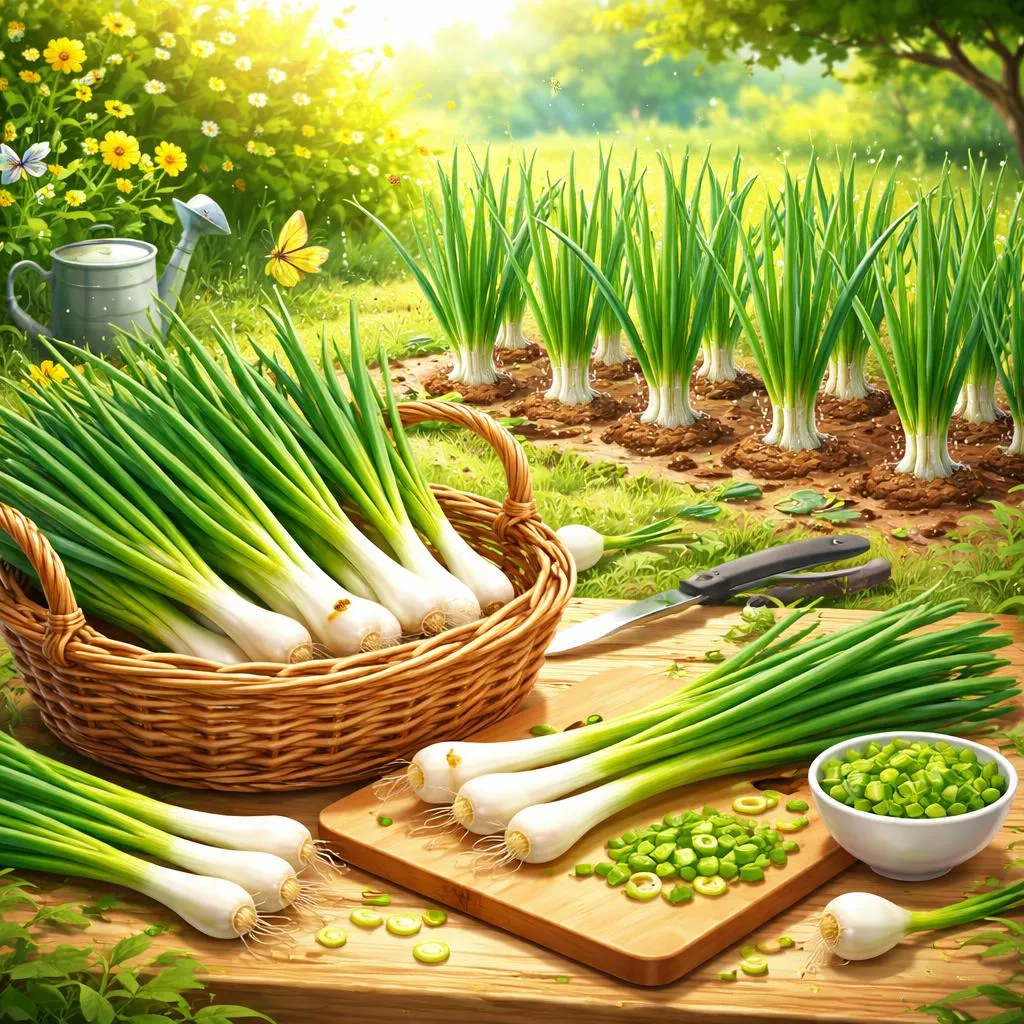

Have you ever seen a bunch of long, green and white vegetables tied together at the market? They look like giant, thick green pencils with white tips and long roots. If you chop the green part, it makes a perfect, colorful topping for soup, salad, or baked potatoes. This plant is a young, quick-growing onion that we eat before it makes a big, round bulb. It’s crisp, mild, and grows in just a few weeks! Let’s get ready to learn about the speedy and tasty Scallion plant.
Let’s Learn the Word! – Open the Treasure Box of Language
Formal Name and Pronunciation
This young onion is called a Scallion. Its scientific name is Allium fistulosum. You can say it like this: /ˈskæl.i.ən/ (SKAL-ee-un). The “Scal” rhymes with “pal,” and “lion” is like the animal. Scal-lion. Say it: Scallion. Many people also call it a Green Onion.
The Etymology Tale
The word “Scallion” is very old! It comes from the Latin region of Ascalonia, now called Ashkelon in Israel. Long ago, this type of onion was famous from that place. So, people called it the “onion from Ascalonia,” which became “scallion.” Its name is a tiny piece of ancient geography!
Nicknames and Friendly Aliases
This plant is known by many friendly names. Most commonly, it is a Green Onion or Spring Onion. In some places, it is called a Welsh Onion (which has nothing to do with Wales!). The white bottom is sometimes called the Bulb, and the green top is the Stem or Stalk. Because it’s harvested young, it’s a Salad Onion.
Building Your Word Web: Core Parts
Let’s learn the words for a Scallion plant’s simple body. The Stem is the long, hollow, green tube we love to chop. The Base is the white, slightly swollen part that was underground. The Root is the hairy, white bunch at the very bottom. The Leaf is actually the whole green part—it’s a hollow leaf! A Bunch is many scallions tied together. A Patch in the garden is a scallion patch.
Action and State Words
Scallion plants are fast and easy. They grow quickly from seed or a small bulb. You can harvest the whole young plant. You can chop or slice the green and white parts. The plant is pulled from the soil. A scallion plant is mild, hollow, fast-growing, and annual.
Ecosystem Friends Vocabulary
A scallion patch is a simple part of the garden. Like other onions, its mild smell can help confuse some garden pests. If you let a scallion flower (which is rare because we harvest it young), it might attract bees with its small, white blooms. Mostly, it is a quiet, helpful neighbor in the vegetable bed.
Cultural Imprint in Language
Scallions are a global symbol of fresh, quick flavor. They are essential in Asian stir-fries, Mexican salsas, and American potato salads. There’s a fun saying: “Don’t cry over scallions,” because they are much milder and less likely to make your eyes water than big onions! They represent speedy cooking, fresh garnish, and the joy of eating something straight from the garden.
Ready for Discovery
We know its quick, mild, and ancient name. Are you ready to be a garden detective and discover how this plant grows so fast? Let’s explore the simple secrets of the Scallion plant.
Discover the Plant’s Secrets! – A Nature Detective’s Notebook
The Plant Passport
Scallions belong to the Amaryllidaceae family. Their genus is Allium, the onion family. They are a type of bunching onion that doesn’t form a large bulb. The whole plant is a cluster of long, hollow, green leaves attached to a small, white stem base. They can grow from seed to harvest in just 8-10 weeks. They grow in almost any climate and love rich, moist soil and full sun.
Survival Smarts
The scallion’s trick is speed and simplicity. It grows very fast, sending up tall, green leaves to catch the sun quickly. It puts most of its energy into growing these tasty leaves rather than storing energy in a big bulb. The hollow leaves are lightweight and help the plant stand up. Its mild onion flavor is a gentle defense against pests. It’s designed to be eaten young and to grow again easily if just the tops are cut.
Its Role and Gifts
In the garden, scallions are a perfect “marker” plant. Gardeners sometimes plant them in rows to show where they’ve planted slower-growing seeds. Their greatest gift is their whole, edible plant. The white base has a stronger onion flavor, perfect for cooking. The green stalk is milder and perfect for a fresh, crunchy garnish. They are the quickest onion to go from garden to table.
Human History and Cultural Symbol
Scallions have been grown for centuries in Asia, especially China. The bunching onion (Allium fistulosum) doesn’t produce seeds easily and is often propagated by dividing the clumps, a method used for over 2,000 years. They spread along trade routes to Europe and the Americas. Today, they are a staple in kitchens worldwide. They represent efficiency, adaptability, and the fresh taste of spring.
Fun “Wow!” Facts
Get ready for a regrow fact! You can regrow scallions in your kitchen! Put the white root ends in a glass of water on a sunny windowsill, and they will grow new green stems for you to snip. And here’s a family fact: Scallions, chives, leeks, and garlic are all cousins in the same big onion family!
From Quick Seed to Your Soup
The story of the Scallion plant is one of speedy results. Would you like to grow your own quick crop of fresh flavor? You can grow scallions easily in a pot! Let’s see how.
Let’s Grow It Together! – A Little Guardian’s Action Guide
Good for Home Growing?
Absolutely perfect! Scallions are one of the fastest and most satisfying vegetables for a child to grow. They don’t need much space. You can grow a whole bunch in a wide, shallow pot on a sunny balcony, windowsill, or step. You’ll be harvesting in just weeks. It’s instant garden gratification!
Little Gardener’s Toolkit
You will need a packet of scallion (bunching onion) seeds or a bunch of scallions from the store to regrow. Get a wide, shallow pot with drainage holes. Use rich, moist potting soil. Have a watering can, a sunny spot, and scissors ready.
Step-by-Step Growing Guide
Planting Your Speedy Stems
You can plant seeds or regrow store-bought scallions. For seeds: sprinkle them thickly in rows on the soil and cover with a tiny sprinkle of soil. Water gently. For regrowing: save the white ends with roots. Plant them in the soil so just the green stumps peek out. Water well. Place the pot in full sun.
Care Calendar
Keep the soil moist. Scallions grow fast and need consistent water. They love full sun. You don’t need to fertilize if your soil is good. The most important thing is to keep them from drying out. Thin the seedlings if they are too crowded, and eat the thinnings!
Watch and Be Friends
Watch for the first loops of green grass-like shoots. They will grow taller and taller. Measure them every few days—they grow so fast! When they are as thick as a pencil and about 6-8 inches tall, they are ready. Gently pull a whole plant, wash it, and taste your homegrown scallion. The best part is how quick it is!
Problem Diagnosis
If the green tops turn yellow, they might need more nitrogen (try a little fertilizer) or more water. If they are thin and weak, they need more sun. They have very few pests. The most common problem is letting the soil get too dry. They are very easy-going plants.
Your Rewards and Gifts
Your gift is the speed of growth. You are learning about quick crops, plant care, and the farm-to-table journey in just weeks. Caring for scallions teaches daily observation, responsibility, and the thrilling, fast reward of harvesting your own food. You become a grower of instant success.
Creative Fun
Start a Speed Grow Journal. Draw your scallions each week. Measure their height. Try the regrowing experiment in water and in soil—which is faster? With an adult, make a simple dipping sauce with your chopped scallions. Create a “passport” for your scallion, stamping countries where it’s popular. Make a garden marker by writing “Scallions” on a popsicle stick. Write a super-short story about the fastest onion in the world.
Growing a Bunch of Quick Green
By planting scallions, you are not just growing an onion. You are growing a lesson in speed and simplicity, a connection to global fast food, and the confidence that you can grow something to eat. You are a cultivator of quick, green joy.
Conclusion and Forever Curiosity
What a quick, mild, and globally tasty journey! You started to learn about the Scallion plant, you discovered its secrets as the speedy, hollow-stemmed member of the onion family, and you learned how to grow your own bunch in record time. You now know the Scallion plant is not just a garnish; it is a lesson in fast growth, a bridge between world cuisines, a teacher of simple gardening, and a symbol of fresh, instant flavor. Remember, its power is in its speed and its whole, usable self. Your curiosity helps you appreciate the quick, simple wonders of the plant world. Keep planting seeds that grow fast, tasting the fresh rewards, and exploring the quick paths from soil to snack. Your adventure to learn about the Scallion plant shows us that the most satisfying flavors can be the quickest to grow.