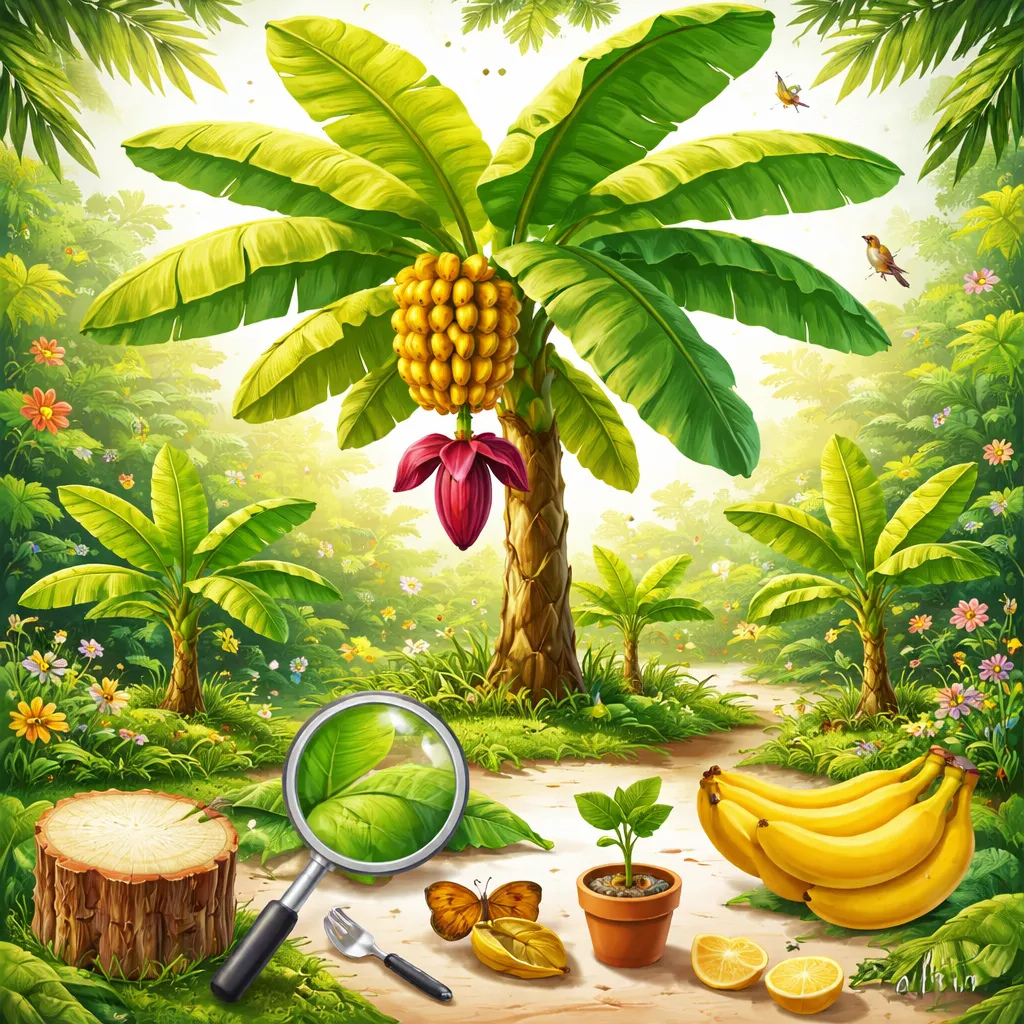

Have you ever eaten a sweet, yellow banana? It’s a perfect snack that comes in its own neat, yellow jacket! But have you ever wondered where it grows? The plant that gives us bananas is a true jungle superstar. It looks like a tall tree with huge, floppy green leaves, but it’s actually the world’s largest herb! It doesn’t grow from seeds in your fruit, but from secret underground parts. It grows incredibly fast and gives us a whole bunch of food. Let’s go on a tropical adventure to learn about the amazing Banana Tree plant.
Let’s Learn the Word! – Open the Treasure Box of Language
Formal Name and Pronunciation
This fast-growing giant is called a Banana plant. Its scientific family is Musa. You can say it like this: /bəˈnæn.ə triː/ (buh-NAN-uh tree). The “ba” sounds like “buh,” and “nana” rhymes with “bandana.” Ba-na-na. Say it: Banana. It’s a fun, bouncy word that makes you smile.
The Etymology Tale
The word “banana” is thought to come from West Africa. Arab traders brought the fruit to the Middle East and called it “banan,” which means “finger.” This makes sense because a single banana is called a finger, and a whole group is called a hand! The name traveled to Spain and Portugal and then to England. So, the name celebrates the fruit’s finger-like shape.
Nicknames and Friendly Aliases
Banana plants have cool names. The most common type for eating is the Cavendish Banana. The plant itself is often called a Banana Palm because it looks palm-like. Because it’s an herb, scientists call it a Giant Herbaceous Plant. In some places, the starchy cooking banana is called a Plantain. The wild banana, full of seeds, is called the Musa acuminata.
Building Your Word Web: Core Parts
Let’s learn the words for a Banana plant’s body. The Pseudostem is the fake trunk. It’s made of tightly wrapped leaf bases, not wood. The Leaf is huge, green, and often torn by the wind, looking like giant green ribbons. The Flower is called the Bell or Heart, a large, purple-red drooping bud. The Fruit is, of course, the banana, a berry that grows in a Hand (a cluster) on a Bunch. The Rhizome is the thick, underground stem (like a big root) that stores food and makes new plants. A Sucker or Pup is a baby plant that sprouts from the rhizome. The Corm is the hard, central part of the rhizome.
Action and State Words
Banana plants are speed demons! They sprout from the ground and grow incredibly fast. The pseudostem shoots up towards the sun. The flower emerges and bends downward. The fruit ripens from green to yellow. After fruiting, the main stem dies back, but new pups take over. The plant is fast-growing, tropical, succulent, and monocarpic (fruits once and dies).
Ecosystem Friends Vocabulary
The banana plant is a mini jungle. Bats and birds are attracted to the sweet nectar of its flowers. Insects visit the blooms. The large leaves collect rainwater, creating tiny pools for tree frogs. The leaves are food for the caterpillars of some beautiful butterflies. In the rainforest, fallen leaves and stems quickly decompose, feeding the soil.
Cultural Imprint in Language
Bananas are part of our everyday talk! If something is easy, we say “It’s a piece of cake… or a banana!” There’s a silly song: “Yes, we have no bananas, we have no bananas today!” Bananas are a symbol of tropical places and simple, healthy food. In some cultures, the banana leaf is used as a natural plate for serving food, showing how the whole plant is useful.
Ready for Discovery
We know its fast-growing, fruity name. Are you ready to uncover the secret life of this giant herb that gives us our favorite yellow fruit? Let’s put on our jungle explorer hat and discover the Banana Tree plant.
Discover the Plant’s Secrets! – A Nature Detective’s Notebook
The Plant Passport
Bananas belong to the Musaceae family. Their main group is Musa. The plant looks like a tree but is a gigantic herb. It has a soft, juicy pseudostem made of leaf stalks. The leaves are enormous, often longer than you are tall, and bright green. The flower is spectacular—a large, purple, teardrop-shaped bud that hangs down. Tiny female flowers at its base become the bananas. It grows in hot, wet tropical regions all over the world and completes its life cycle in about 9-18 months.
Survival Smarts
The banana’s genius is speed and teamwork. It grows from a rhizome, a powerhouse underground, so it can shoot up very fast—sometimes several inches in a day! It doesn’t waste time making strong wood. Its leaves are designed to tear along the veins in the wind, reducing damage so the whole leaf doesn’t rip off. After the main plant fruits and dies, its “pups” (new shoots from the same rhizome) are already growing to take its place. It’s a plant that works as a team.
Its Role and Gifts
In the jungle, the banana is a fast colonizer, quickly covering open ground. Its large leaves create shade and its fruit feeds many animals. For humans, it is the ultimate gift. The fruit is a major global food crop, rich in potassium and energy. The leaves are used for wrapping food, as plates, and even for thatching. The fibrous pseudostem can be used to make rope and paper. It is a plant of 100 uses.
Human History and Cultural Symbol
Bananas are one of the first plants humans cultivated, starting in Southeast Asia thousands of years ago. They were spread by explorers, traders, and colonists. Today, they are a vital food for millions. In many tropical cultures, the banana plant is a symbol of prosperity, generosity, and fertility, and is often planted near homes. The phrase “top banana” means the most important person, showing how the fruit is linked to leadership!
Fun “Wow!” Facts
Get ready for a berry surprising fact! Botanically, a banana is a berry! And the banana plant is the world’s largest flowering herbaceous plant. And here’s a cloning fact: almost all the bananas we eat (Cavendish) are genetic clones. This means every single one is practically identical, which is why they all taste the same!
From Tropical Farm to Your Home
The Banana Tree plant’s story is one of speedy growth and tasty rewards. Would you like to try growing your own tropical jungle? You can grow a banana plant at home! Let’s see how.
Let’s Grow It Together! – A Little Guardian’s Action Guide
Good for Home Growing?
Yes, you can! Many dwarf banana varieties, like the ‘Dwarf Cavendish,’ are perfect for growing in a large pot on a sunny patio or even a bright room indoors. They love heat, humidity, and lots of sunshine. In a warm climate, you can plant it in the garden. It won’t get as huge as a farm banana, but it can still give you beautiful leaves and maybe even a small bunch of fruit!
Little Gardener’s Toolkit
You will need a banana plant “pup” or a young plant from a garden center. Get a very large, sturdy pot with good drainage. Use rich, well-draining potting soil mixed with compost. Have a watering can, liquid fertilizer, and a sunny spot ready. A spray bottle for misting is great for humidity.
Step-by-Step Growing Guide
Planting Your Jungle Friend
The best time to plant is in warm spring or summer. Place your pup or young plant in the center of the large pot. Fill with soil, making sure the base of the stems is at the same level as before. Water it deeply to settle the roots. Place it in the sunniest spot you have.
Care Calendar
Bananas are thirsty and hungry! Water your plant regularly so the soil stays moist (but not soggy). It loves, loves, loves sunshine. Feed it every two weeks in the growing season with a balanced liquid fertilizer. It also loves potassium, so a banana peel soaked in water can be a fun, mild feed! In winter, water much less.
Watch and Be Friends
This is a fast-growing show! Watch a new leaf unfurl from the center—it starts as a tight roll. Count how many new leaves it makes in a month. Measure its height. If you’re lucky, you might see the purple flower bud appear! Patience is key for fruit, but the leaves are a reward in themselves.
Problem Diagnosis
If leaf edges turn brown and dry, the air is too dry. Mist the leaves regularly. If leaves turn yellow, it might need more fertilizer or water. If you see black spots, it might be a fungal issue—remove the bad leaf and let the plant have more air. The most common problem is not enough light or water.
Your Rewards and Gifts
Your gift is watching a piece of the tropics grow at superhero speed. You are caring for the world’s largest herb! Growing a banana plant teaches you about the needs of tropical plants, the importance of feeding and watering, and the incredible joy of nurturing a fast-growing friend. You learn responsibility and the cycle of growth.
Creative Fun
Start a Jungle Growth Journal. Draw your plant every week to see its rapid change. Make huge leaf rubbings on big paper. Use a dried banana leaf as a natural “canvas” for painting. Have a tropical-themed picnic using banana leaves as plates (washed first!). Write a funny poem about a banana plant that grows too fast. Build a mini jungle around your plant with toy animals.
Growing Your Own Tropical Paradise
By planting a banana, you are not just growing a plant. You are growing a living lesson in botany, a provider of beauty, and a touch of the jungle for your home. You are a cultivator of wonder.
Conclusion and Forever Curiosity
What an exciting, fast-paced journey! You started by learning the word “Banana,” you discovered its secrets as the world’s tallest and fastest-growing herb, and you learned how to care for a little piece of the tropics in your own space. You now know the Banana Tree is not a tree at all; it’s a giant herb, a speedy grower, a generous provider, and a botanical wonder. Remember, its strength is in its teamwork and its surprising biology. Your curiosity is like a banana pup—always ready to grow and explore. Keep wondering about the everyday plants around you, asking questions, and maybe even growing your own. Your adventure to learn about the Banana Tree plant shows us that sometimes, the most familiar things hold the most amazing secrets.