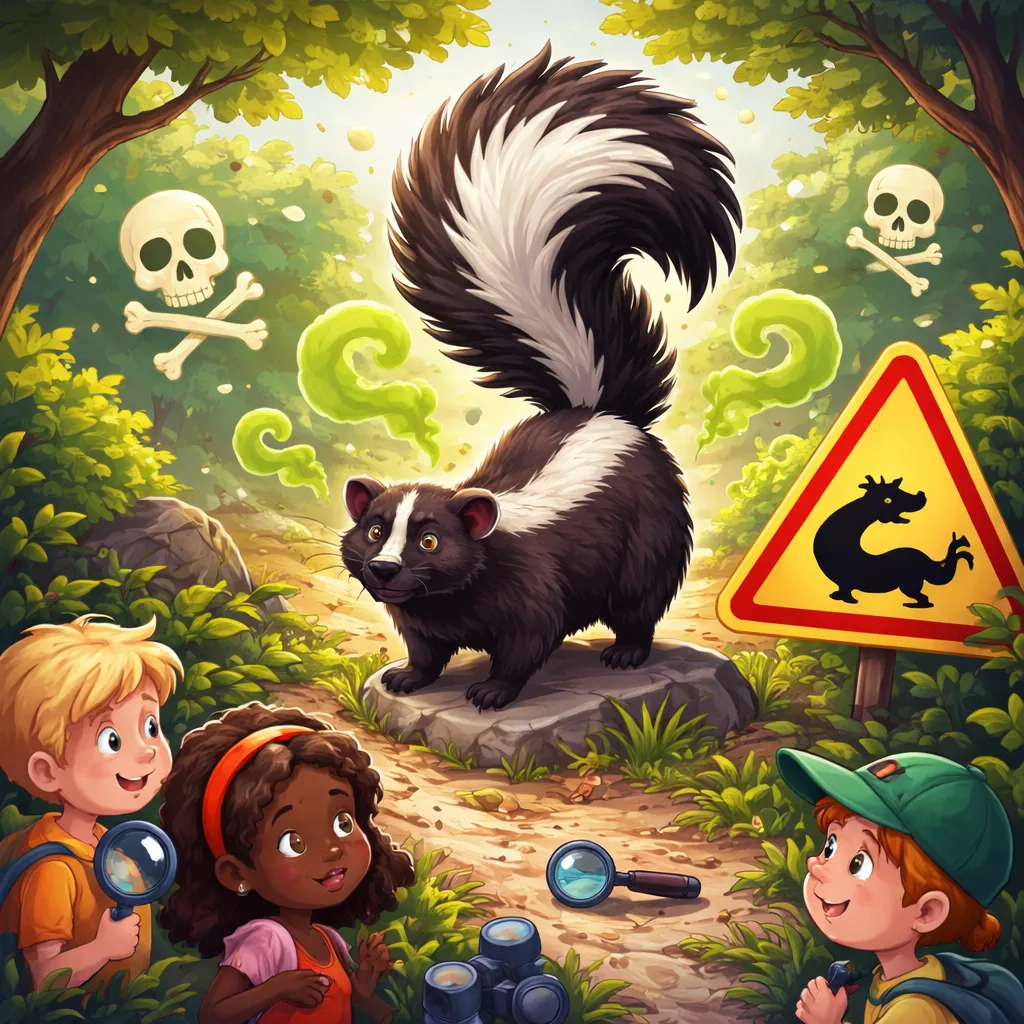

Imagine you’re in your backyard at dusk and you see a black and white animal waddling by. It might be a skunk! With their fluffy tails and famous stripes, skunks are unique animals that everyone recognizes. Learning about skunks is a fascinating adventure that teaches us about their special defense and important role in nature. Let’s tiptoe gently and start our journey of learning about skunk secrets.
English Language Learning
Vocabulary and Spelling Our distinctive friend is called a skunk. The word "skunk" is a noun. A noun names a person, place, or thing. So, a skunk is a thing—a living animal with a special talent. Spelling "skunk" is short and strong: S-K-U-N-K. The 'S' and 'K' start the word together, the 'U' is in the middle, and it ends with 'N-K'. S-K-U-N-K spells skunk.
Sound and Pronunciation Let’s say the word correctly. It sounds like this: /skʌŋk/. We can say it in one clear part. First, say "sk". It’s the sound at the start of "sky". Next, say "unk". It rhymes with "bunk" or "trunk". Now, blend it together! "Sk" "unk". Skunk! Great! The word "skunk" has just one beat, or one syllable. Clap your hands once: Skunk! It’s a short, powerful word.
Related Words Learning about skunks is more fun with new words! Here are some important ones. Body Part: The white line or lines on a skunk’s back are called a stripe. Their famous defense is a stinky spray. Home: A skunk’s cozy home, often under a porch or in a burrow, is called a den. Baby: A baby skunk is called a kit.
A Famous Saying People sometimes say: "As smelly as a skunk!" This is a way to describe a very bad smell. It comes from the skunk’s powerful spray, which it uses only for defense. It reminds us that the skunk’s smell is its superpower for staying safe. Say the saying with me: "As smelly as a skunk!" Remember, they only spray when they feel very threatened.
Now you know the word "skunk"! Are you ready to learn about their special way of life? Let’s walk from words to wonderful knowledge!
Animal Knowledge
Who Are They? – Family and Group What kind of animal is a skunk? Skunks are mammals. They have fur, are warm-blooded, and mother skunks feed their babies milk. They are part of their own family called Mephitidae. Their name comes from a word that means "bad odor." Their cousins are stink badgers.
What Do They Look Like? – Amazing Bodies Skunks are about the size of a cat. They are mostly black with famous white stripes or spots. The most common pattern is one big white stripe from head to tail. They have a big, bushy tail. Their most famous feature is their defense spray. They have two special glands under their tail that can spray a stinky liquid. They can aim it very accurately! Their stripe is a warning sign to other animals. Skunks have special adaptations. They are diggers with long claws for finding food. They have a good sense of smell and hearing. They are not fast runners, so their spray is their best protection.
Where Do They Live and How? – Home and Habits Skunks live in North and South America. Their homes are forests, grasslands, and even cities and farms. They are very adaptable and can live near people. Skunks are omnivores. This means they eat both plants and animals. They are helpful garden visitors because they eat insects, grubs, mice, and fallen fruit. They are not picky eaters! Skunks are mostly nocturnal, meaning they are most active at night. They are solitary animals, meaning they like to be alone. A group of skunks is called a surfeit. They spend their nights digging for food and exploring.
A Skunk’s Life Story – Growing Up A baby skunk is called a kit. Skunks are mammals, so kits are born live from their mother. A mother skunk usually has four to six tiny, blind kits at a time. The mother skunk is a very protective parent. She raises her kits alone in a safe den. She feeds them milk and later teaches them how to find food and use their spray for defense. Kits are born with their stripes, but their eyes are closed. They open their eyes after about three weeks. They follow their mother on her nightly trips. The kits stay with their mother for about a year before going off on their own.
How Do They "Talk"? – Communication Skunks talk with sounds and body language. They can hiss, squeal, and churr. A mother skunk churrs to her kits. Their most important communication is a warning. Before spraying, a skunk will stomp its feet, arch its back, and raise its tail high. This is their way of saying, "Go away, or I will spray!" Their best sense is their excellent sense of smell and hearing. They use their nose to find food. Their ears are good at hearing danger approach, so they can give a warning in time.
Are They Okay? – Taking Care of Them Most skunk species are common and are not endangered. They are doing well because they can adapt to living near people. The main threats are cars, predators, and sometimes people who are afraid of them. They can also get sick from diseases. Sometimes they are trapped or hurt because they are seen as pests. You can be a skunk friend! You can learn about their helpful role in eating bugs. You can be a careful driver at night. Never leave pet food outside, as it can attract them. The best way to help is to give them space and watch from a distance.
Life Connections and Inspiration
How to Be With Them – Safety and Love Skunks are wild animals. They are gentle but have a powerful defense. We must always give them plenty of space and respect. The most important rule is: Watch from far away and never crowd them. If you see a skunk, stay calm, move away slowly, and talk softly. Never try to touch, chase, or feed a skunk. If a skunk stamps its feet or raises its tail, that means it is scared. You should back away immediately! Keep pets indoors or on a leash at night. We show our love by letting them be wild. We can appreciate their helpful job in the ecosystem from a safe distance. A happy skunk is a skunk that feels safe and left alone.
Super Qualities We Learn from Them Skunks teach us wonderful things. One super quality is clear communication and setting boundaries. A skunk gives very clear warnings before it uses its spray. It teaches us to communicate our feelings clearly and to set boundaries in a calm way before a situation gets bad. Another quality is confidence in your own defense. Skunks are not big or fast, but they are confident in their unique ability to protect themselves. They remind us that we all have our own unique strengths and we should be confident in them. Think about it: How can you clearly tell a friend if you are uncomfortable with something? What is a special strength you have that makes you feel confident?
Take Action! – Your "Skunk Safety" Project Let’s do a fun and clear activity! Your project is to create a "Skunk Warning" poster. On a large piece of paper, draw a friendly-looking skunk. Show the warning signs: draw it with its tail up and its feet stomping. Write clear messages on your poster like: "I am a skunk. I am helpful! I eat bugs. Please give me space. If I stamp my feet, I am saying 'Go away!'" You can hang your poster to teach your family and friends about skunk safety and respect.
Closing Learning about skunk signals is a wonderful adventure! We learned the word "skunk" and how to say its strong, one-syllable name. We discovered amazing facts about their warning stripes, their clear communication, and their life as helpful nocturnal animals. We know that skunks are confident, important creatures who teach us about boundaries and using our strengths. You can use your new words to teach others the true story of these striped friends. You can use your knowledge to be a safe and respectful wildlife watcher. The animal world is full of clear communicators and confident beings. Always remember to respect wildlife from a safe distance, communicate your feelings clearly, and be confident in your own special abilities. Keep exploring with curiosity, set boundaries kindly, and be a friend to all creatures. Your thoughtful actions and clear communication make you a true friend to the amazing skunk.