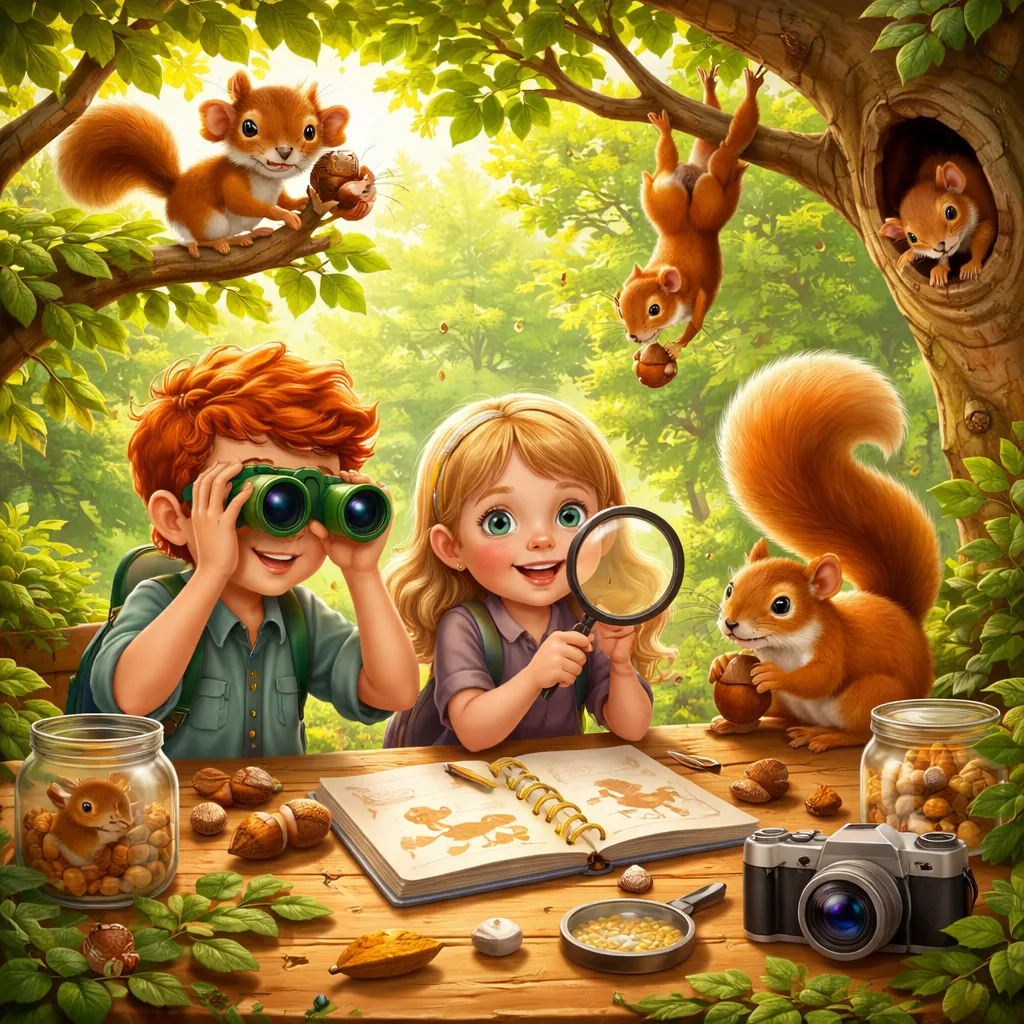

Have you ever watched a squirrel in a park or your backyard? It might be scampering up a tree, digging a hole, or chattering at you from a branch. Squirrels are furry, fast, and full of energy. Learning about squirrels is a fun adventure that takes us to the treetops and gardens all around us. Let’s start our journey of learning about squirrel secrets and skills!
English Language Learning
Vocabulary and Spelling The word for this energetic animal is squirrel. The word "squirrel" is a noun. A noun names a person, place, or thing. So, a squirrel is a thing—a lively, furry animal. Spelling "squirrel" is a fun challenge: S-Q-U-I-R-R-E-L. The 'S' and 'Q' at the start are like a quick start. The 'U' and 'I' are in the middle. Then there are two 'R's, like two quick runs, and it ends with 'E-L'. S-Q-U-I-R-R-E-L spells squirrel.
Sound and Pronunciation Let’s say the word correctly. It sounds like this: /ˈskwɜːr.əl/. We can say it in two parts. First, say "skwur". It rhymes with "her" but starts with "skw". Next, say "ul". It’s a soft sound, like the end of "tunnel". Now, put it together! "Skwur" "ul". Squirrel! You did it! The word "squirrel" has two beats, or two syllables. Clap your hands twice: Squir-rel. It’s a quick, chattery word.
Related Words Learning about squirrels is more fun with new words! Here are some important ones. Body Parts: A squirrel’s big, fluffy tail is called a bushy tail. It helps with balance and shade. A squirrel’s sharp, curved nails are claws for climbing. Sound: The loud, repetitive sound a squirrel makes is a chatter or a bark. Action: Squirrels love to scamper, which means to run quickly and lightly. They also forage for food, which means to search.
A Famous Saying There is a common and useful phrase: "To squirrel something away." This means to hide or save something for later, just like a squirrel hides nuts for the winter. It’s a fun way to talk about saving your treasures or being prepared. Say the phrase with me: "To squirrel something away." What would you like to squirrel away for later? Maybe a special toy or a yummy snack?
Great! Now you know the word "squirrel". Are you ready to learn about their busy lives in the trees? Let’s scamper from words to wonderful facts!
Animal Knowledge
Who Are They? – Family and Group What kind of animal is a squirrel? Squirrels are mammals. They have fur, are warm-blooded, and mother squirrels feed their babies milk. They are part of the rodent family. This is a big family of animals whose front teeth never stop growing! Their close cousins are chipmunks, prairie dogs, and marmots.
What Do They Look Like? – Amazing Bodies Squirrels are about the size of a small cat, with a big, bushy tail that is as long as their body! They usually have fur in shades of gray, brown, or red. Their most famous feature is their big, bushy tail. It is a multi-tool! It helps them balance on thin branches, acts as a parachute when they jump, keeps them warm, and signals to other squirrels. Squirrels have special adaptations for tree life. They have sharp claws for gripping bark. Their back legs are very strong for jumping. They can turn their ankles 180 degrees, so they can climb down a tree head-first!
Where Do They Live and How? – Home and Habits Squirrels live in many places, from deep forests to city parks and backyards. They need trees, but they can adapt to live near people. Squirrels are primarily herbivores. They eat nuts, seeds, pine cones, fruits, and tree buds. Sometimes they eat insects or bird eggs. They do not hibernate, so they spend fall gathering and hiding food for winter. Squirrels are active during the day. They are mostly solitary but are social and will live near other squirrels. A group of squirrels is called a scurry or a dray. They spend their days foraging, grooming, and chasing each other.
A Squirrel’s Life Story – Growing Up Baby squirrels are called kits or pups. Squirrels are mammals, so kits are born live from their mother. A mother squirrel usually has two to four tiny, hairless kits at a time. The mother squirrel is the main caregiver. She builds a cozy nest, called a drey, in a tree. She feeds the kits milk and keeps them warm. The kits grow quickly. Kits are born blind and deaf. After about a month, they open their eyes and grow fur. They start to leave the nest and learn to climb and find food. They stay with their mother for about two to three months.
How Do They "Talk"? – Communication Squirrels are very vocal! They make a chattering or barking sound to warn other squirrels of danger. They also make softer chirps and purrs. They use their tails to talk! A flicking or twitching tail can signal excitement or a warning. They also use scent marking to communicate. Their best senses are their excellent eyesight and sharp sense of smell. Their large eyes help them judge distances for jumping. Their nose helps them find the nuts they buried months ago, even under snow!
Are They Okay? – Taking Care of Them Many common squirrels, like the gray squirrel, are doing very well. But some species, like the red squirrel in some areas, are threatened. The main threats are losing their forest homes, road accidents, and competition with other squirrel species. In cities, they can get into trouble with cars and human food. We can be good neighbors to squirrels! We can plant trees that provide them food. We can be careful drivers, especially near parks. We can watch them and enjoy their antics, but we should not feed them by hand, as human food is bad for them.
Life Connections and Inspiration
How to Be With Them – Safety and Love Squirrels are wild animals. We can enjoy watching them, but we must respect their space. The rule is: Watch, don’t touch, and don’t feed by hand. We can watch them from a window or bench. We should never try to pet or catch a squirrel. They can bite if scared. We can put out a squirrel feeder with nuts in our yard if we want to help, but we should not make them dependent on us. We show our love by letting them be wild and free. We can protect the trees and parks that are their home. A healthy environment for squirrels is a healthy environment for everyone.
Super Qualities We Learn from Them Squirrels teach us wonderful things. One super quality is preparation and resourcefulness. Squirrels work hard in the fall to gather and store food for the winter. They teach us to plan ahead, work hard, and be resourceful with what we have. Another quality is agility and playfulness. Squirrels are amazing athletes, running and jumping with joy. They are also very playful, chasing each other for fun. They remind us to stay active, play, and find joy in movement. Think about it: How can you be prepared and resourceful, like saving your allowance or organizing your toys? How can you be agile and playful in your games and sports?
Take Action! – Your "Squirrel Observer" Project Let’s do a fun activity! Your project is to become a squirrel scientist for a week. Get a notebook and a pencil. Each day, spend 10 minutes watching squirrels from a window or in a park. Draw or write what you see. How do they move? What do they eat? Do they chatter? Do they bury anything? At the end of the week, look at your notes. What did you learn about their daily habits? Create a "Squirrel Fact Sheet" with your top three discoveries. Remember, be a quiet observer so you don’t scare them.
Closing Learning about squirrel antics is a delightful adventure! We learned the word "squirrel" and how to say its chattery, two-part name. We discovered amazing facts about their bushy tails, their clever food storage, and their life in the trees. We know that squirrels are prepared, playful, and an important part of our neighborhoods. You can use your new words to tell stories about these agile creatures. You can use your knowledge to be a respectful wildlife watcher and a steward of nature. The animal world is full of busy teachers right outside our window. Always remember to observe wildlife with quiet wonder, be prepared in your own life, and find time for playful movement. Keep exploring, stay curious, and enjoy the simple joy of watching a squirrel scamper by. Your attentive eyes and caring heart help you appreciate the wonderful wildlife we share our world with.