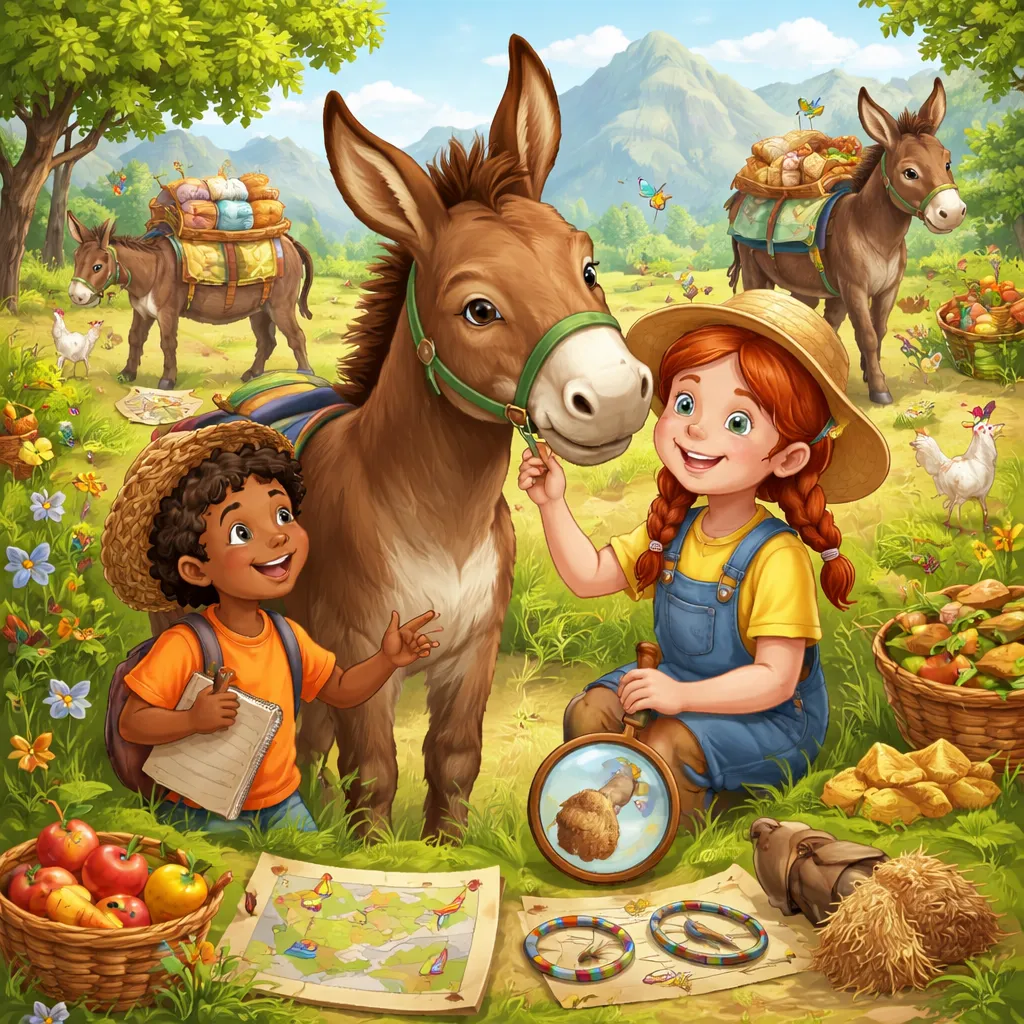

Have you ever seen a donkey at a petting zoo, on a farm, or in a cartoon? With their long ears, soft noses, and gentle eyes, donkeys are calm and sturdy animals. They have been helping people carry heavy loads for thousands of years. Learning about donkeys is a wonderful adventure that takes us to farms and dry lands all over the world. Let’s begin our journey of learning about donkey strength and smarts!
English Language Learning
Vocabulary and Spelling Our strong helper is called a donkey. The word "donkey" is a noun. A noun names a person, place, or thing. So, a donkey is a thing—a patient, living animal. Let’s spell it: D-O-N-K-E-Y. The 'D' stands at the start, like a donkey’s determined head. The 'O' and 'N' are in the middle, and it ends with 'K-E-Y'. D-O-N-K-E-Y spells donkey.
Sound and Pronunciation Let’s say the word correctly. It sounds like this: /ˈdɑːŋ.ki/. We can say it in two clear parts. First, say "dong". It rhymes with "song" or "long". Next, say "key". It sounds just like the key for a door. Now, put it together! "Dong" "key". Donkey! Great job! The word "donkey" has two beats, or two syllables. Clap your hands twice: Don-key. It’s a steady, friendly-sounding word.
Related Words Learning about donkeys is more fun with new words! Here are some important ones. Sound: The loud, unique call a donkey makes is called a bray. It sounds like "hee-haw"! Body Part: A donkey’s foot is called a hoof. Donkeys have hard hooves for walking on rough ground. Group: A group of donkeys is called a herd or a drove.
A Famous Saying There is a common saying: "Stubborn as a donkey." But this is not really fair! Donkeys are not stubborn; they are very careful and smart. They think about their safety before they act. The saying is used when someone does not want to change their mind. It reminds us that being careful and thinking for yourself can be a good thing. Say the saying with me: "Stubborn as a donkey." Now you know that donkeys are actually just being sensible!
Now you know the word "donkey"! Are you ready to learn about their careful and strong nature? Let’s walk from words to wonderful knowledge!
Animal Knowledge
Who Are They? – Family and Group What kind of animal is a donkey? Donkeys are mammals. They have hair, are warm-blooded, and mother donkeys feed their babies milk. They are part of the equine family. This is the horse family! Their closest cousins are horses and zebras. A male donkey is called a jack, and a female is a jenny.
What Do They Look Like? – Amazing Bodies Donkeys are about the size of a large dog or a small horse. They usually have gray or brown fur, with a light muzzle and belly. Their most famous features are their long ears. Their long ears are not just for hearing very well; they also help keep the donkey cool in hot places. Donkeys have a short, upright mane and a tail with a tuft of hair at the end. Donkeys are built to be tough. They have strong legs and hard hooves that are perfect for walking on rocky, uneven ground. Their fur is coarse and helps protect them from bad weather.
Where Do They Live and How? – Home and Habits Donkeys originally come from Africa, but now they live all over the world. They are often found on farms, in villages, and in dry, rocky areas. They can live where there is not much water or grass. Donkeys are herbivores. This means they only eat plants. They eat grass, hay, and shrubs. They are very good at finding food in tough places. Donkeys are social animals and like to live in herds. They are most active during the day and at dawn and dusk. They spend their time grazing, resting, and keeping watch for danger. Donkeys are known for being very brave and will protect their herd from small predators.
A Donkey’s Life Story – Growing Up A baby donkey is called a foal. Donkeys are mammals, so foals are born live from their mother. A mother donkey usually has one foal at a time. The mother donkey takes excellent care of her foal. The foal can stand and walk very soon after it is born. The mother feeds it milk for about six months. Foals are born with long legs and a fuzzy coat. They stay close to their mother for protection. They grow quickly and are able to eat grass within a few weeks. A donkey becomes an adult at about three years old.
How Do They "Talk"? – Communication Donkeys talk in different ways. Their most famous sound is their loud bray. They bray to say hello, to call to friends, or to warn of danger. They also use their bodies. The position of their ears shows how they feel. Ears pointed forward mean they are curious. Ears pinned back might mean they are upset. They nuzzle and groom each other to show friendship. Their best senses are their amazing hearing and sense of smell. Their big ears can hear sounds from far away. Their nose helps them find food and recognize their friends.
Are They Okay? – Taking Care of Them Most domestic donkeys are doing well, but they rely on people for good care. Some wild donkeys, like the African wild ass, are endangered. This means there are very few left. The main threats are losing their natural homes, not having enough water, and sometimes being treated badly by people who work them too hard. You can be a donkey friend! You can learn about them and treat all animals with kindness. If you visit a farm, be gentle and calm around donkeys. You can support groups that rescue and care for donkeys in need. Remember, all animals deserve respect.
Life Connections and Inspiration
How to Be With Them – Safety and Love Donkeys are usually gentle, but they are also large and strong. We must always be calm and respectful around them. If you meet a donkey: Always have an adult with you. Move slowly and let the donkey see you. Hold out your hand so it can sniff you. Pet it gently on the neck or shoulder. Never shout or make sudden moves. Never stand directly behind a donkey. Owning a donkey is a big responsibility for many years. They need a safe field or shelter, fresh water, hay, a vet, and a farrier to care for their hooves. They also need a donkey friend, because they get lonely alone. We show our love by being patient, gentle, and learning how to care for their needs. A happy donkey is a healthy, loved donkey.
Super Qualities We Learn from Them Donkeys teach us wonderful things. One super quality is steady perseverance. Donkeys keep going, step by step, even with a heavy load or on a long journey. They teach us to be steady, to keep trying, and not to give up when things are hard. Another quality is careful courage. Donkeys are not foolishly brave. They stop and think, which keeps them safe. But they are also very brave when protecting their friends. This reminds us to be both careful and courageous in our own lives. Think about it: How can you show steady perseverance on a difficult task? How can you be both careful and brave when trying something new?
Take Action! – Your "Donkey Helper" Project Let’s do a fun and steady activity! Your project is to create a "Donkey Day" storyboard. On a large piece of paper, draw six boxes like a comic strip. In each box, draw what a donkey does at different times of the day. Start with sunrise: the donkey wakes up. Then eating breakfast, going for a walk, having a rest, playing with a friend, and going to sleep. Write a simple sentence under each picture. Share your storyboard and tell the story of a day in the life of a happy, well-cared-for donkey.
Closing Learning about donkey friends is a steady and rewarding adventure! We learned the word "donkey" and how to say its two-part name. We discovered amazing facts about their long ears, their loud bray, and their life as hardy helpers. We know that donkeys are persevering, courageous animals who have been our partners for centuries. You can use your new words to tell stories about these dependable animals. You can use your knowledge to be a kind and responsible friend to all creatures. The animal world is full of strong and gentle teachers. Always remember to approach animals with calm respect, persevere through challenges, and balance caution with courage. Keep exploring with a steady heart, appreciate the helpers around you, and be a voice for kindness. Your patient care and thoughtful actions make you a true friend to the wonderful donkey.