
What Is This Plant?
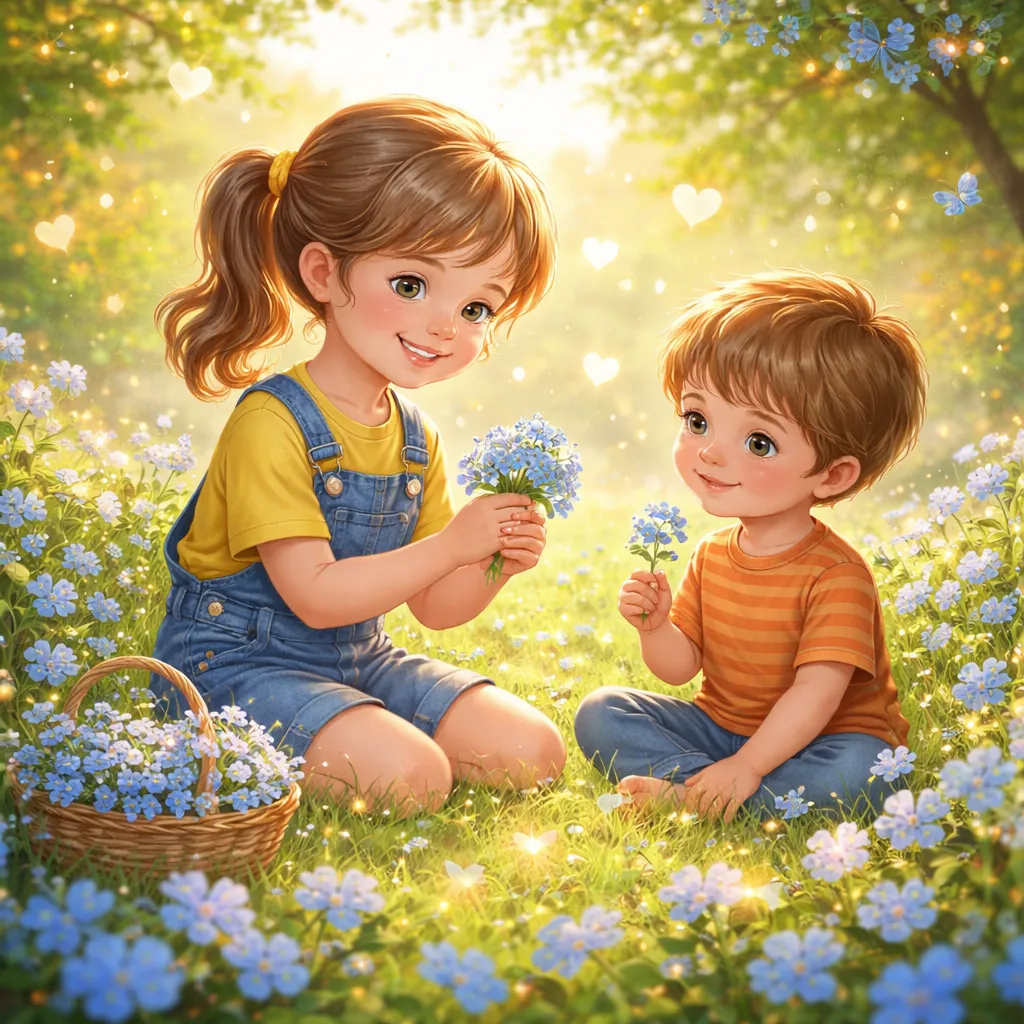
The forget-me-not plant is a tiny, delicate flower that covers the ground with soft blue blossoms in spring. It grows as a low, spreading plant. The leaves are small and oval-shaped. They are bright green and slightly hairy. The flowers are the treasure. They are tiny, about one-quarter inch across. Each flower has five petals. They are sky blue with a yellow center. Some varieties are pink or white. The flowers grow in small clusters at the top of the stems. They bloom in spring. The plant spreads easily. It can form a carpet of blue under trees and along paths. For children, forget-me-nots are like little blue stars. The flowers are so small that you have to look closely to see them. Parents can plant forget-me-nots in shady spots. Children love the tiny blue flowers. The name itself is a message: remember me. This plant teaches children about love, memory, and the importance of remembering people.
English Learning About This Plant
The English name “forget-me-not” comes from a German legend. A knight picked these flowers for his lady. He called out, “Forget me not!” The pronunciation is “for-get-me-not.” The International Phonetic Alphabet (IPA) is /fərˈɡɛt mi nɒt/. Children can say it: for-get-me-not. When we learn about forget-me-not plant, we learn words for its parts. The leaf is the small, oval, bright green part. The stem is the slender part that holds the flowers. The flower is the tiny, five-petaled, blue blossom. The cluster is the group of flowers at the top of the stem. The seed is the tiny part that grows new plants. These words help children describe this tiny treasure.
There is a famous saying about forget-me-nots. The legend says a knight was picking flowers for his lady. He fell into a river. As he was swept away, he threw the flowers to her and cried, “Forget me not!” Another saying goes, “Forget-me-nots are the flowers of faithful love.” Parents can share these words with their child. They become gentle lessons about love, memory, and keeping people in our hearts. Forget-me-nots are also the symbol of Alzheimer’s awareness.
Plant Facts and Scientific Knowledge
The forget-me-not plant belongs to the genus Myosotis. There are about 50 species. The name “Myosotis” comes from Greek words meaning “mouse ear.” The leaves look like mouse ears. Forget-me-nots are native to Europe, Asia, and North America. They are members of the borage family, Boraginaceae.
Forget-me-not flowers have five petals. They are usually sky blue with a yellow center. Some varieties are pink or white. The flowers are tiny, about one-quarter to one-half inch across. They bloom in spring. The flowers are pollinated by bees and flies.
The leaves are small and oval. They are hairy. The plant grows low to the ground. It spreads by seeds and by creeping stems. It can form large patches.
Forget-me-nots prefer moist, shady places. They grow in woodlands, along streams, and in gardens. They are biennials or short-lived perennials. They often self-seed and come back year after year.
Forget-me-nots have deep symbolic meaning. They represent true love, remembrance, and faithfulness. The name itself is a message. Giving forget-me-nots means “remember me” or “I will never forget you.” They are often given as a symbol of lasting love.
How to Grow and Care for This Plant
Growing a forget-me-not plant is easy for families. Plant seeds in spring or early summer. Choose a shady or partly shady spot. Forget-me-nots like moist soil. They need well-drained soil that stays damp.
Scatter the seeds on the soil surface. Press them gently into the soil. Do not cover them. They need light to germinate. Water gently. Children can help by scattering the tiny seeds. The seeds are very small. Mix them with sand to see them better.
Water forget-me-nots regularly. They need consistent moisture. Do not let the soil dry out. They will bloom in spring. After flowering, let the plants self-seed. They will come back next year.
Forget-me-nots need little care. Remove weeds around them. They spread easily. You can divide them in spring or fall. They are low-maintenance plants.
Benefits of Growing This Plant
Growing a forget-me-not plant brings many gifts to a family. First, the tiny blue flowers are beautiful. They create a carpet of blue in spring. Second, the name teaches a lesson. Children learn about love and memory.
Forget-me-nots attract early pollinators. Bees visit the tiny flowers. Children can watch them.
The plant spreads easily. Children can see how one plant becomes many. This teaches about plant growth and reproduction.
Forget-me-nots also teach about remembrance. Parents can share the legend. Children learn that flowers can carry messages.
What Can We Learn From This Plant
A forget-me-not plant teaches children about love. The name means “remember me.” Children learn that love includes remembering people. They can remember people who are far away or who have passed.
Forget-me-nots also teach about faithfulness. The flowers represent faithful love. Children learn that being faithful means staying true to people.
Another lesson is about small things. The flowers are tiny. But they carry a big message. Children learn that small things can be important. A small kindness can mean a lot.
Forget-me-nots also teach about memory. The plant reminds us to remember. Children learn that memory is precious. They can make memories with people they love.
Fun Learning Activities
There are many simple activities to help children learn about forget-me-not plant. One activity is a flower hunt. In spring, look for forget-me-nots. See how many tiny blue flowers you can find. Count them. This builds observation and counting skills.
Another activity is a legend telling. Tell the story of the knight and the forget-me-nots. Ask your child to draw the story. This builds imagination and connection to the flower.
A nature journal works well for forget-me-nots. Draw the small, oval leaves. Draw the clusters of tiny blue flowers. Draw the yellow center. Label the parts: leaf, stem, flower, cluster. Write the date when the first flower opened.
For art, try painting forget-me-nots. Use blue paint. Paint the tiny five-petaled flowers. Add the yellow center. Paint the small, oval leaves. This creates a delicate spring picture.
Vocabulary games are fun too. Write the words forget-me-not, leaf, stem, flower, cluster, and memory on cards. Say each word. Ask your child to point to the part on the plant. Practice saying forget-me-not together. Clap the syllables: for-get-me-not.
Finally, try a remembrance activity. Talk about people you love. Plant forget-me-nots in their memory. Make a card with a pressed forget-me-not flower. Give it to someone you love. This connects the plant to love and memory.
Through these activities, children build a deep connection with a tiny flower that carries a big message. They learn new words, hear a legend, and discover the importance of remembering. The forget-me-not plant becomes a symbol of love and faithfulness. Each spring when the tiny blue flowers appear, children remember that love includes memory. They remember that small things can carry big messages. This delicate flower opens a world of spring wonder, heartfelt connection, and the lasting lesson that saying “forget me not” is a promise to keep someone in your heart.