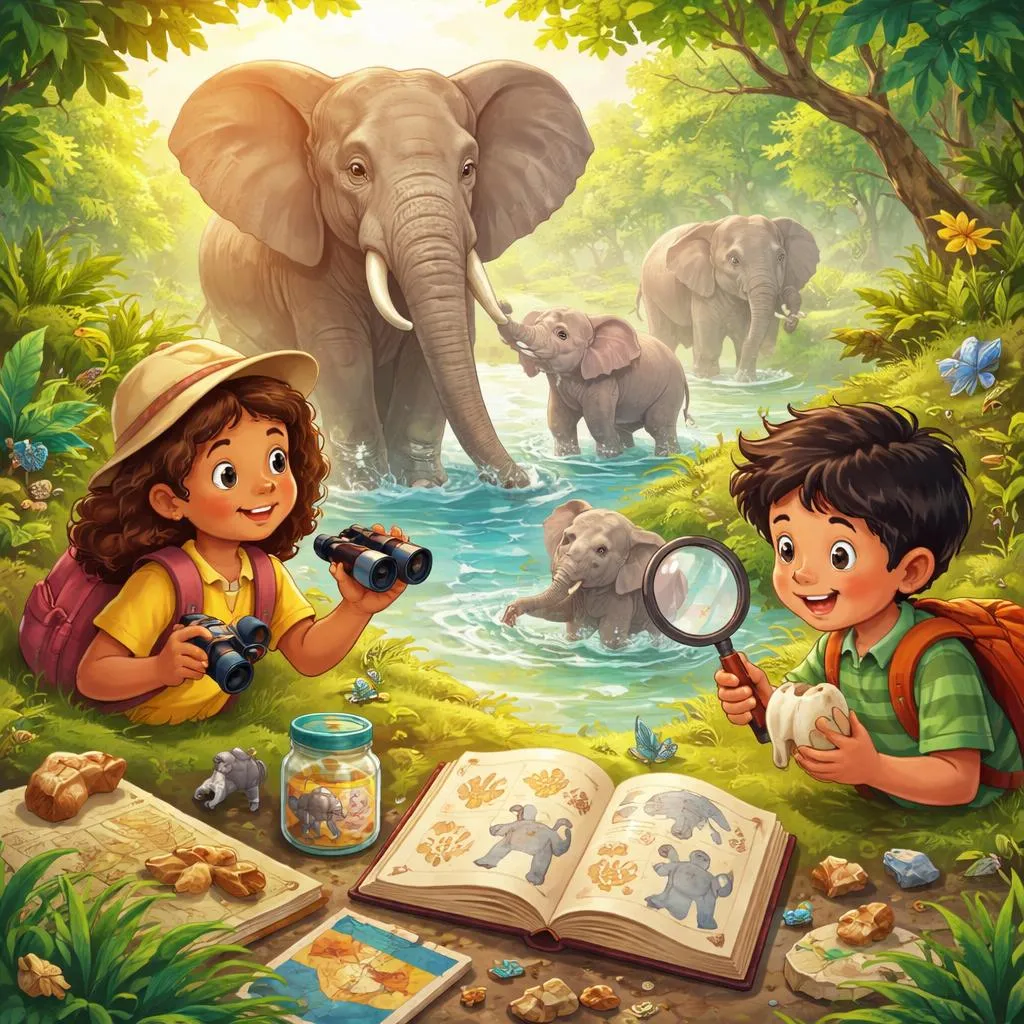

Have you ever seen an elephant at the zoo or in a movie? They are the biggest animals that walk on land! With their long trunks, huge ears, and gentle eyes, elephants are truly wonderful. Learning about elephants takes us on a trip to faraway grasslands and forests. Let’s discover the amazing world of these gentle giants together.
English Language Learning
Vocabulary and Spelling Our giant friend’s name is elephant. The word "elephant" is a noun. A noun is a word for a person, place, or thing. So, an elephant is a thing—a very big, living thing! The word "elephant" is fun to spell: E-L-E-P-H-A-N-T. It’s a long word, just like an elephant’s trunk! Look, it has the letter ‘E’ three times, like two big eyes and a trunk in the middle. The ‘PH’ in the middle sounds like an ‘F’. Try to picture a big, grey elephant as you spell it: E-le-ph-ant.
Sound and Pronunciation Let’s say the word correctly. It sounds like this: /ˈel.ɪ.fənt/. We can say it in easy parts. First, say "el". It rhymes with "bell" or the letter ‘L’. Next, say "i". It sounds like the ‘i’ in "it" or "sit". Last, say "phant". It sounds like "fant" in "fantastic". Now, say it faster! "El" "i" "phant". Elephant! You did it! The word "elephant" has three beats, or syllables. Clap your hands three times: El-e-phant. It’s a grand, marching kind of word.
Related Words Learning about elephants is more fun with new words! Here are some important ones. Body Parts: An elephant’s long nose is called a trunk. It is like a super-strong hand and nose together! Their long, white teeth are called tusks. Sound: The loud, happy call an elephant makes is a trumpet. It sounds like a brass instrument! Actions/Habits: Elephants love to spray water or dirt on their backs with their trunks to stay cool. A group of elephants will often march together to find water.
A Famous Saying People have a famous saying about elephants: "An elephant never forgets." This means elephants have fantastic memories. They can remember friends, places, and paths to water for many, many years. It reminds us that having a good memory is a superpower! It’s also a fun way to say someone remembers things very well. Say the saying with me: "An elephant never forgets." Try to remember this fun fact as we learn more!
Now you know how to say and spell "elephant"! These words are your key. Are you ready to unlock the secrets of the elephant’s world? Let’s go from words to wonders!
Animal Knowledge
Who Are They? – Family and Group What kind of animal is an elephant? Elephants are mammals. Like all mammals, they have hair (a little bit!), are warm-blooded, and mothers feed their babies milk. They are the biggest land mammals alive today! They have their own special family group called elephantidae. Their closest living relatives are surprising animals like manatees and hyraxes, which are much smaller!
What Do They Look Like? – Amazing Bodies Elephants are enormous! They can be as tall as a school bus is long and as heavy as five small cars. Their skin is thick and grey, like wrinkled rock. Their most amazing part is their trunk. It is a nose and upper lip joined together. It has no bones but has thousands of muscles! They use it to breathe, smell, drink, grab food, and give hugs. Their long tusks are actually big teeth. They use them to dig, lift things, and protect themselves. Elephants have special adaptations. Their huge ears are like giant fans. They flap them to cool down their big bodies. Their thick skin helps protect them, but they still get sunburned, so they throw dirt and mud on their backs for sunscreen!
Where Do They Live and How? – Home and Habits Elephants live in warm places in Africa and Asia. Their homes are savannas (grassy plains), forests, and jungles. They need lots of space, water, and food. Elephants are herbivores. This means they only eat plants. They eat roots, grass, fruit, bark, and leaves. An adult elephant can eat the weight of hundreds of hamburgers in plants every single day! They are very social and smart. They live in family groups called herds. A herd is usually all the mothers, sisters, aunts, and babies. The oldest, wisest female is the leader. They spend their days walking, eating, bathing, and playing.
An Elephant’s Life Story – Growing Up A baby elephant is called a calf. Elephants are mammals, so calves are born live from their mother, just like human babies. The mother is pregnant for a very long time—almost two years! The whole herd helps take care of the baby. All the aunts and sisters protect the little calf and help it walk. The mother feeds it milk for several years. The calf stays close to its mother for a very long time. A calf grows slowly. It drinks its mother’s milk for years and learns what to eat by watching the herd. It takes more than ten years for an elephant to grow into a full-sized adult. It will stay with its family for its whole life.
How Do They "Talk"? – Communication Elephants are great at talking to each other. They use deep rumbles, trumpets, and even body language! They make rumbling sounds we can barely hear. These rumbles can travel through the ground for miles to send messages! They also touch each other with their trunks to say hello or show love. Their best sense is smell. Their trunk is a super-smeller! They can smell water from miles away. Their hearing is also super. They can hear the deep rumbles of other elephants from very far.
Are They Okay? – Taking Care of Them Some elephants, like African Forest Elephants, are in big trouble and are endangered. This means there are not many left in the wild. The main problems are people taking their land for farms and cities, and bad people who hunt them for their ivory tusks. This is called poaching and it is very wrong. You can help elephants from far away! You can learn and tell others about them. You can choose to not buy things made from ivory. You can support groups that protect wild lands. Remember, saving trees and paper helps save forests where elephants live.
Life Connections and Inspiration
How to Be With Them – Safety and Love Elephants are wild animals, not pets. We must love them from a safe distance. We must always look, don’t touch. We watch wild elephants in movies, books, or from very far away at a good zoo with wide spaces. We never, ever try to get close to a wild elephant. They are gentle but also very big and strong. They can be dangerous if they are scared. We show our love by protecting their home. We can be elephant heroes by keeping their forests and grasslands safe. This means caring for our planet.
Super Qualities We Learn from Them Elephants teach us wonderful things. One super quality is wisdom and memory. Like the saying goes, they remember for a long time. They teach us to learn from the past, to remember our family, and to be smart. Another quality is strong family love. Elephant families stick together. They help each other, protect the babies, and are led by a wise grandmother. They show us how important it is to love and care for our own families and friends. Think about it: How can you use your memory for good? How can you be a strong, caring member of your family or friend group, just like an elephant in its herd?
Take Action! – Your "Elephant Guardian" Project Let’s do a fun activity! Your project is to create an elephant herd shadow puppet show. Find some paper, scissors, a stick, and a flashlight or lamp. Draw a big elephant shape on paper—don’t forget the trunk and big ears! Cut it out and tape it to a stick. Make a few more for the herd. In a dim room, shine a light on the wall and put your puppet in front of it to make a shadow. Make your elephant herd march across the wall. Tell a story about their journey to find water, led by the wise grandmother elephant. What do they see? How do they help each other?
Closing Learning about elephant giants is an incredible adventure! We learned the word "elephant" and how to say its long, strong name. We discovered amazing facts about their super-smart trunks, their big families, and their wonderful memories. We know that elephants are wise and gentle giants who need our protection. You can use your new words to teach others about these animals. You can use your knowledge to make choices that help them. The natural world is full of gentle giants who are our friends. Always remember to be a voice for animals who cannot speak for themselves. Keep exploring, keep remembering, and keep caring for our planet. Your actions can help these magnificent creatures for generations to come.